
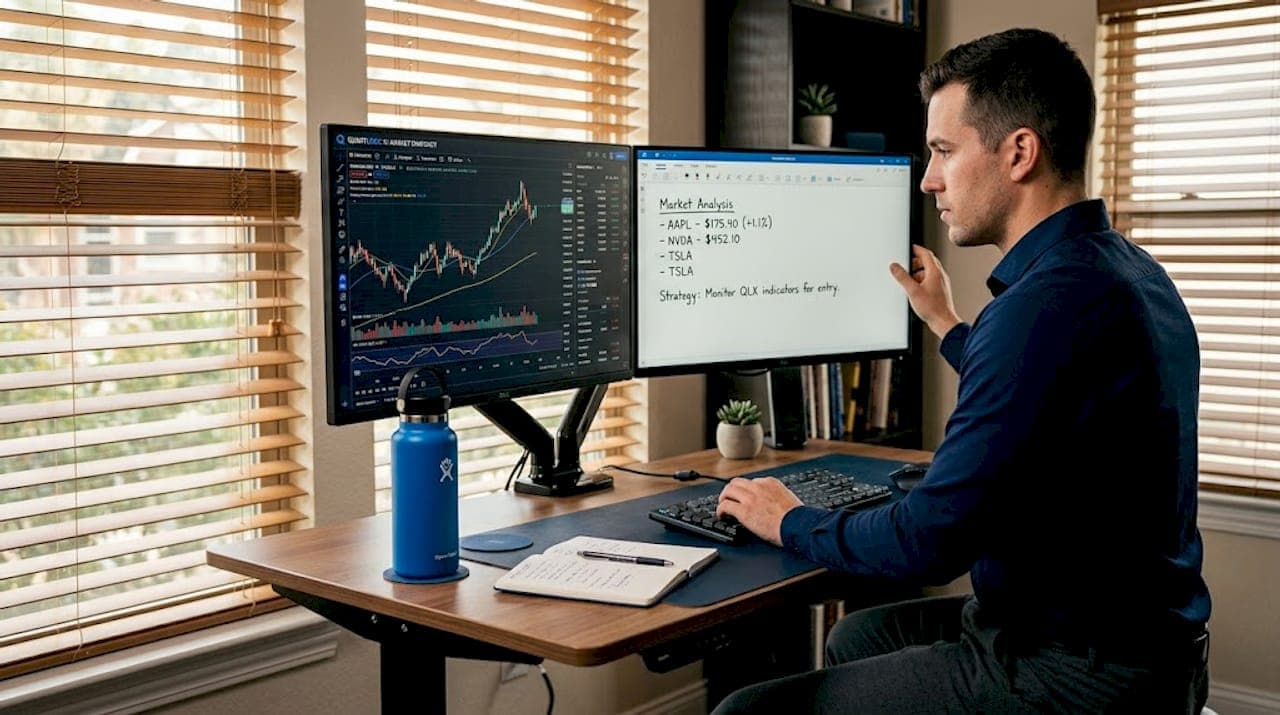
Missing a five-minute window on a call or put can cost you the entire trade. That's the brutal reality of options scalping. Scalping signals for calls and puts demand a level of precision that standard swing trading setups simply don't require. You're not waiting for a daily candle to close. You're reacting to micro moves, gamma effects, and institutional order flow in real time. This guide breaks down exactly what you need: the right tools, the right signals, and the right mindset to stop guessing and start executing with confidence.
Table of Contents
- Key takeaways
- What you need before scalping calls and puts
- Using Call Walls and Put Walls as scalping signals
- Stochastic settings and indicator combos that actually work
- Step-by-step scalping strategies for calls and puts
- Common mistakes that kill scalping consistency
- My honest take on what actually works
- Take your signals further with Quantlogicx
- FAQ
Key takeaways
| Point | Details |
|---|---|
| Call and Put Walls define range | These institutional levels act as dynamic support and resistance, shaping your entry and exit zones. |
| Stochastic settings matter | Adjusting smoothing values to 1 to 3 on 1-minute charts reduces false signals by up to 30%. |
| Price action leads indicators | Trade setups should be based on the underlying asset's movement first, with indicators confirming. |
| Strike selection is dynamic | Reassess your ITM strike continuously throughout the day as price moves and delta shifts. |
| Volatility capture beats direction | Scalpers who focus on capturing volatility, not just predicting direction, build more consistent results. |
What you need before scalping calls and puts
Before you place a single scalp trade, your setup has to be right. Sloppy tools produce sloppy results, and in a market where seconds matter, there's no room for lag or confusion.
Platforms and charting software
TradingView is the go-to charting platform for most options scalpers because of its speed, customization, and indicator ecosystem. You'll also want direct access to your broker's option chain, ideally in a side panel you can reference without switching windows. Platforms like Thinkorswim or Tastytrade work well for this.
Core indicators to have ready
Here's what your chart should include before the open:
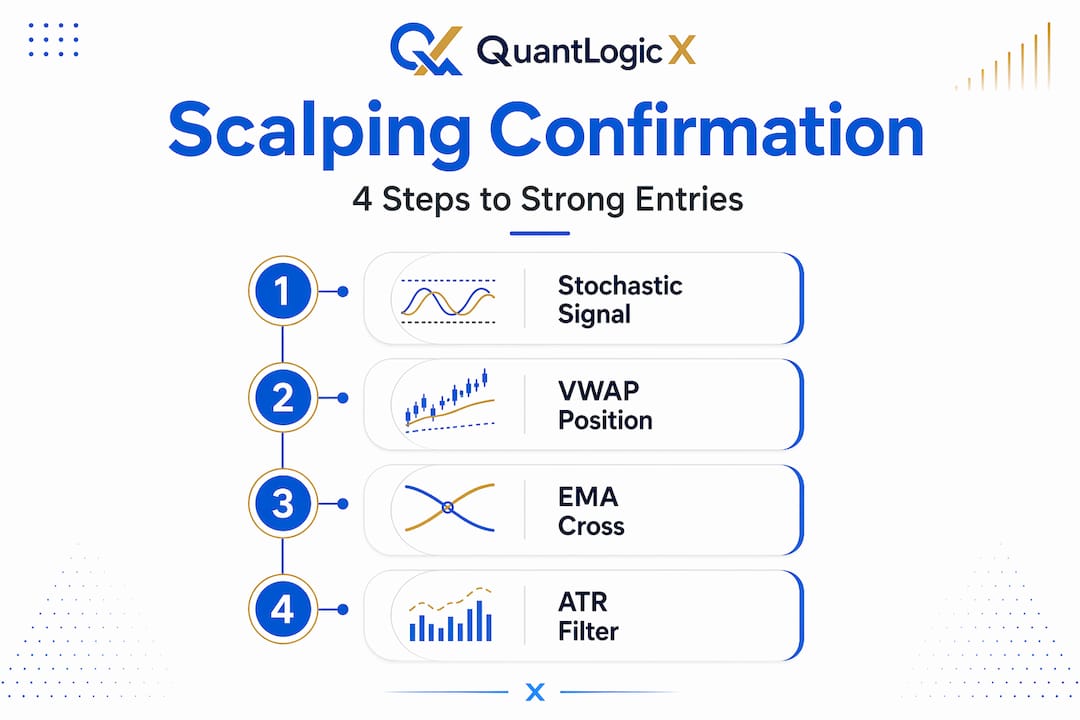
- VWAP: Acts as a dynamic intraday benchmark for institutional bias. Price above VWAP favors calls; below favors puts.
- EMA (9 and 21): Short-period crossovers highlight momentum shifts on 1-minute charts.
- Stochastic oscillator: Configured for fast scalping conditions (more on exact settings below).
- ATR (Average True Range): Filters trades based on current volatility so you're not entering during dead zones.
Timeframes and watchlists
Run your primary signals on the 1-minute chart and use the 5-minute chart as your trend filter. If the 5-minute trend is bearish, you should be leaning toward puts, not calls, regardless of what a single 1-minute candle suggests. Keep your watchlist tight. Three to five underlying assets with high options volume, like SPY, QQQ, or TSLA, is more than enough.
| Setup element | Recommended configuration |
|---|---|
| Primary chart timeframe | 1-minute |
| Trend filter timeframe | 5-minute |
| Key indicators | VWAP, 9 EMA, 21 EMA, Stochastic, ATR |
| Option chain focus | Top 3 to 5 high-volume underlyings |
| Strike target | 1 ITM from current price |
Using Call Walls and Put Walls as scalping signals
This is where most retail scalpers leave money on the table. They focus entirely on price charts while ignoring the options market's own structural signals.

Call Walls mark resistance at strikes with massive call open interest, while Put Walls mark support at strikes with heavy put open interest. These aren't arbitrary levels. They represent where market makers are most exposed and where they're likely to hedge aggressively to keep price from blowing through.
Why gamma matters near these walls
When price approaches a Call Wall, market makers who sold those calls must sell the underlying to stay delta neutral. That selling pressure pushes price back down. Near a Put Wall, they buy the underlying to hedge, which creates a floor. This gamma effect is why prices slow or reverse near these levels with unusual consistency.
Practical entries and exits using walls:
- Buy calls when price bounces off the Put Wall with VWAP below acting as support confirmation.
- Buy puts when price stalls at the Call Wall and stochastic is overbought on the 1-minute chart.
- Exit calls as price approaches the Call Wall. Don't wait for it to break.
- Exit puts as price approaches the Put Wall. The floor is real until open interest shifts.
| Scenario | Signal | Action |
|---|---|---|
| Price bounces off Put Wall | Stochastic turning up, VWAP holding | Buy 1 ITM call |
| Price stalls at Call Wall | Stochastic overbought, EMA flattening | Buy 1 ITM put |
| Price breaks through Call Wall | Volume spike, EMA crossover bullish | Hold call, trail stop |
| Price breaks through Put Wall | Volume surge, EMA crossover bearish | Hold put, trail stop |
Pro Tip: Check open interest levels the night before to identify where the major walls sit for the next session. These levels rarely move dramatically overnight, giving you a reliable map before the open.
Stochastic settings and indicator combos that actually work
The default stochastic settings (14, 3, 3) are built for swing trading, not scalping. On a 1-minute chart, they lag too much to be useful. Adjusting smoothing values to between 1 and 3 reduces false signals by up to 30% compared to default settings, which is a significant edge when you're trading dozens of setups per session.
Two configurations worth testing:
- 5, 3, 3: Fast signals, best for aggressive scalping in trending conditions.
- 9, 3, 1: Slightly slower but reduces false entries during trending moves. Good for choppier sessions.
How to stack your indicators for confirmation
No single indicator should trigger a trade on its own. Here's how the stack works together:
- Stochastic crosses above 20 (oversold exit) while price is above VWAP: lean long, consider a call.
- 9 EMA crosses above 21 EMA on the 1-minute chart: momentum confirmation for the call.
- Price action on the underlying shows a higher low: entry trigger.
For bearish setups, reverse the logic. Stochastic crosses below 80, price is below VWAP, 9 EMA crosses below 21 EMA, and the underlying prints a lower high. That's your put entry.
| Indicator | Bullish signal | Bearish signal |
|---|---|---|
| Stochastic | Cross above 20 | Cross below 80 |
| VWAP | Price above VWAP | Price below VWAP |
| EMA (9/21) | 9 EMA crosses above 21 | 9 EMA crosses below 21 |
| Price action | Higher low on underlying | Lower high on underlying |
Pro Tip: Use ATR to skip trades during low-volatility windows. If ATR on the 1-minute chart drops below its 10-period average, the options premiums won't move enough to justify the risk. Wait for volatility to return.
Step-by-step scalping strategies for calls and puts
Here's where the theory becomes a trade. These setups are built around clear rules, not intuition.
Pullback entry strategy
- Identify the trend direction on the 5-minute chart using VWAP and EMA alignment.
- Wait for a pullback to the 9 EMA on the 1-minute chart in the direction of the trend.
- Watch for stochastic to dip into oversold (for calls) or overbought (for puts) territory.
- Enter 1 ITM strike as price begins to resume the trend direction.
- Set your stop below the most recent swing low (for calls) or above the swing high (for puts).
- Target the nearest Call Wall for calls or Put Wall for puts as your exit level.
Breakout entry strategy
- Identify a consolidation range on the 1-minute chart, typically three to five candles with tight bodies.
- Watch for a volume surge as price breaks above resistance (call setup) or below support (put setup).
- Momentum scalping tools like RSI above 70 or MACD crossovers confirm the breakout is real.
- Enter immediately after the breakout candle closes, not before.
- Trail your stop using the ATR value multiplied by 1.5 to lock in profits as the move extends.
Pro Tip: Avoid the first five minutes after market open for breakout setups. Price discovery during that window creates false breakouts that stop out scalpers who jump in too early. Wait for 9:35 AM EST before taking breakout trades.
Scaling in and out is a skill most scalpers underuse. If your call is up 30% quickly, take half off the table and let the remainder run to your wall target. This locks in profit while keeping exposure to the full move.
Dynamic strike selection throughout the day is non-negotiable. If the underlying moves 2% against your morning strike choice, that option's delta has shifted. Reassess and adjust to maintain consistent ITM exposure rather than holding a strike that's now far out of the money.
Common mistakes that kill scalping consistency
Even traders with solid setups blow up their accounts through avoidable errors. Here's what to watch for.
- Trading the option chart instead of the underlying: Option prices lag. Always use the underlying's price action as your primary signal, with the option price as a secondary reference.
- Anchoring to morning strikes: Market conditions require dynamic strike selection throughout the day. What was 1 ITM at 9:30 AM may be 3 OTM by noon.
- Overtrading during low-volatility windows: If the market is grinding sideways with no clear trend, the best trade is often no trade. Patience is a position.
- Ignoring exit rules: Entering a trade without a defined exit is the fastest way to turn a scalp into an overnight bag-hold.
- Letting losses run while cutting winners short: This is the opposite of what successful scalpers prioritize. Set a max loss per trade and honor it every time.
"A scalping signal losing validity looks like this: price fails to follow through after your entry candle, volume drops off, and the stochastic reverses before reaching the target zone. That's your cue to exit, not to hope."
Emotional discipline separates profitable scalpers from everyone else. If you've hit your daily loss limit, stop. No setup is worth blowing past your risk parameters.
My honest take on what actually works
I've watched traders spend months chasing the perfect indicator setup while completely ignoring the one thing that actually drives options prices: the underlying asset's price action. Successful scalpers focus intensely on intraday price action and volatility, using tools like VWAP and EMAs for structure, never relying solely on indicators.
In my experience, the traders who consistently profit from scalping calls and puts aren't the ones with the most complex systems. They're the ones who understand that capturing volatility matters more than predicting direction. You don't need to be right about where the market goes. You need to be fast, disciplined, and positioned where the premium moves.
The biggest misconception I see is that scalping options is just faster swing trading. It's not. It requires a completely different relationship with risk, time decay, and strike management. If you're not reassessing your strike selection every hour, you're not really scalping. You're just holding short-term positions and calling them scalps.
What I've found actually works is simple: anchor your bias to the 5-minute trend, use the 1-minute chart for timing, respect the walls, and never let an indicator override what price is clearly telling you.
— Tran
Take your signals further with Quantlogicx
You now have the framework. The next step is having a tool that executes it cleanly without second-guessing every bar.
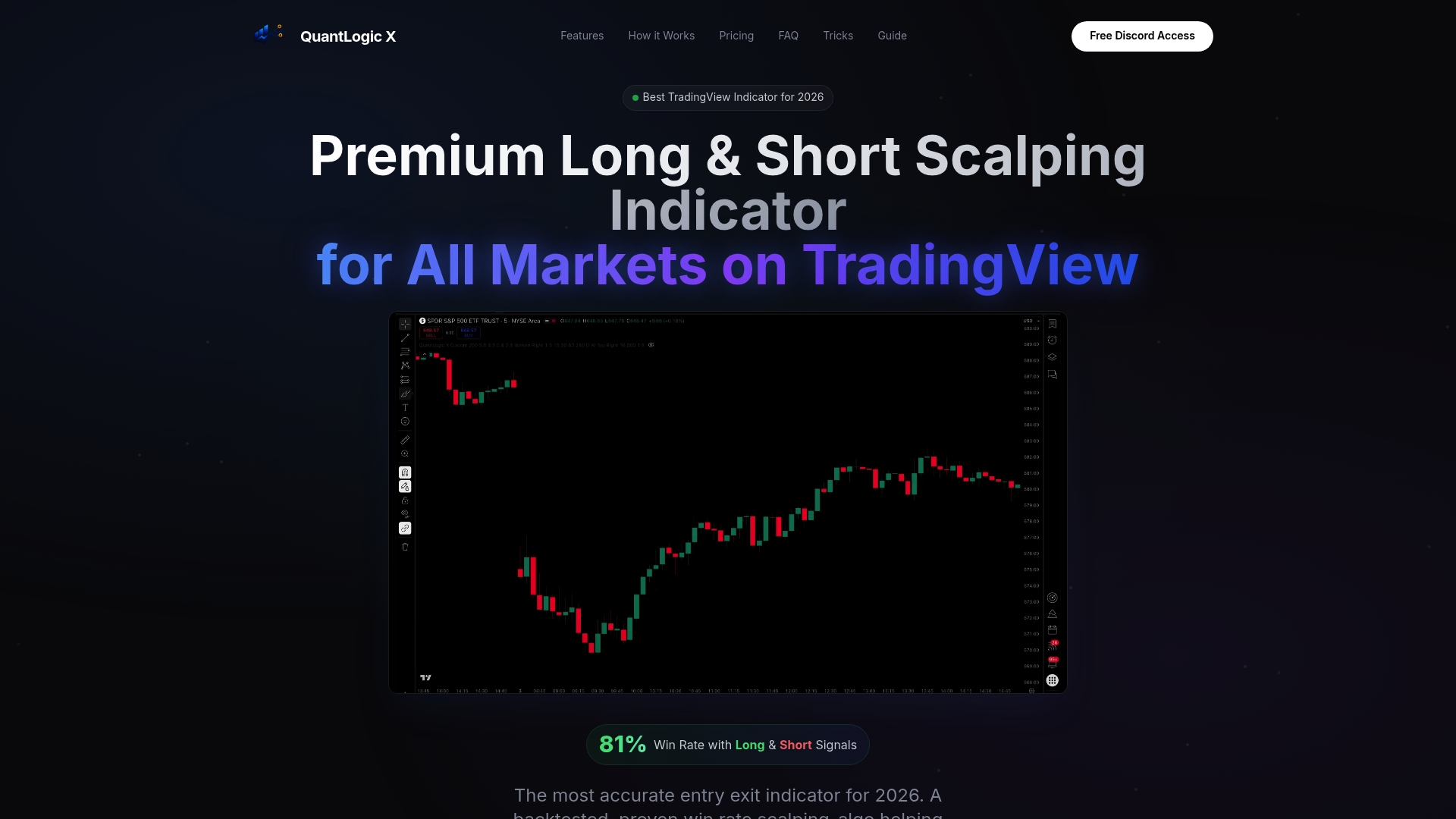
Quantlogicx was built specifically for traders who scalp across stocks, forex, and crypto. The TradingView scalping indicator delivers long and short signals with zero repaint technology, meaning the signal you see at bar closure is the signal that stays. No repainting, no retroactive changes. Over 2,000 traders are already using it, with individual users recording gains of $8,200 in a single month. The algorithm carries an 81% win rate across tested conditions, and it integrates directly with TradingView's alert system so you never miss a setup. If you want reliable buy and sell signals built for 2026 market conditions, Quantlogicx is worth a serious look.
FAQ
What are scalping signals for calls and puts?
Scalping signals for calls and puts are short-term trade triggers, based on price action, indicators, and open interest levels, that tell you when to enter or exit a call or put option within minutes.
How do Call Walls and Put Walls work as scalping signals?
Call Walls act as resistance and Put Walls act as support due to heavy open interest at those strikes. Gamma hedging by market makers reinforces these levels, making them reliable entry and exit zones for scalpers.
What stochastic settings work best for scalping options?
Settings of 5, 3, 3 work well for aggressive scalping, while 9, 3, 1 suits trending conditions. Smoothing values of 1 to 3 on 1-minute charts reduce false signals significantly compared to default configurations.
Should I trade the option chart or the underlying asset chart?
Always trade based on the underlying asset's price action. Option prices lag and can mislead. Use the underlying for your signal and the option chain for strike selection.
How often should I reassess my strike selection when scalping?
Reassess your strike at minimum every hour, or any time the underlying moves more than 1% from your entry point. Maintaining consistent ITM delta exposure is what keeps your scalping signals aligned with actual market movement.