

Most traders treat a stop loss as a safety net, something you set and forget. But the real role of stop loss in trading is far more nuanced than that. A stop loss is simultaneously a risk management tool, a position sizing anchor, and a discipline mechanism — and most traders only use it as the first of those three. When you misunderstand how stop losses work, you either place them too tight, too arbitrary, or with misplaced confidence that they guarantee a fixed loss cap. They don't. Here's what you actually need to know.
Table of Contents
- Key takeaways
- The role of stop loss in trading, explained
- How to place stops correctly
- Risk math: sizing your position around your stop
- Execution risk and slippage: the part nobody warns you about
- Tight vs. wider stops: what the research says
- My perspective on how most traders misuse stops
- How Quantlogicx makes stop placement more precise
- FAQ
Key takeaways
| Point | Details |
|---|---|
| Stop losses are not guaranteed exits | Slippage can cause fills at worse prices than your stop level, especially in fast markets. |
| Technical placement beats arbitrary levels | Stops placed at market structure points (support, resistance) reduce premature exits. |
| Position sizing flows from stop distance | Calculate trade size after defining your stop, not before, to control dollar risk precisely. |
| Tight stops can hurt long-term returns | Overly tight stops increase stop-out frequency and reduce your payoff ratio over time. |
| Slippage must be budgeted | Add a realistic slippage buffer to your risk estimates so your actual risk matches your plan. |
The role of stop loss in trading, explained
A stop loss order is an instruction to your broker to close a position automatically when the price reaches a specified level less favorable than your entry. If you buy 100 shares at $50 and set a stop at $45, the position exits if the price drops to $45. Stop-loss orders automatically close positions at a predefined stop price, limiting losses without requiring you to watch the screen every minute.
That automation is the first major benefit of using stop loss orders. They remove the need for a real-time decision during a stressful moment. When a trade is moving against you, emotion pulls toward hope rather than logic. A stop loss makes the decision before emotion gets involved.
There are three main types worth knowing:
- Basic stop loss: Triggers a market order when price hits your stop level. Simple, widely available, and the most common.
- Trailing stop: Automatically follows favorable price moves and only triggers if price reverses by the trail amount. Useful for locking in profits without manually moving your stop.
- Guaranteed stop (where available): Broker guarantees execution at your exact stop price, protecting against slippage. Comes with a premium cost.
The importance of stop loss in any strategy is this: it converts an open-ended potential loss into a defined one. Without a stop, every trade has theoretically unlimited downside. With one, you know the worst case before you enter.
How to place stops correctly
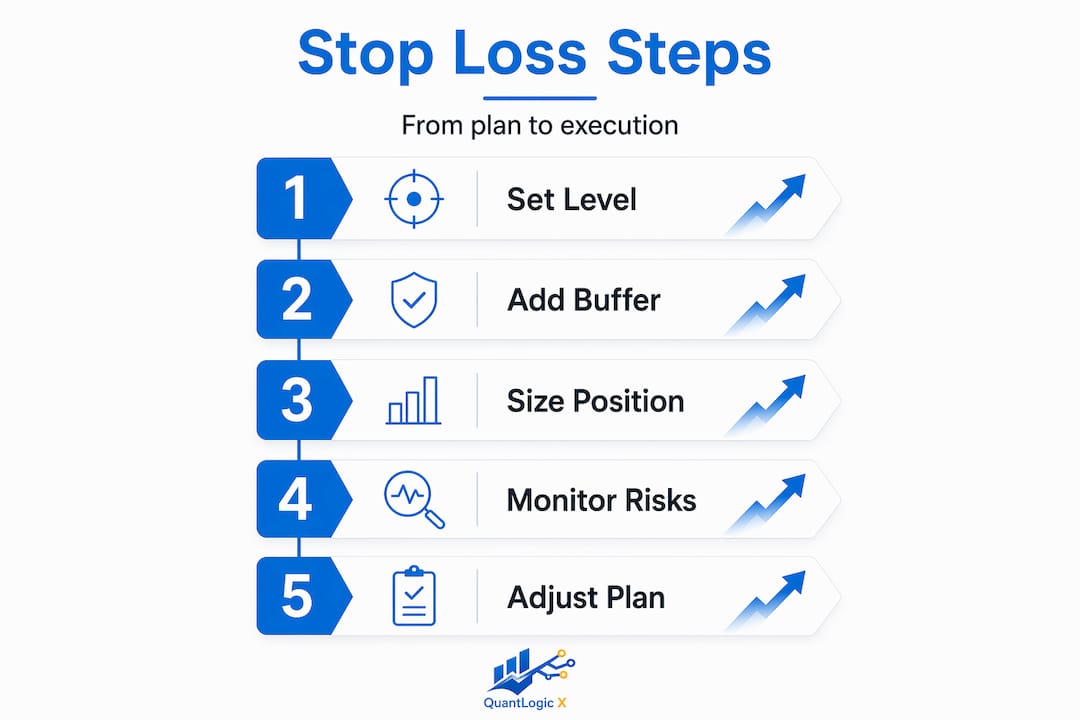
Here's where most traders go wrong. They pick a stop level based on how much money they're comfortable losing, or based on a round number below entry. That's an arbitrary stop, and it has no relationship to whether the trade idea is still valid.
A technical stop is placed where the trade thesis is invalidated. If you're buying a breakout above a resistance level, your thesis fails if price falls back below that resistance. That's where the stop goes, not at a random 2% below entry.
The most reliable technical reference points for stop placement include:
- Swing lows and highs: For a long trade, the most recent significant swing low is the natural invalidation point.
- Support and resistance levels: A break through these levels signals that market structure has shifted.
- Moving averages: Particularly useful in trend trades. A close below the 20 EMA in an uptrend is often a thesis-breaker.
The risk with stops placed at obvious levels is stop hunting. Large market participants know that retail traders cluster stops around popular levels like round numbers and recent swing lows. Price often probes these levels before reversing. This means stops inside normal price noise around support/resistance lead to frequent stop-outs that have nothing to do with your trade failing.
Pro Tip: Add a buffer of 0.5% to 1% beyond your chosen technical level. If your thesis invalidation is a break below $100, place the stop at $99 or $98.50. This small buffer absorbs minor wicks and reduces the chance of getting stopped out by noise before the trade has a real chance to develop.

Risk math: sizing your position around your stop
This is where the importance of stop loss becomes mathematical rather than conceptual. Most traders pick a position size based on how many shares or contracts they want to own. That's backwards. The correct process is:
- Decide how much dollar risk you're willing to accept on this trade (typically 1% of your account).
- Measure the distance between your entry price and your technical stop level.
- Divide your dollar risk by the entry-to-stop distance to get your position size.
For example: You have a $20,000 account and risk 1% per trade, so your max loss is $200. Your entry is $50 and your stop is $47, a $3 distance. $200 divided by $3 equals 66 shares. That's your position size.
The formula: dollar risk equals position size multiplied by the entry-to-stop price distance.
| Account Size | Risk % | Max $ Risk | Entry | Stop | Distance | Position Size |
|---|---|---|---|---|---|---|
| $10,000 | 1% | $100 | $50 | $47 | $3 | 33 shares |
| $20,000 | 1% | $200 | $50 | $47 | $3 | 66 shares |
| $20,000 | 1% | $200 | $50 | $45 | $5 | 40 shares |
| $50,000 | 2% | $1,000 | $100 | $95 | $5 | 200 shares |
When you size first and set stops later, you're guessing at your actual risk. When you define your stop first, your position size becomes a precise output. This is the foundation of consistent risk management across every stop loss strategy worth using.
Execution risk and slippage: the part nobody warns you about
Stop orders are not magic. When a stop price is hit, the order converts to a market order. In normal conditions, execution is close to your stop level. In fast-moving or low-liquidity markets, the fill can come at a significantly worse price.
Slippage is an inevitable transactional cost that affects your realized risk. A 1% stop can become a 1.4% actual loss once slippage is factored in. Over many trades, that gap matters.
The conditions most likely to cause significant slippage include:
- News events: Prices gap through stop levels when a major announcement hits. Your fill could be several percent below your intended stop.
- Low liquidity periods: Thin order books mean fewer buyers/sellers to fill your order near your intended price.
- Cryptocurrency and small-cap markets: These are structurally less liquid than large-cap stocks or major forex pairs.
"Realized losses often exceed theoretical risk due to stops converting to market orders; slippage must be budgeted to avoid volatility surprises." Slippage execution risk in trading
Practical responses to slippage risk: add a 0.1% to 0.3% slippage buffer to your expected loss in your risk calculations, avoid holding positions through major scheduled news events if slippage is unacceptable, and consider stop-limit orders when slippage protection matters more than guaranteed exit. The psychological dimension matters here too. Slippage and execution risk distort theoretical risk management and must be incorporated into your trading plan, not treated as an exception.
Tight vs. wider stops: what the research says
Most newer traders assume a tighter stop is always safer. Logically it sounds right. You lose less per trade. But the research tells a different story.
Tight stops increase win rate but reduce payoff ratio, potentially harming overall capital growth. If your stop is so tight that normal market noise triggers it, you're not cutting bad trades. You're cutting good trades prematurely.
| Stop Type | Win Rate Effect | Payoff Ratio Effect | Long-Term Growth Risk |
|---|---|---|---|
| Very tight | Higher short-term | Significantly reduced | High (truncated exposure) |
| Moderate (technical) | Moderate | Balanced | Lower |
| Very wide | Lower | Higher per winner | Moderate (larger single losses) |
The goal is not to minimize the loss on any single trade. The goal is to maximize total capital growth across hundreds of trades. Tight stop-losses can unintentionally hamper long-term capital growth by truncating exposure during normal market noise and regime shifts.
When to set stop loss levels wider than you're comfortable with: when your time frame involves larger price swings, when the asset has high average true range (ATR), or when your backtest data shows the trade idea consistently needs room before moving in your direction.
Pro Tip: Use the ATR (Average True Range) indicator to measure typical daily price movement for your asset. Setting your stop at 1.5x to 2x the ATR gives your trade room to breathe without making your risk unmanageable.
My perspective on how most traders misuse stops
I've watched traders set stops emotionally for years. They put the stop at a level that feels psychologically tolerable rather than at the level where their trade idea is genuinely wrong. The result is a high stop-out rate with no correlation to actual trade quality.
What I've learned is that stop losses automate the decision of when a loss becomes unacceptable. But that automation only works if the level you chose was rational in the first place. An emotional stop set with rational-looking math attached to it is still an emotional stop.
My other hard-won lesson: stops are only one layer of risk management. Robust risk management treats stop loss as part of a broader exit framework, including hard max daily loss limits and clear rules for intraday mechanics. The traders I've seen blow up weren't missing stops. They were missing the broader system that stops are supposed to support.
The uncomfortable truth is that the benefits of using stop loss orders only fully materialize when your position sizing is also correct. A well-placed stop on an oversized position still destroys your account. Consistent sizing and consistent stop placement, practiced together, are what actually build discipline over time.
— Tran
How Quantlogicx makes stop placement more precise
Understanding stop loss mechanics is one thing. Executing them consistently across dozens of trades is another challenge entirely. This is where tools matter.
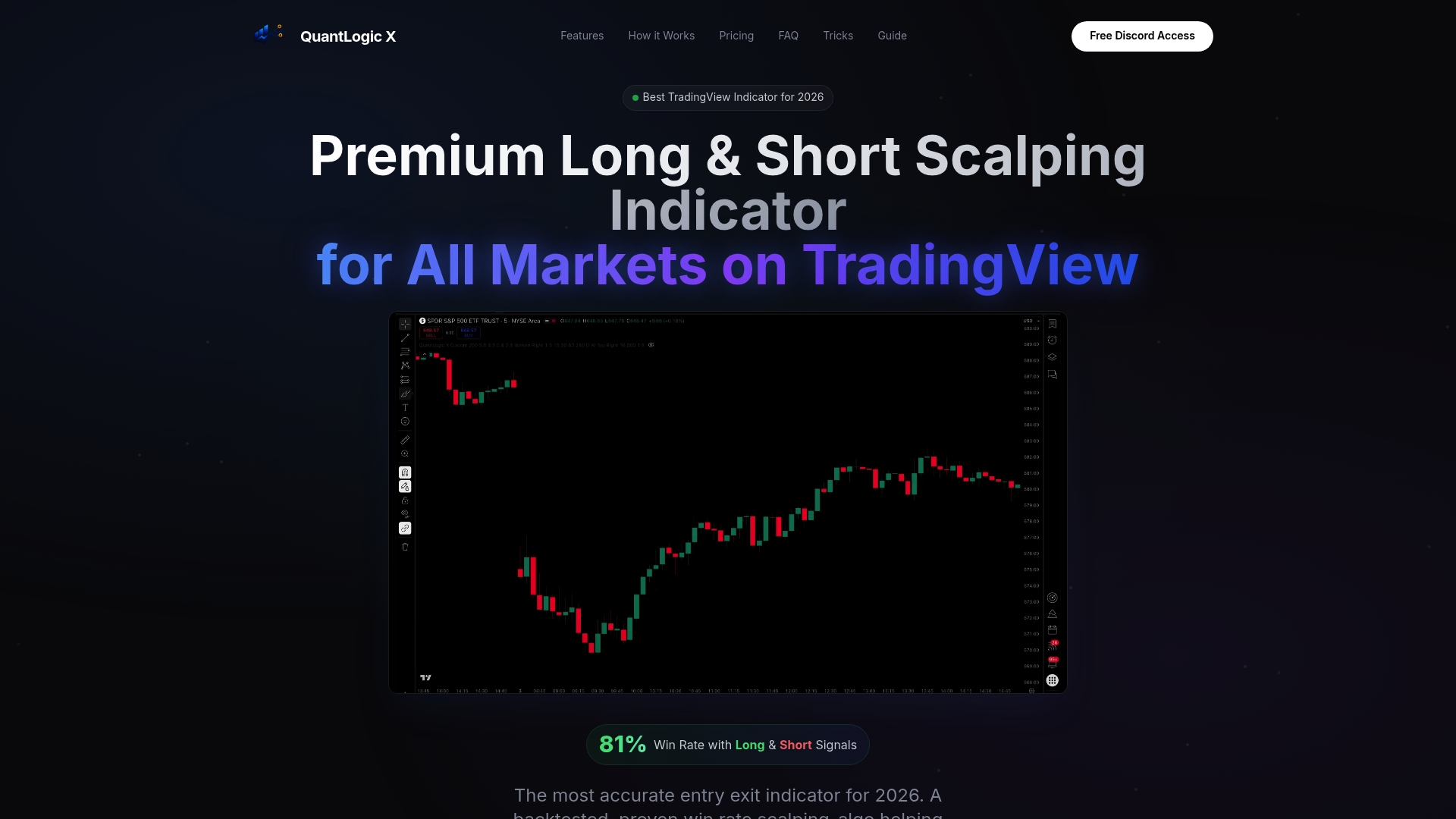
Quantlogicx was built for exactly this problem. The platform's zero repaint TradingView indicator gives you clear long and short signals confirmed at bar closure, so you're not chasing entries that shift after the fact. That reliability is what makes stop placement defensible. When you know exactly where your signal triggered, you know exactly where the thesis fails. Quantlogicx users across stocks, forex, and crypto have used these signals to anchor technical stops with confidence, including traders using the best TradingView indicator for forex signals to define precise risk levels on every setup. Over 2,000 traders have already put this to work. The real-time alerts mean your stop adjustments happen when the market tells you to move, not after the moment has passed.
FAQ
What is the role of stop loss in trading?
A stop loss order automatically exits a position when price reaches a predefined level, limiting downside risk without requiring manual intervention. Its broader role includes enforcing trading discipline and anchoring position sizing decisions.
How does slippage affect stop loss orders?
When a stop is triggered, it becomes a market order that fills at the best available price. In fast or low-liquidity markets, that fill can be significantly worse than your stop level, meaning your actual loss exceeds your theoretical risk.
When should you set a stop loss level?
Set your stop loss before entering the trade, at the price where your trade thesis is invalidated based on market structure, such as a break below key support or a moving average. Never set it based on how much you're willing to lose emotionally.
Are tight stop losses better than wider ones?
Not necessarily. Tight stops increase the frequency of being stopped out by normal price noise, which reduces your payoff ratio and can harm long-term capital growth even if individual losses feel smaller.
What is the 1% risk rule for stop losses?
The 1% rule means you risk no more than 1% of your total account on any single trade. You calculate position size by dividing your maximum dollar risk (1% of account) by the distance between your entry and stop price.