

Most traders assume a trading entry signal is just a flashing arrow on a chart. They see a crossover, click buy, and wonder why the trade fails. The reality is that understanding what is a trading entry signal goes far deeper than any single indicator. Entry signals are rule-based triggers built from technical patterns, price action, and market context. Get them right, and you trade with precision. Get them wrong, and you are essentially guessing with extra steps. This guide breaks down exactly how entry signals work, what makes them reliable, and how to use them consistently.
Table of Contents
- Key takeaways
- What a trading entry signal actually is
- Common entry signal indicators explained
- Why timing and validity windows change everything
- Comparing entry signal strategies by use case
- How to identify and execute high-quality entry signals
- My take on what traders consistently get wrong
- Take your entry signals further with Quantlogicx
- FAQ
Key takeaways
| Point | Details |
|---|---|
| Entry signals are rule-based | A quality signal replaces emotional guessing with an objective, repeatable execution trigger. |
| Timing defines signal quality | A signal that was valid 20 minutes ago may no longer be. Validity windows matter as much as the signal itself. |
| Confluence filters false signals | Combining multiple confirming factors dramatically reduces the chance of entering a bad trade. |
| Signal type must match conditions | Trend-following signals work in trending markets; oscillators work better in ranging ones. |
| Risk management completes the picture | Every entry signal needs a stop-loss and a target to be a complete trade idea. |
What a trading entry signal actually is
At its core, an entry signal is the specific, rule-based trigger that converts your market analysis into a single execution decision. It tells you when to open a position, in which direction, and under what conditions. That last part matters most.
Most beginners treat entry signals as binary: the indicator fired, so I trade. But professional traders treat them as hypotheses. A signal says "conditions favor a long here." It does not guarantee anything. What separates profitable traders from losing ones is how they filter, confirm, and act on those hypotheses.
Entry signals can come from three broad sources:
- Technical analysis: Indicator crossovers, breakouts, candlestick patterns, and price action setups
- Fundamental events: Earnings releases, economic data prints, or central bank decisions that shift market direction
- Sentiment analysis: Extreme positioning data, put/call ratios, or fear and greed readings that signal potential reversals
The defining characteristic of a good entry signal is objectivity. Systematic, repeatable execution is what separates a signal from a gut feeling. If you cannot write down the exact conditions that triggered your entry, you do not have a signal. You have a hunch.
Common entry signal indicators explained
Understanding the tools is step one. Here is how the most widely used entry signal indicators actually work in practice.
Moving average crossovers
When a shorter-period moving average crosses above a longer one, it signals upward momentum. The classic 50/200 EMA "golden cross" is a trend-following signal used across stocks, forex, and crypto. The problem is lag. By the time the cross happens, a significant portion of the move is often already done. Crossovers work best as confirmation tools rather than standalone triggers.

RSI and MACD as entry triggers
The Relative Strength Index (RSI) signals potential entries when it crosses back above 30 from oversold territory or drops back below 70 from overbought. The MACD histogram turning positive after a negative period can confirm early momentum shifts. Neither should be used alone. Waiting for volume confirmation after an RSI signal, for example, meaningfully improves reliability.
Candlestick patterns and signal bars
A pin bar at a key support level, an engulfing candle after a pullback, or a hammer at a Fibonacci zone. These are price action entry signals that require no indicator at all. Al Brooks' framework defines this precisely: a signal bar forms the hypothesis, and the entry bar confirms or denies it. You place your buy stop one tick above the signal bar high. If price triggers it, you are in. If not, the setup is invalidated cleanly.
Breakouts and trendline breaks
A close above a multi-week resistance level or a break of a descending trendline with expanding volume are classic breakout signals. The trap here is false breakouts. Price briefly pierces a level and snaps back. This is why breakout entries almost always need volume or a retest confirmation before committing.
Pro Tip: Never use a single indicator as your sole entry signal. Even the best setups fail in isolation. The strongest entries happen when price action, an oscillator reading, and a key level all align at the same moment.
Why timing and validity windows change everything
Here is where most traders lose money even when they identify the right signal. They act too late.
A validity window defines the specific time period during which a trade setup remains active and worth taking. Every signal has one. A breakout signal on a 15-minute chart might be valid for two candles. A daily chart reversal setup might remain valid for three trading sessions. Once that window closes, the signal is dead regardless of how clean it looked.
The most common mistake beginners make is chasing. They see a signal fire, hesitate, watch price move, and then enter late. At that point, the risk/reward has collapsed. The stop-loss is now too far away, and the potential target has shrunk. You are taking on more risk for less reward because you missed the timing.
"A strong live signal should ideally include the asset, direction, entry zone, stop-loss, target, validity window, and invalidation conditions." — Professional traders' signal framework
This is the checklist that separates a complete trade idea from a vague directional bias. If your signal does not include all of these elements, you are missing critical information before you risk real money.
Pro Tip: Write your validity window down before the market opens. If price has not triggered your entry by a specific time or price level, mark the setup as expired and move on. This single habit eliminates most emotional trading errors.
Comparing entry signal strategies by use case
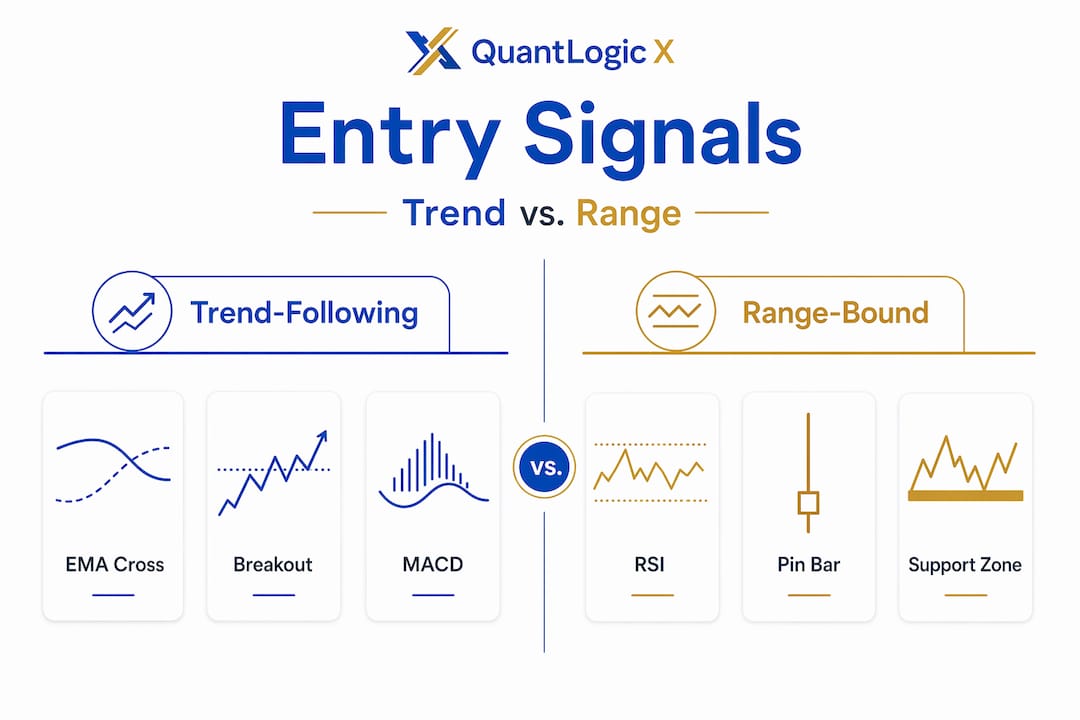
Different signals work best in different market conditions. Applying a trend-following signal in a choppy range will produce losses, just as using a mean-reversion oscillator in a strong trend will get you repeatedly stopped out.
| Strategy | Best market condition | Key tools | Main risk |
|---|---|---|---|
| Trend-following | Strong directional trend | EMA crossovers, MACD, ADX | Late entries after big moves |
| Mean reversion | Ranging or sideways market | RSI, Bollinger Bands, Stochastics | Fighting a trend that resumes |
| Breakout entry | Consolidation near key levels | Volume, ATR, horizontal support/resistance | False breakouts and fakeouts |
| OTE / Fibonacci entry | Post-impulse pullbacks | Fibonacci 62-79% zone, Smart Money concepts | Misidentifying the impulse leg |
| Price action signal bars | Any condition with clear structure | Candlestick patterns, Al Brooks methodology | Requires significant chart reading skill |
The Optimal Trade Entry (OTE) method deserves special mention. The 62-79% Fibonacci retracement zone is where institutional order flow tends to cluster, making it a high-probability entry area after a strong impulse move. This is not random. It reflects where large participants re-enter positions after a pullback. Combining OTE with a signal bar confirmation at that zone is one of the more precise entry methods available to retail traders.
For traders focused on fast markets, scalping entry signals require even tighter criteria because the validity window is measured in seconds, not hours.
How to identify and execute high-quality entry signals
Knowing what signals look like is not enough. You need a repeatable process for acting on them. Here is a practical framework:
-
Identify the market structure. Is price trending, ranging, or in a consolidation? Your signal type must match the environment. A trend signal in a range will fail consistently.
-
Mark your key levels. Support, resistance, Fibonacci zones, and session highs and lows. These are the areas where high-probability signals form. Random signals in the middle of a range carry far less weight.
-
Wait for the signal to form. Do not anticipate. Let the candlestick close, let the indicator cross, let the breakout happen. Entering before confirmation is speculation, not signal trading.
-
Confirm with at least one secondary factor. Volume surge, RSI position, a second time frame alignment, or a price action pattern. Multi-factor confirmation is the single most effective filter against false signals.
-
Define your entry, stop, and target before you click. Your stop-loss should be placed at the point where the signal is invalidated. Your target should reflect a realistic risk/reward ratio, typically 2:1 or better.
-
Check your validity window. If the signal is more than a few candles old on your time frame, reassess. Late entries on expired signals are one of the leading causes of unnecessary losses.
The trading entry criteria you apply consistently matter far more than finding the "perfect" indicator. Discipline in execution beats sophistication in setup selection every time.
My take on what traders consistently get wrong
I have watched traders spend months hunting for the perfect entry signal indicator, cycling through RSI settings, trying every MACD variation, and downloading every free script on TradingView. The irony is that their entries were never the real problem.
What I have found, working with traders across experience levels, is that the biggest losses come from ignoring validity windows. A trader identifies a beautiful setup, gets distracted, comes back 45 minutes later, and enters anyway because the setup still "looks good." It does not matter how good it looks. The window is closed. The institutions who set that signal up have already moved on.
My approach now is to treat every signal like a flight. If you miss boarding, you do not chase the plane down the runway. You wait for the next one. The market will always give you another setup. What it will not give back is money lost chasing a stale entry.
I also think traders underestimate how much signal quality improves when you combine price action with a single confirming indicator rather than stacking five indicators together. A clean signal bar at a key Fibonacci level with RSI confirming oversold conditions is more reliable than three overlapping indicators all derived from the same price data.
Patience is not passive. It is the active decision to wait for the conditions you defined in advance, then execute without hesitation when they appear.
— Tran
Take your entry signals further with Quantlogicx
If you want to stop second-guessing your entries, Quantlogicx built its TradingView indicator specifically to solve the timing problem. The algorithm generates long and short signals with zero repaint technology, meaning the signal you see at bar close is the signal that stays. No rewriting history.
Over 2,000 traders across stocks, forex, and crypto use it to get reliable entry signals with real-time alerts, removing the guesswork from execution. The 81% win rate comes from the same confluence principles covered in this article, built directly into the algorithm. Whether you are scalping or swing trading, the tool gives you the objective trigger your strategy needs. Explore the full indicator suite and see why traders are calling it one of the most practical signal tools available in 2026.
FAQ
What is a trading entry signal in simple terms?
A trading entry signal is a rule-based trigger that tells you when to open a trade, based on specific technical, fundamental, or price action conditions being met.
How do I identify high-quality entry signals?
Look for signals that form at key price levels with confirmation from at least one secondary factor, such as volume, RSI position, or a second time frame alignment.
What is a validity window in trading?
A validity window is the defined time period during which a trade setup remains active. Once it expires, the signal should be ignored even if it still looks visually appealing.
What are the best entry signals for trend trading?
EMA crossovers, MACD histogram reversals, and breakouts above key resistance levels are among the most reliable entry signals in trending market conditions.
Do entry signals work the same across all markets?
No. Signal effectiveness varies by market condition. Trend-following signals outperform in directional markets, while oscillator-based signals work better in ranging or sideways conditions.