

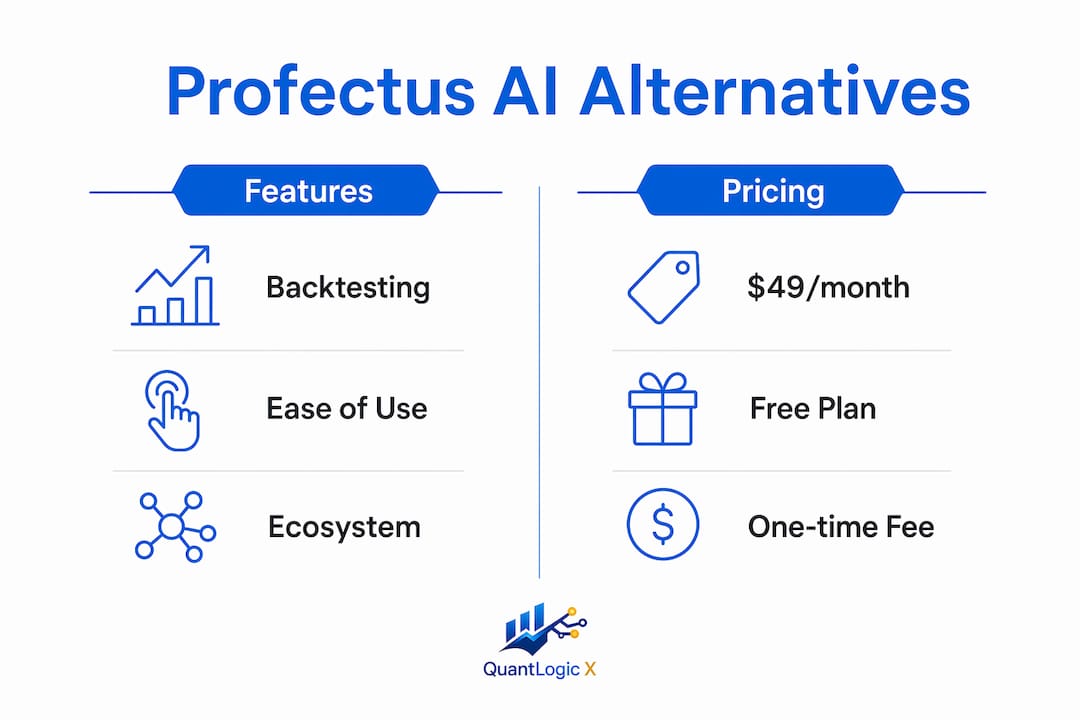
If you're looking for Profectus AI alternatives, the strongest options right now are MachineTrader.io, Tradetron, FXdreema, and Algobuilder. Each takes a different approach to no-code strategy building, and the right pick depends on your market focus, execution needs, and how much you want to pay monthly.
| Platform | Best For | Pricing | Platform Integrations | Backtesting | Ease of Use | Ecosystem Support |
|---|---|---|---|---|---|---|
| MachineTrader.io | Dedicated cloud execution | $49/month | Alpaca, Polygon.io | SuperTest engine | Moderate | Udemy course, AI models |
| Tradetron | Multi-asset strategies | Free + paid plans | Multi-broker, US indexes | Built-in | Easy | Marketplace, community |
| FXdreema | Visual MT4/MT5 building | Free + paid tiers | MetaTrader 4/5 | Basic | Very easy | Forums, tutorials |
| Algobuilder | Script export workflows | Tiered plans | Broker APIs, scripting | Moderate | Moderate | Developer docs |
| Profectus AI | Quick AI-generated strategies | Free + paid plans | MetaTrader 5 | Basic | Very easy | Limited community |
How do these Profectus AI alternatives compare on features and pricing?
Pricing and feature depth vary more than the "no-code" label suggests. MachineTrader.io charges $49/month for a dedicated Kubernetes cloud instance, which is a fundamentally different infrastructure model than the shared environments most competitors use. You get AI strategy generation via Claude, GPT-4, and Gemini, plus a Node-RED visual editor with over 100 nodes and NLP news sentiment from 80+ publications. For traders who need 24/7 uptime and full strategy isolation, that price is hard to argue with.

Tradetron takes the opposite approach: a free plan lets you build up to 10 strategies and deploy any single one on paper trading at no cost. Live execution requires a paid plan. Its real strength is asset breadth. You can automate options, futures, ETFs, and stocks on US indexes like SPY and SPX, and connect to multiple brokers without writing a line of code.
FXdreema is the most mature visual builder for MetaTrader traders specifically. Its drag-and-drop interface maps directly to MQL logic, so what you build is what gets executed on MT4 or MT5. The community is large, the tutorials are plentiful, and the learning curve is genuinely low. The tradeoff is that you're locked into the MetaTrader ecosystem.

Algobuilder targets traders who want to design in a visual environment but export to scripting languages or broker APIs for live execution. That node-based export workflow suits developers who want flexibility without starting from scratch in code.
Common drawbacks across these platforms:
- Shared cloud infrastructure on most platforms introduces latency that can affect live execution quality
- Backtesting fidelity varies widely; few platforms offer tick-accurate deterministic results
- Free tiers typically restrict live deployment or limit the number of active strategies
- MetaTrader-focused tools (FXdreema, Profectus AI) don't serve crypto or multi-asset traders well
- AI strategy generation is often a starting point, not a finished product
How do you choose the right no-code trading platform?
Start with your execution environment. New traders often prioritize the drag-and-drop interface, while experienced algo developers care more about whether their strategy runs on isolated infrastructure or a shared server that other traders' bots also occupy. That distinction directly affects live performance.
Key criteria to evaluate before committing:
- Backtesting quality: Does the platform use tick-accurate historical data, or simplified bar data? Deterministic backtesting produces reproducible results and reduces the risk of overfitting strategies that fail in live markets.
- Brokerage integration: Confirm your broker is supported before you build anything. MachineTrader.io connects to Alpaca for commission-free US equity trading; Tradetron supports multi-broker deployment across US and international markets.
- Low-code flexibility: The best no-code platforms let advanced users inject custom scripts in JavaScript or Python when a visual node can't handle edge-case logic. That escape hatch matters more than it sounds.
- Pricing model: Monthly subscriptions with no lock-in are preferable to annual commitments when you're still testing a platform.
- Community and support: Active forums and documented tutorials reduce the time between "I have an idea" and "my strategy is live."
Pro Tip: Before you backtest anything, verify whether the platform uses bar-close data or tick data. A strategy that looks profitable on bar data can fail badly in live execution because entries and exits are priced at the open of the next bar, not the actual signal price.
What does Profectus AI actually offer?
Profectus AI is a no-code platform built primarily for MetaTrader 5, using GPT-based AI to generate trading strategies through a drag-and-drop interface. It's designed for traders who want to go from idea to deployed strategy quickly, without touching MQL code.
What it includes:
- AI-powered strategy generation with a visual builder
- MetaTrader 5 as the primary execution environment
- A free plan with limited broker support
- Basic backtesting capabilities
The platform's strengths are speed and simplicity. Its weaknesses are the same. Backtesting is not tick-accurate, the ecosystem is thinner than FXdreema's, and multi-asset traders will find the MetaTrader-only focus limiting. For traders who need options, futures, or crypto automation, Profectus AI is not the right fit.
Quantlogicx: a signal-based alternative worth knowing
Quantlogicx takes a different approach entirely. Rather than building full automated strategies through a visual editor, it offers a TradingView indicator engineered specifically for scalping across stocks, forex, and crypto.
The 81% win rate is backed by real-time alerts and a community of active traders sharing results. For scalpers who want reliable long and short signals without building a full strategy from scratch, that combination of performance data and community accountability is a meaningful differentiator. Quantlogicx suits traders who already know their market and want a signal layer they can trust, not a platform that builds the strategy for them.
Quantlogicx signals: a different path to automated edge
If the platforms above feel like more infrastructure than you need, Quantlogicx offers a sharper entry point. You get buy/sell signals on TradingView with zero repaint, real-time alerts, and a community of over 2,000 traders already using the same system.
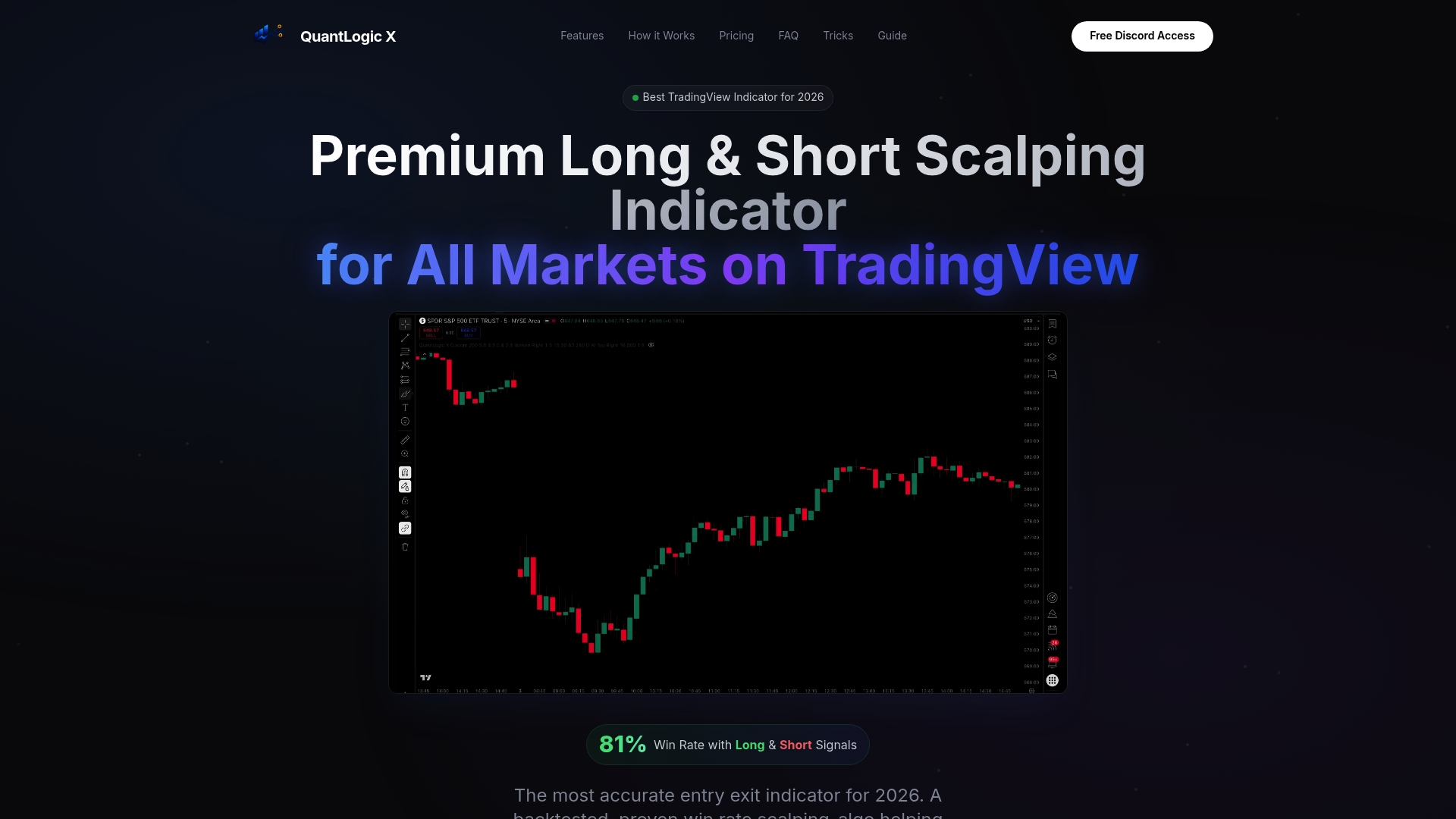
No server setup, no broker API configuration, no monthly platform fee eating into your P&L. For traders focused on scalping SPY, forex pairs, or crypto, the Quantlogicx indicator plugs directly into TradingView and starts generating signals immediately. It's not a replacement for a full algo platform if you need multi-leg options automation. But if you want a proven signal tool with documented performance, it's worth a serious look before you commit to a $49/month infrastructure subscription.
FAQ
What is the best free Profectus AI alternative?
Tradetron offers the most capable free tier, letting you build up to 10 strategies and paper trade any of them at no cost. Live execution requires a paid plan.
Does MachineTrader.io work for US equity traders?
Yes. MachineTrader.io integrates with Alpaca Markets for commission-free US equity trading, making it a strong fit for US equity algo traders.
Which platform has the best backtesting for no-code strategies?
MachineTrader.io's SuperTest engine and platforms using tick-accurate historical data produce the most reliable backtesting results. Simplified bar-data backtesting, common on entry-level platforms, tends to overstate strategy performance.
Is there a no-code alternative that supports options strategies?
Tradetron supports a wide range of options strategies including scalping, multi-leg, iron flies, and risk-defined trades, all without coding, and deploys them to connected brokers.
Can Quantlogicx replace a full no-code algo platform?
Quantlogicx is a TradingView signal indicator, not a full strategy builder. It suits scalpers who want reliable entry and exit signals across stocks, forex, and crypto, rather than traders who need multi-asset automation or broker API deployment.
Key Takeaways
The strongest Profectus AI alternatives in 2026 separate themselves on execution infrastructure, asset breadth, and backtesting quality, not just interface design.
| Point | Details |
|---|---|
| Execution environment matters | MachineTrader.io's dedicated Kubernetes server at $49/month outperforms shared-cloud competitors for live trading reliability. |
| Asset breadth varies widely | Tradetron covers options, futures, ETFs, and stocks; FXdreema and Profectus AI are limited to MetaTrader environments. |
| Backtesting quality is critical | Tick-accurate deterministic backtesting reduces overfitting risk; most free-tier platforms use simplified bar data instead. |
| Low-code flexibility extends no-code tools | Platforms that allow JavaScript or Python injection handle edge-case logic that pure no-code nodes cannot. |
| Quantlogicx for signal-focused scalpers | The Quantlogicx TradingView indicator provides zero-repaint long/short signals, achieving an 81% win rate across stocks, forex, and crypto. |