

Most scalpers don't lose because they lack a good strategy. They lose because they override their own rules the moment a trade looks "almost right." A structured scalping signal checklist converts those shaky judgment calls into mechanical yes/no gates, removing emotion from the equation before you ever click buy or sell. This guide walks you through every layer of that checklist: pre-trade filters, signal-specific verification steps, market comparisons, and exit rules that actually protect your capital across stocks, forex, crypto, and options.
Table of Contents
- Key takeaways
- 1. Your scalping signal checklist starts here: the pre-trade gates
- 2. DOM scalping: the order-book signal checklist
- 3. Level 2 momentum and VWAP deviation checklists
- 4. Market comparison: which checklist fits your market?
- 5. Risk management checklist: exit rules that protect your capital
- My honest take on checklist discipline
- How Quantlogicx makes your scalping checklist work in real time
- FAQ
Key takeaways
| Point | Details |
|---|---|
| Pre-trade gates are non-negotiable | Apply all seven checklist criteria before every trade to block impulsive, low-quality entries. |
| Signal type shapes the checklist | DOM, Level 2, VWAP, and options scalps each require distinct verification steps and exit rules. |
| Exit rules matter as much as entries | Define your "exit if wrong" condition before entering, not after the trade goes against you. |
| Market context determines your tools | Match your checklist complexity and platform requirements to the specific market you trade. |
| Time stops prevent trade drift | A 30-second resolution rule keeps scalps from morphing into unplanned swing positions. |
1. Your scalping signal checklist starts here: the pre-trade gates
Before you analyze any specific signal, you need a universal pre-trade filter. This is the foundation of every reliable scalping strategy guide, and skipping it is where most traders bleed money.
A 7-point pre-trade checklist covers the core gates every scalper should apply: valid setup, defined stop loss, correct position size, acceptable reward-to-risk ratio, good session timing, no imminent high-impact news, and mental state clarity. Each item is a pass/fail decision. Not a "mostly yes." Pass or fail.
Here's what each gate actually means in practice:
- Valid setup: Does the price action, order flow, or indicator signal match your predefined strategy? If you trade VWAP bounces, a random momentum candle is not a valid setup.
- Defined stop loss: Your stop must be placed at a structural level, not a round number you picked because it feels comfortable. Price structure defines the stop. You don't.
- Correct position size: Position size must be small enough to absorb a full stop loss without affecting your psychology or account balance.
- Acceptable reward-to-risk ratio: Most scalpers require at least 1.5:1. Anything below that and the math doesn't work over a large sample of trades.
- Session timing: High-probability windows like the first hour after market open or major forex session overlaps dramatically increase the reliability of your signals.
- No imminent news: A scheduled Fed announcement or earnings release can wipe out a technically perfect setup in seconds. Check the economic calendar before every session.
- Mental clarity: Are you trading to recover a loss? Are you distracted? Revenge trading is not a strategy. It's a liability.
After running through the full list, take a deliberate pause. A 10-second pause after checklist completion before placing orders helps prevent emotional overrides and allows your rational thinking to confirm the decision. It sounds minor. It isn't.
Pro Tip: Print your pre-trade checklist and keep it next to your monitor. Reading it physically, even after you've memorized it, creates a behavioral pattern that resists impulsive decisions under pressure.
2. DOM scalping: the order-book signal checklist
Depth of Market scalping is one of the most demanding forms of scalp trading, but it's also one of the most precise when you know what to look for. The signal checklist here is tightly tied to specific order-book behaviors.

In DOM scalping, five order-book patterns reliably predict short-term price movement: absorption, iceberg detection, stack thinning, momentum stacking, and cross-exchange divergence. Your job is to identify which pattern is forming, then verify it before acting.
Your DOM signal checklist, step by step:
- Identify the pattern type. Is large size absorbing aggressive orders at a level (absorption)? Are hidden orders refreshing repeatedly (iceberg)? Is the bid or offer stack thinning rapidly (stack thinning)?
- Look for corroborating evidence. One signal alone is not enough. A thinning stack confirmed by momentum stacking on the tape is a much stronger signal than either alone.
- Predefine your exit levels. Before clicking, know your target and your "exit if wrong" level. If the absorption resolves and price breaks through, you exit immediately. No debate.
- Size the position. DOM scalps are typically very short duration. Size down accordingly.
- Apply the time stop. If price hasn't moved in your favor within 30 seconds, exit flat or near flat. The 30-second resolution rule prevents a stalled scalp from drifting into a losing swing trade.
Pro Tip: Cross-exchange divergence, where the same asset shows different order book pressure on two exchanges simultaneously, is one of the least-used but most reliable DOM signals. If you trade crypto, this is worth adding to your checklist.
3. Level 2 momentum and VWAP deviation checklists
Level 2 scalping and VWAP bounce setups are more accessible than DOM trading because they don't require specialized software, but they still demand structured verification.
For Level 2 momentum scalping, your checklist looks like this. First, confirm that large bids are stacking at or just below the current price, signaling institutional buying interest. Second, watch for the breakout: price clears a key intraday resistance level on expanding volume. Third, enter only after the breakout candle closes above the level, not during it. Fourth, and this is critical: if the large bids vanish and large offers suddenly appear, that's an order book flip. Exit immediately. Exiting on an order book flip outperforms waiting for a formal stop loss hit because it cuts losses earlier and keeps your average loss smaller.
For VWAP deviation scalps, the checklist shifts slightly. You're looking for price to stretch significantly away from VWAP, then show a reversal signal near a key deviation level. Confirm the reversal with a volume spike. Enter at the first candle that closes back toward VWAP. Set your target at VWAP itself, and your stop just beyond the deviation extreme. Clean, simple, repeatable.
For traders exploring options scalping signals, the checklist adds quantitative gates. Options scalping requires a 12-step checklist with specific risk gates: IV Rank above 50, position sizing capped at 5% of portfolio, total portfolio exposure below 30%, defined premium targets, and clear stop loss rules tied to premium loss rather than underlying price movement. Options scalping is faster to size but slower to execute cleanly, so the checklist does more work here than in any other market.
Pro Tip: For VWAP setups, the first test of VWAP after a large deviation is almost always the cleanest trade. By the third or fourth test, the setup degrades. Build that into your checklist as a filter.
4. Market comparison: which checklist fits your market?
Not all scalping signal checklists are created equal. The criteria that matter for crypto DOM scalping are largely irrelevant for options scalping, and vice versa. Here's a direct comparison to help you match your checklist to your market.
| Criteria | Crypto DOM scalping | Level 2 equities | Options scalping |
|---|---|---|---|
| Typical trade duration | 5 to 30 seconds | 30 seconds to 3 minutes | 2 to 15 minutes |
| Stop loss method | Time stop + signal negation | Order book flip | Premium loss threshold |
| Reward-to-risk target | 1.5:1 to 2:1 | 1.5:1 to 2:1 | 1:1 to 2:1 |
| Best session timing | 24/7, highest volume windows | First 90 minutes of market open | Pre-market and first hour |
| Key checklist tool | DOM feed, cross-exchange data | Level 2 quotes, time and sales | IV Rank, options chain |
| Difficulty level | High | Medium | Medium to high |
The biggest mistake traders make is applying a generic day trading checklist to a market it wasn't designed for. A crypto DOM trader needs real-time order book data from multiple exchanges. An equities scalper needs fast Level 2 access and a clean time-and-sales feed. An options scalper needs an IV Rank reading and a clear understanding of theta decay during the trade window.
Your checklist should reflect your platform's actual capabilities. If your broker's Level 2 data has a two-second delay, DOM scalping is not viable for you. Match your tools to your checklist, not the other way around.
Pro Tip: Start with Level 2 equities scalping if you're newer to how to scalp trading. The signals are more visible, the execution windows are longer, and the checklist is easier to internalize before you graduate to DOM or options.
5. Risk management checklist: exit rules that protect your capital
The entry gets you into the trade. The exit determines whether you make money. Most scalping guides spend 80% of their content on entries and treat exits as an afterthought. That's backwards.
Your risk management checklist for scalping should include these non-negotiable rules:
- Exit if wrong, immediately. Each setup needs a predefined condition that signals the trade thesis is broken. Waiting for your stop loss after the signal reverses increases risk without any benefit.
- Apply time stops. If the trade isn't working within your expected timeframe, exit flat. A stalled scalp is a losing scalp waiting to happen.
- No averaging down. Adding to a losing scalp position is not risk management. It's hope masquerading as strategy.
- One stop hit, one break. After a stop loss triggers, step away for at least five minutes. Chasing the next trade immediately after a loss is how small losses become large ones.
- Track checklist adherence in your trade log. Analyzing trades filtered by checklist adherence reveals exactly where your discipline breaks down and which setups are actually profitable versus which ones just feel good.
Scalping strategies work best when paired with strict exit rules and time stops that prevent position drift and runaway losses. The traders who last in this game are not the ones who find the best entries. They're the ones who exit cleanly, every single time.
Pro Tip: Write your exit conditions on a sticky note next to your monitor before you enter any trade. Reading "exit if bid stack vanishes" out loud before you click buy sounds excessive. It also works.
My honest take on checklist discipline
I've watched traders with genuinely good setups blow up their accounts because they couldn't follow a list. Not because the list was wrong. Because the moment a trade looked "almost right," they convinced themselves the checklist was a suggestion rather than a rule.
The real cost of overriding your checklist isn't one bad trade. It's the erosion of the systematic edge you spent months building. Every time you skip a gate, you're teaching yourself that the checklist is optional. And once it's optional, it's useless.
The rule that has saved my account more than any other is the "exit if wrong" condition. Not the stop loss. The signal negation exit. When the DOM imbalance resolves or the Level 2 stack flips, I'm out. Not thinking about it. Out. That single habit, applied consistently, is what separates a disciplined trade entry from a gamble dressed up in technical analysis.
Here's the counterintuitive part: sometimes the best trade you make all day is the one you didn't take because it failed a single checklist gate. Skipping a "good looking" setup that doesn't fully qualify is not a missed opportunity. It's the checklist working exactly as designed.
— Tran
How Quantlogicx makes your scalping checklist work in real time
Running a mental checklist at scalping speed is genuinely hard. Quantlogicx was built to solve that problem. The QuantLogic X TradingView indicator embeds checklist criteria directly into its signal alerts, giving you clear long and short signals at bar closure with zero repaint. That means the signal you see is the signal that was there. No second-guessing.
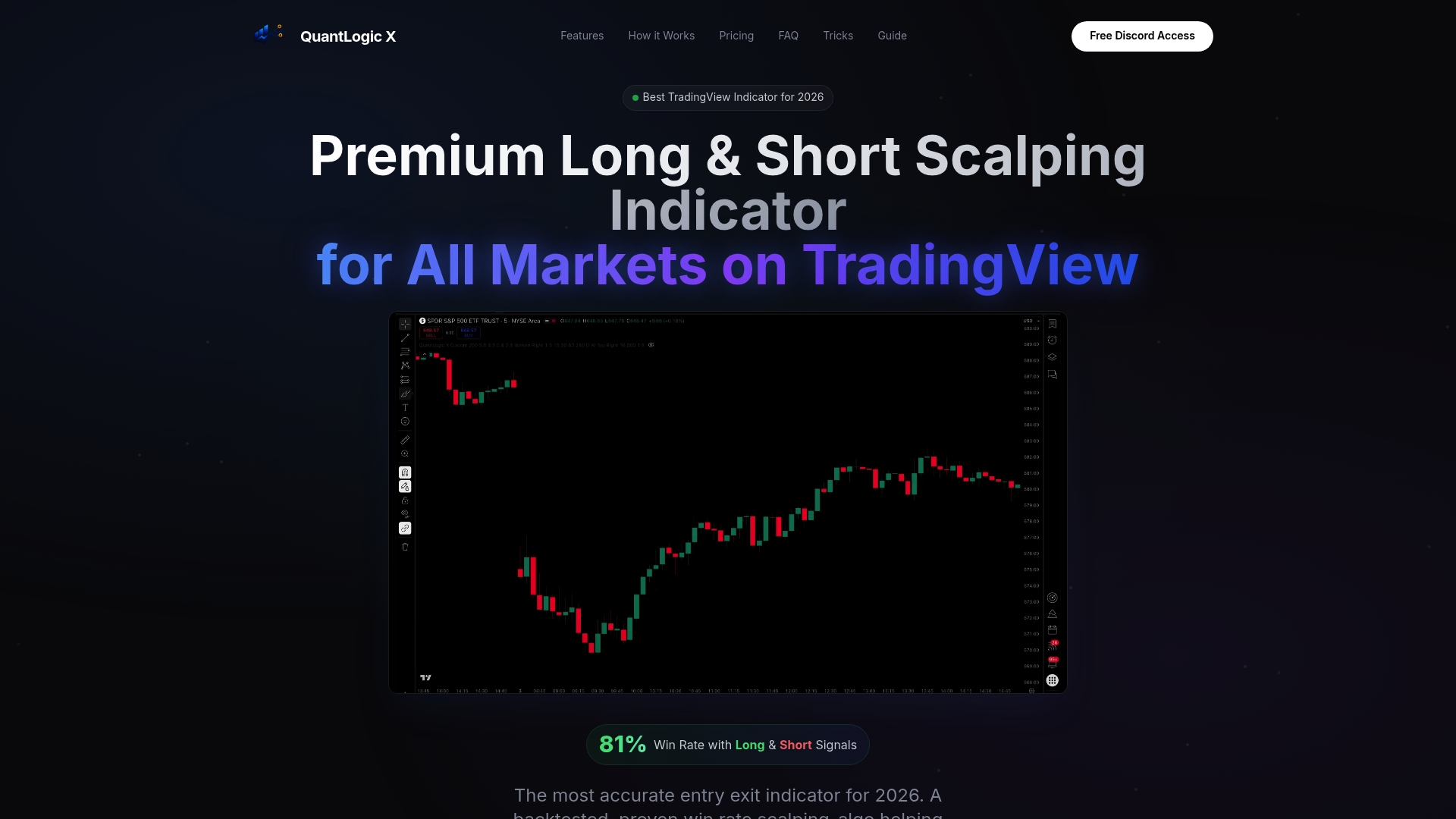
Over 2,000 traders use Quantlogicx across stocks, forex, and crypto, with individual users recording gains like $8,200 in a single month. The platform's 81% win rate comes from the same principle this article is built on: mechanical filters applied consistently. If you want to see how automated checklist compliance works in a live scalping signal tool, Quantlogicx is worth a serious look.
FAQ
What is a scalping signal checklist?
A scalping signal checklist is a set of predefined pass/fail criteria a trader applies before entering any scalp trade. It covers setup validity, stop loss placement, position sizing, reward-to-risk ratio, session timing, news avoidance, and mental state.
How many items should a scalping checklist have?
A pre-trade scalping checklist should have at least seven core items. Options scalping checklists often extend to 12 steps to account for IV Rank, strike selection, and portfolio exposure limits.
What is the "exit if wrong" rule in scalping?
The "exit if wrong" rule means you exit a trade immediately when the primary signal that justified the entry is negated, such as when a DOM bid stack vanishes or a Level 2 order book flips. This approach reduces losses more effectively than waiting for a formal stop loss to trigger.
Does a scalping checklist work for options trading?
Yes. An options scalping checklist includes quantitative gates like IV Rank above 50, position sizing capped at 5% of portfolio, and defined premium loss thresholds. The checklist structure is the same; the specific criteria differ from equity or crypto scalping.
How do time stops fit into a scalping risk management checklist?
A time stop exits a trade if price hasn't moved in your favor within a set window, typically 30 seconds for DOM scalping. This prevents a stalled scalp from drifting into an unintended longer-duration trade and protects capital from slow-bleed losses.