

Scalping signal algorithms are the engine behind some of the most profitable short-term trading strategies in modern markets, yet most traders misunderstand what they actually do. A scalping signal algorithm is not just a fast indicator. It is a system that converts live market data into high-confidence entry and exit decisions, typically within seconds to a few minutes, using layered logic that filters out noise before committing to a trade. If you have ever wondered why some traders execute dozens of profitable trades daily while others chasing the same setups lose consistently, the answer usually lives inside the algorithm's architecture.
Table of Contents
- Key takeaways
- What is a scalping signal algorithm and how it works
- Common strategies and indicators behind scalping signals
- Technical challenges and microstructure noise
- Practical implementation for day traders
- My take on what actually makes scalping algorithms succeed
- See the principles in action with Quantlogicx
- FAQ
Key takeaways
| Point | Details |
|---|---|
| Algorithms fuse multiple signals | A scalping signal algorithm combines price, volume, and order-flow data into a single confidence score before triggering an entry. |
| Quality gates are non-negotiable | Spread conditions, latency checks, and kill switches prevent trading in poor microstructure environments. |
| Multi-timeframe confirmation cuts false signals | Signals validated across 1m, 5m, and 15m charts reduce entries based on noise rather than genuine momentum. |
| Position management is part of the signal | Trailing stops and partial take-profits are wired into the algorithm, not bolted on as afterthoughts. |
| Trade direction accuracy matters more than most realize | Misclassification of buy versus sell flow degrades order-flow signals and skews performance over time. |
What is a scalping signal algorithm and how it works
The term "scalping signal algorithm" is the plain-language way to describe what engineers call an automated microstructure signal engine. Both names refer to the same thing: a program that reads real-time market inputs, scores them, and outputs a directional trade signal with enough confidence to act on.
What is scalping in trading, at its core, is the practice of capturing small price moves repeatedly, relying on volume and speed rather than large directional bets. Algorithms make this practical because human reaction time cannot process order book changes, volume bursts, and price velocity simultaneously in under a second.
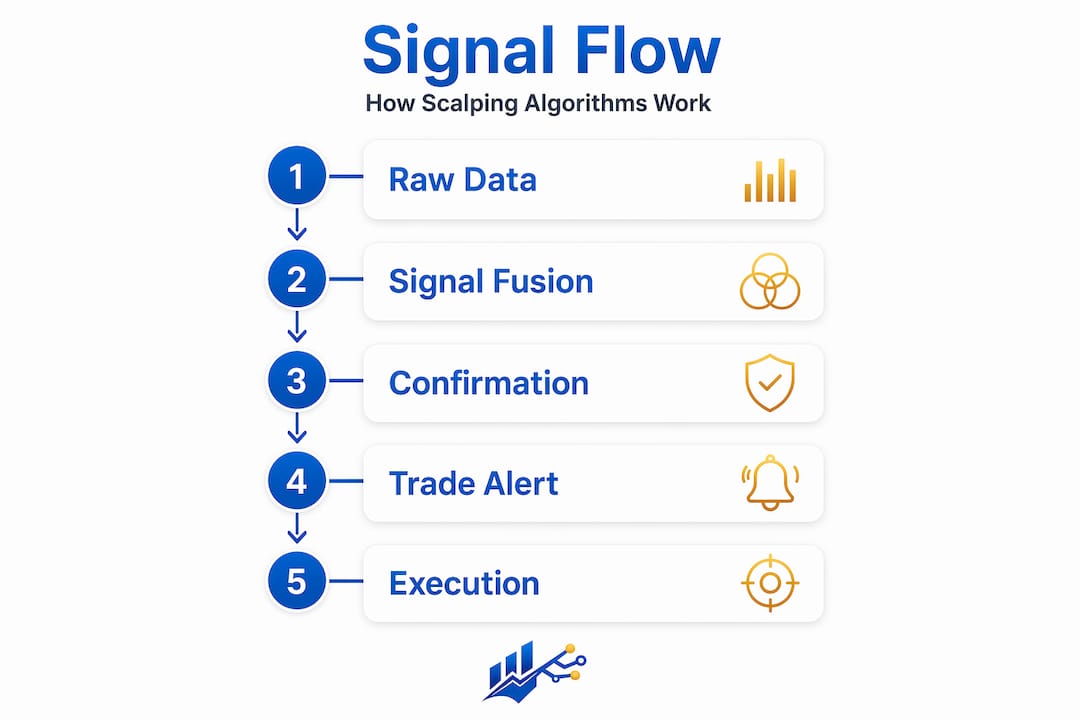
Here is how the architecture works in practice. The algorithm ingests raw inputs including tick-by-tick price data, volume, bid-ask spread width, and order book depth. It then runs each input through individual signal modules, each scoring a directional view. Those scores are weighted and fused into a master confidence value. If that value clears a defined entry threshold and passes a series of quality gates, the algorithm fires a buy or sell signal.
The Smallfish scalping engine is a well-documented example of this architecture. It fuses 13 microstructure signals into a single directional confidence score and only permits entry when confidence exceeds a set threshold, multiple signals agree, and conditions like spread width and data latency pass their gates. That layered logic is what separates a signal engine from a simple indicator crossover.
Pro Tip: Never evaluate a scalping algorithm by its raw win rate alone. Check what percentage of signals actually pass the quality gates. A system with a 90% gate rejection rate and an 81% win rate on cleared signals is performing exactly as designed.
Common strategies and indicators behind scalping signals
There is no single indicator that powers a scalping algorithm. Real systems use a stack of signals, each contributing a different perspective on market conditions. Understanding this stack helps you interpret signals more intelligently.
Momentum and trend signals
Algorithms frequently use RSI to measure overbought and oversold conditions at the micro level, MACD for momentum divergence, and EMA crossovers to confirm directional bias. None of these work reliably in isolation for scalping, but as weighted inputs to a confidence score they add meaningful information. Multi-factor scoring that combines trend, momentum, volatility, and price action with adjustable weights is the standard approach in production systems.

Order-flow and volume signals
This is where scalping algorithms separate themselves from retail indicator setups. Cumulative volume delta (CVD), trade burst detection, and order book imbalance signals give the algorithm a real-time view of whether buyers or sellers are in control. Execution quality factors like spread and latency matter more to a scalping system than any crossover because they determine whether the edge in the signal survives the actual fill.
The table below compares the three most common strategy types used in scalping signal systems:
| Strategy type | Signal logic | Best market condition |
|---|---|---|
| Momentum scalping | EMA crossover plus CVD surge | Trending market with rising volume |
| Mean reversion scalping | RSI extreme plus spread normalization | Range-bound market with tight spreads |
| Breakout scalping | Volume burst plus order book imbalance | High-volatility period, pre-news or open |
Two-stage signal flows
Production scalping systems typically run a two-stage process. The first stage generates a pre-alert when early conditions start aligning. The second stage fires a confirmed signal only after multi-timeframe agreement and quality grading clear. This prevents the algorithm from entering on a signal that looks good on the one-minute chart but contradicts the five-minute and fifteen-minute trend context. The result is fewer trades and a far better signal-to-noise ratio.
Technical challenges and microstructure noise
Building a reliable scalping algorithm is harder than it looks, primarily because of problems that do not show up in backtests but destroy live performance.
The first major challenge is trade direction classification. Algorithms that use order-flow signals need to know whether each trade was buyer or seller initiated. The Lee-Ready algorithm is the standard method for inferring this from price and quote data, but it has real limitations. When timestamp precision is low or the quote midpoint changes rapidly (known as midpoint jitter), the classification degrades. Research from the Bank of England found that improved algorithms halve misclassification rates, which has a direct impact on portfolio cost estimates and signal quality.
The second challenge is microstructure regime changes. Spread widths, liquidity depth, and order flow patterns shift throughout the trading day. A confidence score that signals correctly during the first hour of New York trading may generate false signals during the low-liquidity midday session. This is why real-world scalping systems rely heavily on gating mechanisms rather than treating confidence scores as standalone triggers.
Here is a practical sequence of the failure points most traders overlook:
- Timestamp misalignment between price data and order book snapshots creates phantom signals that look real in replay but never materialize in live trading.
- Spread blowout during news events causes the algorithm to see a strong momentum signal at the exact moment execution cost makes it unprofitable.
- Signal misclassification bias builds up over hundreds of trades, slowly tilting the algorithm toward one direction without any obvious single error.
- Kill switch absence means the algorithm keeps firing signals during periods of technical dysfunction, accelerating drawdowns.
Pro Tip: Run your scalping algorithm through sessions with deliberately widened spread filters before going live. If performance collapses when you tighten the quality gates, the system is trading noise, not edge.
Practical implementation for day traders
Understanding the theory is one thing. Actually applying a scalping signal algorithm to your trading is where most people get stuck.
Start with confidence thresholds. Every scalping algorithm produces signals on a spectrum from weak to strong. Systems like the Nyao Scalper MT5 EA compute a 0-10 signal score and only enter trades above a set cutoff. Trading every signal regardless of score is one of the fastest ways to drain a trading account. Your job as the trader is to decide which confidence tier matches your risk tolerance.
Position sizing should scale with signal strength. A high-confidence signal with multiple timeframe agreement and tight spread conditions justifies a larger position than a borderline entry. Tying position size directly to the signal score is a practice that most retail traders ignore and professional systems always include.
Here are the most common implementation mistakes and how to avoid them:
- Overtrading low-confidence signals. If a signal scores below your defined threshold, skip it. There will be another.
- Ignoring quality gate alerts. Wide spreads or stale data flags are not suggestions. They are the algorithm telling you the edge has disappeared.
- Using fixed stop-losses. Scalping algorithms work best with ATR-based stops and trailing stops that adapt to current volatility rather than arbitrary pip counts.
- Skipping partial take-profits. Partial take-profits and trailing stops wired into the signal logic help lock in gains while letting winners run, which is the actual source of long-term edge in scalping systems.
- Running live before forward testing. Paper trade the algorithm across at least two weeks of live market conditions before risking capital.
Integrating scalping trading signals with your execution platform requires either a native API connection for automated systems or a reliable alert mechanism for manual traders. TradingView-based systems send webhook alerts directly to brokers or notify you in real time. Understanding trading entry signals at a foundational level helps you make better decisions about when to override or confirm what the algorithm is telling you.
My take on what actually makes scalping algorithms succeed
I have spent years analyzing scalping systems across stocks, forex, and crypto, and the pattern I keep seeing is this: traders obsess over the signal generation side and completely neglect the gating side. Signal fusion is genuinely interesting. It feels like the magic. But in my experience, it is the quality gates that decide whether an algorithm survives contact with the real market.
I have watched traders take a technically sound algorithm and lose money because they disabled the spread gate during volatile sessions, thinking the bigger moves would compensate. They never do. The algorithm was designed with that gate for a reason.
Another misconception I encounter constantly is the idea of a "perfect signal." No scalping algorithm generates perfect signals, and any system claiming otherwise is either backtested on curve-fitted data or outright misleading. What good systems do is generate statistically reliable signals across a large enough sample. That is a completely different claim, and it is the one worth trusting.
What I have found actually works is a strict separation of roles. The algorithm handles signal generation and quality filtering. You handle the meta-level decisions: which sessions to trade, which asset classes suit the current regime, and when to switch the algorithm off entirely because conditions are outside its design parameters. That balance between automation and judgment is where real scalping performance lives.
— Tran
See the principles in action with Quantlogicx
Everything this article covers, from multi-signal fusion to zero-repaint confirmed signals, is built into the Quantlogicx TradingView indicator. Over 2,000 traders use it daily across stocks, forex, and crypto, and the system carries an 81% win rate backed by a zero-repaint commitment that ensures signals lock in at bar closure. One user recorded $8,200 in gains within a single month trading the system's long and short signals.
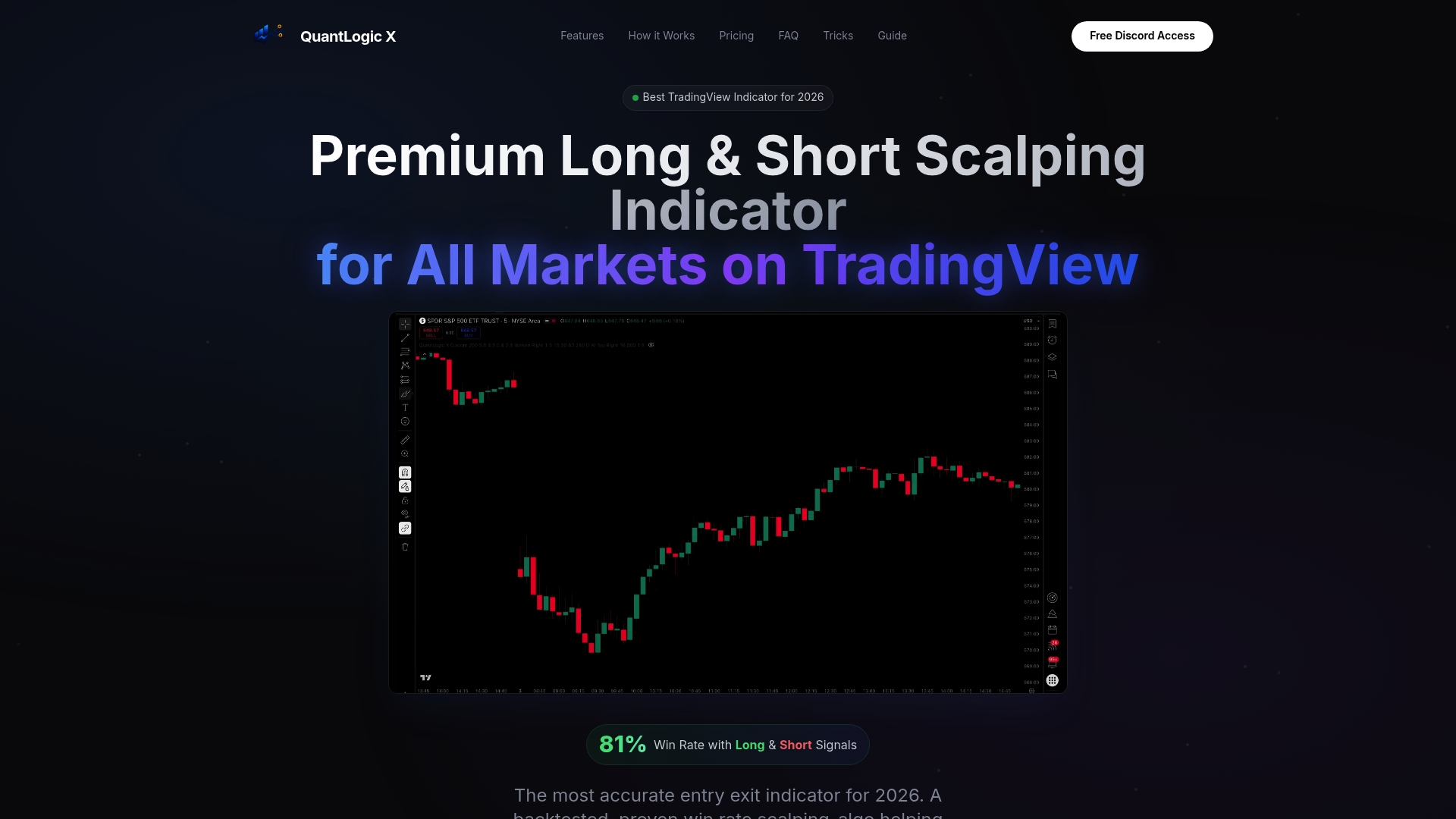
Quantlogicx integrates real-time alerts, dynamic signal grading, and a community of traders sharing setups in live market conditions. Whether you are new to scalping signal strategies or a seasoned trader who wants cleaner entries and exits without rebuilding an algorithm from scratch, this tool gives you production-grade signal logic without the engineering overhead. Explore it at Quantlogicx and put these principles to work.
FAQ
What is the scalping algorithm meaning in simple terms?
A scalping algorithm is an automated system that reads real-time market data and generates short-term buy or sell signals using a confidence score built from multiple technical and order-flow inputs. It is designed to execute many small trades in rapid succession, each targeting a modest profit.
How does a scalping algorithm work differently from a regular indicator?
A regular indicator shows one data point, like RSI or a moving average. A scalping algorithm fuses multiple indicators into a weighted confidence score and then applies quality gates, such as spread checks and latency filters, before generating a signal. The result is a filtered, high-probability entry rather than a raw crossover.
What are the main scalping signal algorithm benefits?
The core benefits are speed, consistency, and emotion removal. The algorithm processes market microstructure data faster than any manual trader and applies the same logic on every trade, eliminating hesitation and overriding emotional bias during volatile conditions.
Do scalping algorithms repaint their signals?
Some do, which makes historical results look far better than live performance. Zero-repaint systems like Quantlogicx lock signals at bar closure, meaning what you saw in the past is exactly what would have appeared in real time. Always verify repaint behavior before trusting any scalping signal tool.
What is the best way to start using scalping trading signals as a beginner?
Start by paper trading a clearly defined signal system for at least two weeks across live market sessions. Focus on learning when the quality gates reject signals and why. Once you understand the conditions the algorithm favors, size into live trades gradually based on signal confidence levels rather than trading every alert at full size.