

Beginner crypto trading entry is the process of making your first cryptocurrency trades safely and strategically using spot trading, proper position sizing, and defined risk controls. The standard industry term for this process is trade entry, and every professional trader treats it as a structured decision, not a gut feeling. This guide walks you through exchange setup and first trades using 2026 best practices, covering everything from choosing a platform like Coinbase or Binance to placing your first Bitcoin (BTC) or Ethereum (ETH) order with a stop-loss already defined. Volatility is real, custody risk is real, and the traders who survive their first year are the ones who treat process as their edge.
What does a beginner crypto trading entry guide actually cover?
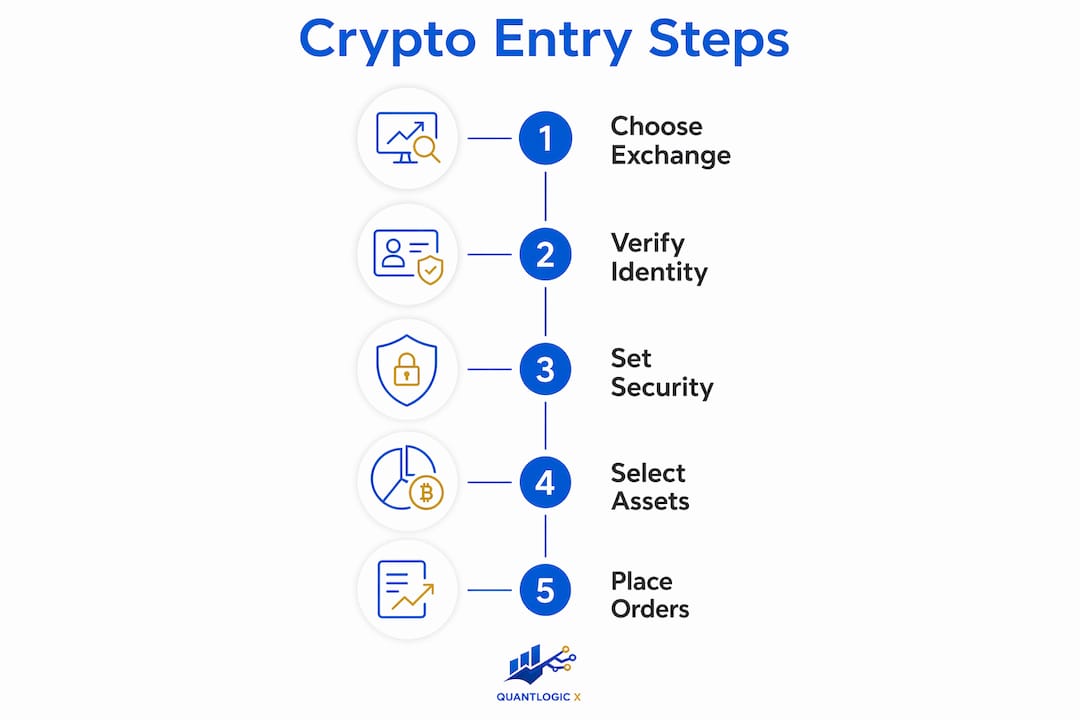
A solid entry guide covers five things: choosing a reputable exchange, completing identity verification, understanding order types, sizing positions correctly, and defining your exit before you enter. Most beginners skip steps four and five. That is why most beginners lose money in their first three months. The typical beginner workflow starts with selecting an exchange, completing KYC (Know Your Customer) verification, depositing fiat currency, and then placing small spot trades on liquid pairs like BTC/USDT or ETH/USD. Spot trading means you own the actual asset. There is no leverage, no margin call, and no liquidation risk. That simplicity is the point.
Bitcoin and Ethereum are the right starting assets because they have the deepest liquidity, the most publicly available analysis, and the lowest spread costs on most exchanges. Chasing low-cap altcoins before you understand order execution is a fast way to lose capital on volatility you cannot read yet. Start with assets you can research, on exchanges you can trust, with amounts you can afford to lose entirely.

How to choose a reputable crypto exchange and set up your account
Exchange selection is the single most consequential decision a new trader makes. The wrong platform exposes you to custody risk, poor liquidity, and opaque fees before you place a single trade. Crypto exchanges typically lack SEC broker-dealer registration, which means your funds carry less regulatory protection than a standard brokerage account. That gap matters when things go wrong.
Evaluate any exchange against these five criteria before depositing:
- Security record: Has the exchange been hacked? How did it respond? Look for proof-of-reserves audits and cold storage policies.
- Regulatory compliance: Is it registered with FinCEN, FCA, or a comparable authority in your region?
- Fee transparency: Maker and taker fees should be clearly published. Hidden withdrawal fees are a red flag.
- Usability: Coinbase suits absolute beginners with its clean interface. Binance offers more pairs and lower fees once you are comfortable. Bybit is popular for active traders who want spot and futures under one roof.
- Regional availability: Not every exchange operates in every country. Confirm availability before starting KYC.
Account creation with KYC takes 15 to 25 minutes and requires a government-issued ID and a selfie. First deposits should be modest, around $100 to $500, so you learn execution mechanics without meaningful financial exposure. Fund your account via bank transfer for the lowest fees, or use a debit card if speed matters more than cost.
Security setup is non-negotiable. Use a unique password generated by a tool like 1Password or Bitwarden. Enable two-factor authentication (2FA) using an authenticator app like Google Authenticator rather than SMS, which is vulnerable to SIM-swapping attacks. Account security practices at the infrastructure level also matter, particularly for traders managing multiple accounts or using VPNs.
Pro Tip: Never store large amounts on an exchange long-term. Move holdings above your active trading balance to a hardware wallet like a Ledger or Trezor device.
What are the trading basics every beginner needs to know?
Spot trading, order types, and pair selection are the three mechanics that determine whether your first trades go as planned or surprise you with bad fills and unexpected costs.
Spot trading means buying or selling a cryptocurrency at the current market price and taking immediate ownership of the asset. You are not borrowing funds. You are not speculating on price direction with leverage. Simple spot buys and sells are the safest starting strategy for beginners, far safer than derivatives or margin products that can liquidate your position before you even understand what happened.
The two order types you need to master first are market orders and limit orders:
| Order type | How it works | Best for beginners? |
|---|---|---|
| Market order | Executes immediately at the best available price | Useful for speed, but costs more in slippage |
| Limit order | Executes only at your specified price or better | Preferred for cost control and precision |
Limit orders are the better default for beginners. Placing a limit order slightly below the current ask price reduces slippage and gives you control over your entry cost. Market orders on low-liquidity pairs can fill at prices significantly worse than what you saw on screen.
Stick to high-liquidity pairs like BTC/USDT, ETH/USD, or ETH/USDT when starting out. These pairs have tight spreads and deep order books, which means your orders fill cleanly. Avoid complex products like futures, margin trading, and perpetual contracts for at least your first six months. Avoiding leverage until you understand liquidation risks is one of the most consistent pieces of advice across every credible 2026 trading guide.
Pro Tip: Use trading entry signals to identify specific price levels for your limit orders rather than placing trades based on general market sentiment.
How do you set position size, stop-loss, and take-profit targets?
Risk management is where most beginners fail, not because they do not know the rules, but because they misunderstand what "risk" actually means. Risk must be defined as the maximum dollar amount you lose if your stop-loss triggers, not as the total size of your position. This distinction is critical. A $1,000 position in BTC with a 10% stop-loss carries $100 of risk. That is the number you manage.
Follow this sequence before placing any trade:
- Define your entry price. Use a limit order at a specific level, not a market order at whatever price is available.
- Set your stop-loss. Place it below a logical support level on the chart, not at an arbitrary percentage. A stop at $27,800 because that is where buyers have historically stepped in is more defensible than a stop at "5% below entry."
- Calculate your position size. If you are willing to risk $50 on a trade and your stop is $200 away from your entry, your maximum position size is 0.25 BTC (or the equivalent in your pair).
- Set your take-profit target. Use a reward-to-risk ratio of at least 2:1. If your stop is $100 away from entry, your target should be at least $200 away in the profitable direction.
- Place the trade only after all three numbers are defined. Trades without a defined stop and target are guesses, not plans.
The math behind reward-to-risk ratios is counterintuitive for beginners. A 40% win rate can be profitable when you consistently capture 2:1 or 3:1 reward-to-risk ratios. You do not need to be right most of the time. You need your winners to be bigger than your losers. That realization changes how you think about trading entirely.
The disciplined execution framework of strict position sizing, stop-loss adherence, and journaling is the biggest edge available to beginners. It costs nothing and requires no special knowledge. It just requires consistency.
Understanding how stop-loss placement works in practice, including where to anchor stops relative to chart structure, is a skill worth developing before you scale position sizes.
What mistakes do beginner traders make most often?
The most damaging beginner mistakes are not technical. They are behavioral. Overleveraging, revenge trading after a loss, and ignoring stop-losses are the three patterns that wipe out new accounts fastest. Each one has a structural fix.
- Overleveraging: Using 10x or 20x leverage on a volatile asset like BTC means a 5% move against you erases your entire position. Avoid leverage entirely until you have at least six months of profitable spot trading documented in a journal.
- Revenge trading: Losing a trade and immediately placing another to "win it back" is the fastest way to turn a small loss into a large one. Set a daily loss limit, say 3% of your account, and stop trading for the day when you hit it.
- Ignoring stop-losses: Moving a stop-loss further away because you "believe in the trade" is not discipline. It is hope. A stop-loss that moves is not a stop-loss.
- Trading money you cannot afford to lose: Crypto is volatile. Treat your trading capital as money you have already mentally written off. This removes the emotional pressure that causes bad decisions.
- Skipping the journal: Every trade you do not record is a lesson you cannot learn from. Log your entry, exit, reasoning, and emotional state after every trade.
Pro Tip: Read your trading signals guide before your first live trade. Understanding what a signal means before you act on it removes one of the most common sources of beginner confusion.
A process-first mentality built around repeatable spot trades and dollar-cost averaging creates the disciplined habits that separate traders who grow from traders who quit. Patience and gradual scaling after mastering the basics is not conservative advice. It is the only advice that consistently produces long-term results.
Key takeaways
Successful beginner crypto trading entry requires a reputable exchange, spot trading discipline, predefined stop-losses, and a reward-to-risk ratio of at least 2:1 before any trade is placed.
| Point | Details |
|---|---|
| Choose a regulated exchange | Prioritize security, fee transparency, and KYC compliance before depositing any funds. |
| Start with spot trading | Own the asset directly with no leverage until you have six months of documented trades. |
| Define risk before entry | Risk means your max loss if the stop triggers, not the size of your position. |
| Use limit orders by default | Limit orders reduce slippage and give you control over your exact entry price. |
| Journal every trade | Recording entries, exits, and reasoning is the only way to identify and fix recurring mistakes. |
What I actually learned starting out in crypto
My first three months of crypto trading were a masterclass in what not to do. I traded altcoins I could not pronounce, used market orders on illiquid pairs, and moved stop-losses because I "felt" the trade would recover. I lost money I could afford to lose, which was the only lucky part of that period.
The shift came when I stopped trying to predict markets and started treating every trade as a process problem. What is my entry? What is my stop? What is my target? If I could not answer all three before placing the order, I did not place the order. That single constraint cut my losing trades by more than half within two months.
The conventional wisdom that beginners should "learn the market" before trading is backwards. You learn the market by trading it, but only if you are trading with a structure that forces you to analyze each decision. Spot trading with small positions and a journal does that. Chasing signals on Telegram does not.
The other thing nobody tells you clearly enough: your first goal is not to make money. Your first goal is to not lose money while you build the habit of disciplined execution. Profitability follows from that habit. It does not precede it. Tools that give you clear, non-repainting entry signals, like the indicators built by Quantlogicx, accelerate this learning curve because they remove ambiguity from the entry decision. You still need to manage the trade. But at least you know where you got in and why.
— Tran
Start trading with clearer entries using Quantlogicx
Timing your entries is the hardest part of crypto trading for beginners, and it is where most new traders lose confidence fastest. Quantlogicx built its TradingView indicator specifically to solve this problem. The tool delivers zero-repaint long and short signals confirmed at bar close, so you are never acting on a signal that disappears after the fact. Over 2,000 traders use the algorithm across stocks, forex, and cryptocurrency, with individual users recording gains of $8,200 in a single month. Real-time alerts and a supportive community mean you are not figuring this out alone. If you want to see how the best buy/sell indicator fits your trading setup, explore the full feature breakdown on the Quantlogicx platform.
FAQ
What is spot trading in crypto?
Spot trading means buying or selling a cryptocurrency at the current market price and taking immediate ownership of the asset. There is no leverage involved, making it the safest starting method for beginners.
How much money do I need to start crypto trading?
Most exchanges allow you to start with as little as $10, but a practical starting range is $100 to $500. This amount is large enough to practice real execution mechanics without exposing you to significant financial loss.
What is a good reward-to-risk ratio for beginners?
A 2:1 reward-to-risk ratio means your profit target is twice the distance of your stop-loss from your entry. Even a 40% win rate is profitable at this ratio, which makes it the standard starting benchmark for new traders.
Should beginners use leverage in crypto trading?
No. Avoid leverage for at least your first six months of trading. Leverage amplifies both gains and losses, and a single bad trade can liquidate your entire position before you have time to react.
How do I know if a crypto exchange is safe?
Look for regulatory registration, a published proof-of-reserves audit, cold storage policies, and a clean security history. Exchanges that lack SEC broker-dealer registration carry less investor protection than traditional brokerage accounts, so custody risk is a real factor to evaluate.