
Most traders assume scalping and swing trading are just two speeds of the same thing. They are not. Understanding how scalping signals differ from swing trading goes far deeper than holding time. The signal sources are different, the technical tools are different, and the psychological demands are so distinct that a habit built for one style will actively sabotage the other. Whether you are trying to decide which approach fits your life or you want to sharpen how you read and act on signals, this guide cuts through the confusion and gives you a clear framework for both.
Table of Contents
- Key Takeaways
- How scalping signals differ from swing trading at the source
- Trade frequency, decision load, and your wallet
- Risk management and signal invalidation
- Choosing the right signal style for your trading profile
- My honest take on which style actually builds better traders
- See your signals clearly with Quantlogicx
- FAQ
Key Takeaways
| Point | Details |
|---|---|
| Signal sources are fundamentally different | Scalping reads order flow and Level 2 data; swing trading reads chart structure on higher timeframes. |
| Time invalidation rules matter | Scalp signals unresolved within about 30 seconds should be exited flat; swing signals are judged over days. |
| Transaction costs hit scalpers hard | Trading 40 times a day can erase most of your gross profit through commissions and slippage alone. |
| Stop logic cannot be shared | Using swing-style wide stops on a scalp trade, or tight scalp stops on a swing position, breaks both strategies. |
| Trader profile drives the choice | Your available time, risk tolerance, and psychological wiring determine which signal style you can execute consistently. |
How scalping signals differ from swing trading at the source
The most misunderstood aspect of scalping vs swing trading is not frequency. It is where the signals come from. These two styles read completely different data, and that distinction shapes everything downstream.
Scalping signals are built on market microstructure. Specifically, tape reading and order flow form the foundation of scalping rather than chart patterns or indicators. A scalper watches Level 2 data (the live order book showing bids and asks at every price level) and Time & Sales (the real-time print of executed trades) to identify short-term imbalances. Order book liquidity walls act as primary entry and exit signals. A large static bid wall suggests institutional support. When that wall suddenly vanishes, it can signal a trap or a breakout, depending on context.

Swing trading signals come from an entirely different layer of the market. A swing trader is not watching individual prints. They are assessing chart structure on the 4-hour or daily timeframe, looking for pattern completions, moving average crossovers, or momentum divergences. Swing setups use ATR-based stops sized at roughly 1.5 to 2 times the 14-period ATR on the 4-hour chart to account for normal price noise without getting stopped out prematurely.
Here is what that looks like practically:
- Scalp signal: Bid wall at $185.00 absorbs selling for 45 seconds, Time & Sales shows large buy prints stacking, DOM imbalance shifts long. Entry at $185.05, target $185.30.
- Swing signal: Price pulls back to the 21-day moving average after a trending week, RSI reaches oversold on the 4H chart, ATR is 1.2 points. Stop placed at 2.4 points below entry, target at prior swing high.
Those two signals share almost no common DNA. One is a real-time execution decision measured in seconds. The other is a multi-day thesis with a quantified volatility framework.
Pro Tip: If you cannot describe your signal source in under 10 words without mentioning a chart, you are probably not scalping. Real scalping signals come from the order book, not the candlestick.
You can explore the full breakdown of signal checklists for short-term trading in this 2026 day trader guide for a structured look at what inputs actually matter.
Trade frequency, decision load, and your wallet
The operational difference between these two styles is stark once you put real numbers on it.
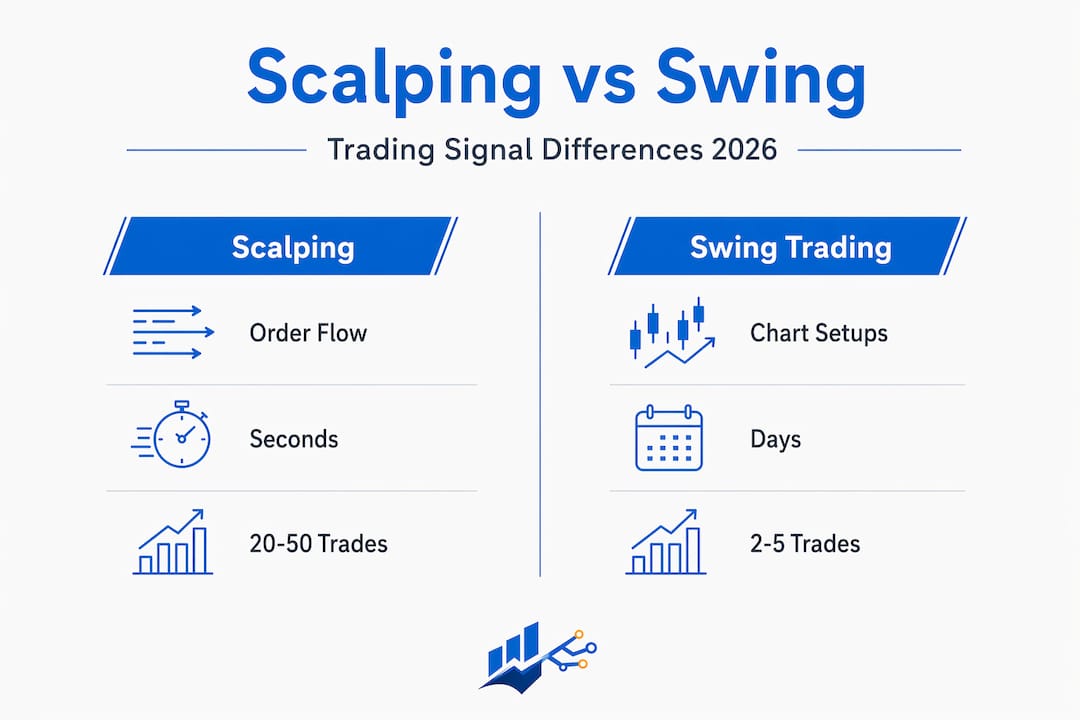
Scalping means high-frequency, relentless focus. A serious scalper might take 20 to 50 trades in a single session, each requiring a fast entry decision, active management, and a clean exit. There is no room for hesitation because your edge exists only in that narrow window of order-flow imbalance. The psychological cost for scalpers is the relentless mental energy spent on rapid-fire decisions, while swing traders must endure prolonged uncertainty with fewer decisions.
Swing trading is almost the opposite experience. You might take two to five trades per week. Each decision carries more weight, but you also have time to analyze, confirm, and size your position deliberately. The challenge shifts from execution speed to emotional endurance. Can you hold a position through a two-day pullback when the weekly thesis remains intact?
The transaction cost gap between these styles is severe and underappreciated:
- Commission drag on scalping: A trader running 40 trades daily could realistically gain about 10 points gross but lose 3 to 4 points to costs after commissions and slippage. That is a 30 to 40% haircut on gross profit before you account for losing trades.
- Slippage compounds in fast markets: Scalpers often trade during volatile conditions specifically to find imbalances. Those same conditions widen spreads and increase slippage, which compounds the cost problem.
- Swing trading's cost efficiency: A swing trader taking five trades per week with larger position size per trade pays far less in relative transaction costs because the profit target per trade is measured in multiples of ATR, not ticks.
- Capital requirements differ: Scalping typically requires direct-access platforms, tight spreads, and often more starting capital to absorb the transaction cost reality while remaining profitable.
Your lifestyle also matters here. Scalping demands that you are present, screen-focused, and mentally sharp for every hour of your trading session. Swing trading is compatible with a day job or other commitments because your signals develop over days and your position management does not require second-by-second attention.
Risk management and signal invalidation
This is where mixing strategies causes the most damage, and where most intermediate traders make their costliest mistakes.
Scalping uses time as the primary invalidation trigger. Scalp setups not resolved within 30 seconds should be exited flat by professional traders. The logic is sound: if an order-flow imbalance does not convert into price movement quickly, the imbalance has been absorbed or was fake to begin with. Sitting in that trade is no longer scalping. It is hoping, and hope is not a trading signal.
Key contrasts in stop and invalidation logic:
- Scalping stops: Tight, often just a few ticks beyond the entry level. Sized to the specific order-flow structure that created the signal.
- Swing stops: Wider stops based on ATR multiples reflect the natural volatility over multi-day holding periods. Stops placed too tight on swing trades cause constant premature exits.
- Scalping invalidation: Time-based first, price-based second. If the trade is not working within the expected window, get out regardless of where price is.
- Swing invalidation: Price-based and structure-based. A swing trade is invalidated when price closes beyond a key level that breaks the thesis, often assessed at the end of the daily or 4-hour candle.
The most damaging habit a trader can develop is holding scalp trades beyond their natural resolution window, which effectively converts them into swing trades with incompatible risk and sizing frameworks. A scalp position sized for a 10-tick stop cannot safely hold through a multi-day swing that may draw down 80 ticks against you before resolving.
Pro Tip: Label every trade before entry as either a scalp or a swing position, and write down the specific invalidation trigger. If the trade type changes after entry, close it and re-evaluate with the correct framework.
Choosing the right signal style for your trading profile
Understanding the technical differences only gets you halfway there. The other half is honest self-assessment.
| Factor | Scalping | Swing trading |
|---|---|---|
| Time required | 4 to 8 hours of focused screen time daily | 30 to 60 minutes of analysis per day |
| Decision speed | Seconds to minutes | Hours to days |
| Psychological demand | Rapid-fire emotional control and execution | Patience and confidence in the framework |
| Transaction cost sensitivity | Very high; costs can consume most of gross profit | Moderate; fewer trades, larger profit targets |
| Best market conditions | High volume, tight spreads, active sessions | Trending or range-bound markets with clear structure |
| Skill development focus | Execution speed, order-flow reading, discipline | Technical analysis, volatility assessment, position sizing |
Some traders run both approaches, but only by treating them as completely separate systems. Scalping in the first two hours of a session when volume is highest, then switching to monitoring swing positions for the rest of the day, works well for traders with the capacity to mentally compartmentalize. The non-negotiable rule is to never mix capital or signal frameworks between the two styles. Separate accounts, separate watchlists, and separate decision rules.
If you are new to reading entry signals across different timeframes, start with this trading entry signal guide before layering in style-specific techniques. Getting the foundation right accelerates everything else.
My honest take on which style actually builds better traders
I have watched traders rush into scalping because it looks exciting. The fast feedback, the constant action, the idea that you can grind out profits every single day. What they discover is that scalping is a game of execution and order-flow confirmation, not prediction. You are not deciding where the market is going. You are deciding whether a specific imbalance will resolve in your favor within a tight time window. That is a different cognitive skill entirely, and most traders are not wired for it out of the box.
Swing trading, in my view, builds more transferable skills. The process of reading volatility regimes, sizing stops to market conditions, and holding through normal noise without panic forces you to develop a real understanding of price behavior. Those skills compound over time.
That said, I have seen scalpers who are genuinely elite at what they do. They treat every signal with almost mechanical detachment. They exit when the signal says exit, not when their ego says wait. The discipline gap between a profitable scalper and a losing one is enormous, far bigger than in swing trading, because the feedback loop is so fast and unforgiving.
My honest advice: start with swing trading to build your analytical foundation. Then, if the idea of reading order flow genuinely fascinates you rather than intimidates you, add scalping as a secondary skill. Never lead with scalping because you think it is faster to profit. It is usually faster to lose.
— Tran
See your signals clearly with Quantlogicx
Understanding signal differences on paper is one thing. Acting on them in real time is another.
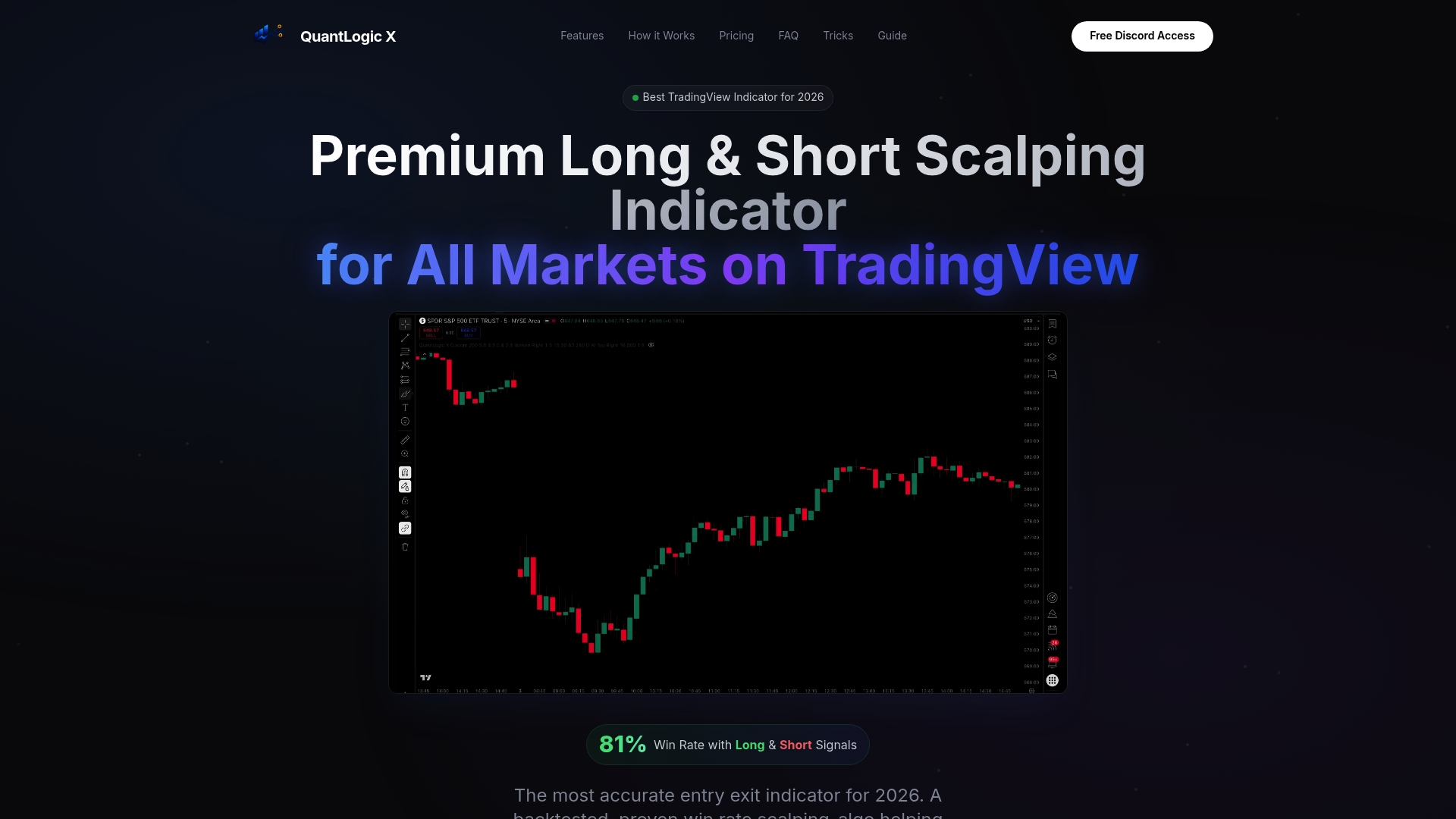
Quantlogicx was built specifically for traders who need signal clarity without ambiguity. The TradingView indicator uses zero-repaint technology, which means every long and short signal you see at bar close is the actual signal, not a retroactive repainting that looks good in hindsight. Over 2,000 traders across stocks, forex, and crypto use it to generate consistent entries, with individual users recording gains of $8,200 in a single month. Whether you are applying scalping-focused signals on short timeframes or confirming swing setups on the 4-hour chart, Quantlogicx adapts to your style. The Forex signal indicator is particularly well-suited for traders running both approaches across currency pairs.
FAQ
What makes scalping signals different from swing signals?
Scalping signals come from real-time order flow, Level 2 data, and Time & Sales, while swing signals derive from chart structure and volatility indicators on higher timeframes like the 4-hour or daily chart. The two signal types require different tools, different stops, and different decision speeds.
How many trades do scalpers take compared to swing traders?
Scalpers typically take 20 to 50 trades per day, while swing traders average 2 to 5 trades per week. The higher frequency in scalping also means significantly higher transaction costs that can erode gross profits by 30 to 40%.
Can you use scalping and swing trading together?
Yes, but only by treating them as completely separate systems with separate capital and signal rules. Mixing the two frameworks, particularly the stop logic and invalidation triggers, is a common cause of discipline failures and significant losses.
How long should a scalp trade last before you exit?
Professional scalpers exit positions that do not resolve within approximately 30 seconds, treating an unresolved setup as an invalidated signal. Holding beyond that window converts the scalp into a different trade type with incompatible risk parameters.
What is the biggest psychological difference between the two styles?
Scalping demands rapid emotional control under constant pressure with frequent small losses. Swing trading requires patience and confidence to hold positions through normal price noise over days, where each individual decision carries more consequence.