

A day trading session is defined as the scheduled time window during which traders open and close all positions within the same trading day, capturing short-term price movements without holding overnight risk. Unlike swing trading or long-term investing, the definition of day trading centers on this single constraint: every trade must start and finish within one session. Understanding the structure of that session, its hours, its phases, and the rules that govern it, is the difference between trading with a plan and trading on impulse.
What is a day trading session and how does it work?
A day trading session is the structured time block that defines when a trader can legally and practically execute intraday trades on a given market. The term "trading session" is the standard industry phrase; "day trading session" simply specifies that all positions open and close within that same block. Professional traders treat the session as a decision framework, not just a clock. Structured session windows map liquidity and volatility shifts so traders avoid random risk-taking and improve execution quality.
The session creates a hard boundary that forces discipline. When the closing bell rings, every open position must be resolved. That constraint eliminates the uncertainty of overnight news, earnings releases, and gap risk that can wipe out gains accumulated during the day. For beginners, this boundary is actually an advantage. It forces you to define your entry, your target, and your exit before the trade even opens.

What are the typical hours of a day trading session in major markets?
Day trading hours vary by market, but the U.S. equity market sets the global standard most beginners encounter first.
| Market | Regular Session Hours | Extended Hours |
|---|---|---|
| U.S. Equities (NYSE, Nasdaq) | 9:30 AM to 4:00 PM ET | Pre-market: 4:00 AM to 9:30 AM ET; After-hours: 4:00 PM to 8:00 PM ET |
| Forex (North American) | 8:00 AM to 5:00 PM ET | 24-hour market; no hard close |
| Forex (European) | 3:00 AM to 12:00 PM ET | Overlaps with Asian and North American sessions |
| Forex (Asian) | 7:00 PM to 4:00 AM ET | Lowest liquidity of the three major sessions |
The regular U.S. session runs from 9:30 AM to 4:00 PM ET and accounts for 85% to 90% of total daily volume. That concentration of volume matters because high volume produces tighter spreads, faster fills, and more reliable price signals. Thin markets do the opposite.
Pre-market trading runs from 4:00 AM to 9:30 AM ET, but most retail traders focus on the 7:00 AM to 9:30 AM window for research and preparation. Pre-market reflects overnight news and shapes the opening auction price, but volume is low and spreads are wide. Treat it as an intelligence-gathering period, not a primary trading window.
Key characteristics of each session type:
- U.S. equities regular session: Highest volume, tightest spreads, most predictable price behavior
- Pre-market and after-hours: Lower liquidity, wider spreads, higher slippage risk
- Forex sessions: The global forex market exceeds $9 trillion in daily turnover, with peak liquidity occurring during session overlaps, particularly the London and New York overlap from 8:00 AM to 12:00 PM ET
What rules and regulations govern day trading sessions?
The most consequential rule for U.S. equity day traders is the Pattern Day Trader rule, enforced by FINRA. The PDT rule requires $25,000 in equity within a margin account before a trader can execute more than three day trades within any five-business-day rolling window. Breach that limit without the required equity and your broker restricts your account to closing trades only for 90 days.
This rule shapes session strategy directly. Traders under the $25,000 threshold must be selective. Three trades per five days forces prioritization. You stop chasing every setup and start waiting for high-conviction ones. That constraint, frustrating as it feels initially, builds the habit of patience that separates profitable traders from impulsive ones.
Additional regulatory and broker-level constraints include:
- Margin account requirements: Day trading requires a margin account. Cash accounts do not permit same-day reuse of settled funds, which limits intraday flexibility.
- Broker-specific session rules: Some brokers restrict certain order types during pre-market and after-hours sessions, including limit-only orders and no market orders.
- Leverage limits: Margin accounts for day trading typically allow up to 4:1 intraday leverage, which amplifies both gains and losses proportionally.
Pro Tip: If you are under the $25,000 PDT threshold, consider trading forex or futures instead. Both markets operate outside FINRA's PDT rule and offer legitimate intraday trading without the equity restriction.
What are the different phases within a day trading session?
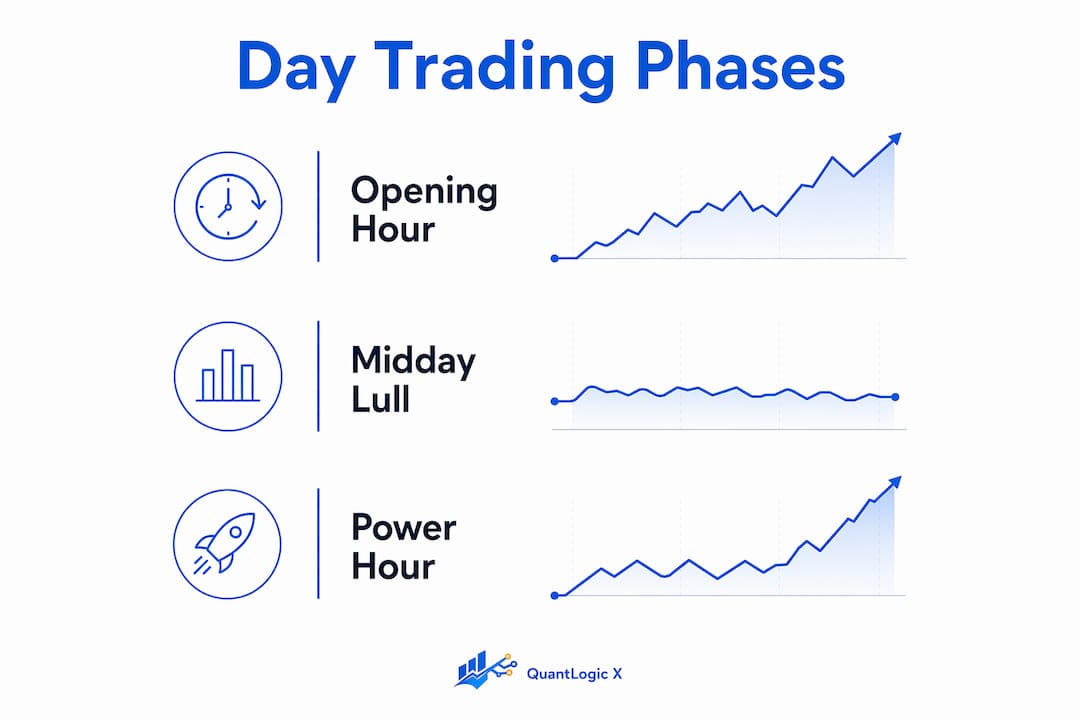
A single U.S. equity session is not uniform from open to close. It breaks into three distinct phases, each with its own volume profile, volatility character, and opportunity set.
The opening hour (9:30 AM to 10:30 AM ET)
The first 60 minutes of the session carry the highest volume and the most aggressive price movement. Overnight news, earnings reports, and pre-market positioning all resolve at the open. Opening hour volatility produces the largest intraday price swings, which creates both the biggest opportunities and the fastest losses. Experienced traders prepare specific watchlists before 9:30 AM and execute only pre-planned setups during this window.
The midday lull (12:00 PM to 2:00 PM ET)
Volume drops sharply after the morning rush. Many professional traders step away from screens between 12:00 PM and 2:00 PM ET because price action becomes choppy, low-conviction, and prone to false signals. Spreads widen slightly and moves lack follow-through. Forcing trades during this window is one of the most common beginner mistakes.
The closing hour or "power hour" (3:00 PM to 4:00 PM ET)
Volume surges again as institutional traders rebalance portfolios, mutual funds execute end-of-day orders, and algorithmic systems close positions. This creates directional moves with real conviction behind them. The closing hour is the second-best trading window of the session, but it requires awareness of the hard 4:00 PM deadline.
Pro Tip: Set a calendar alert for 3:45 PM ET every trading day. That 15-minute buffer gives you time to close any remaining positions cleanly before the session ends, without rushing into a bad fill.
How do traders effectively manage their positions during a day trading session?
Position management within a session is where strategy meets execution. The goal is simple: capture the move you planned for, limit the damage when you are wrong, and never let a trade outlive its session.
-
Close all positions before market close. Holding overnight exposes you to gap risk from after-hours news. Hard stops before session end are the most reliable way to eliminate overnight exposure. Many traders automate this with broker alerts or platform rules that trigger at 3:50 PM ET.
-
Use time-in-force order types. DAY orders automatically cancel at session close if unfilled. Immediate-or-Cancel (IOC) orders fill what they can and cancel the rest instantly. DAY and IOC order types prevent order backlog and keep your execution aligned with session boundaries.
-
Set a daily loss limit before you open your first trade. A defined daily loss limit of 2% to 3% of capital per session stops a bad morning from becoming a catastrophic day. Session-specific loss limits combined with a maximum trade count prevent emotional decision-making when the market moves against you.
-
Define a maximum trade count. Overtrading is the most common session discipline failure. Setting a hard cap, such as five trades per session, forces selectivity and reduces transaction costs.
-
Review your daily trading routine before the open. Pre-session preparation, including reviewing key levels, news catalysts, and your watchlist, reduces reactive decisions during the session itself.
Pro Tip: Use a physical or digital trading journal to log every session. Record entry time, exit time, setup type, and outcome. Patterns in your losses reveal which session phases or setups you should stop trading entirely.
How do different markets compare for day trading sessions?
Stocks and forex represent the two most common markets for new day traders, and their session structures are fundamentally different.
| Factor | U.S. Equities | Forex |
|---|---|---|
| Session hours | 9:30 AM to 4:00 PM ET (6.5 hours) | 24 hours, 5 days a week |
| Peak liquidity window | 9:30 AM to 11:00 AM ET | London/New York overlap (8:00 AM to 12:00 PM ET) |
| PDT rule applies | Yes (FINRA regulated) | No |
| Typical spread | Narrow during regular session | Varies; tightest during session overlaps |
| Overnight risk | Eliminated by session close | Requires manual position management |
Forex's 24-hour structure means there is no single hard close. That flexibility is both an advantage and a trap. Without a defined session boundary, traders can rationalize holding losing positions indefinitely. Successful forex day traders impose their own session boundaries, treating the London or New York session as their personal trading window and refusing to trade outside it.
The forex market's $9 trillion daily turnover concentrates during session overlaps. Trading EUR/USD during the London and New York overlap produces tighter spreads and more reliable technical signals than trading the same pair during the Asian session. Market selection and session timing work together. Choosing the right instrument for the right session window is as important as the trade setup itself.
Scalping signal algorithms are particularly effective during high-liquidity session windows because the volume supports faster fills and tighter execution. Low-volume periods punish scalpers with slippage and false breakouts.
Key takeaways
A day trading session is the defined time window that governs every intraday trade, and mastering its structure, phases, and rules is the foundation of consistent profitability.
| Point | Details |
|---|---|
| Session definition | A day trading session is the scheduled window where all trades open and close within the same day. |
| U.S. equity hours | The regular session runs 9:30 AM to 4:00 PM ET and accounts for 85% to 90% of daily volume. |
| PDT rule impact | Traders under $25,000 equity are limited to three day trades per five business days in U.S. equities. |
| Session phases | The opening and closing hours carry the highest volume; the midday lull from 12:00 PM to 2:00 PM ET is best avoided. |
| Risk management | Daily loss limits, DAY order types, and closing all positions before session end protect capital and eliminate overnight risk. |
Why session structure is the skill most beginners skip
I have watched hundreds of new traders blow up accounts not because they picked bad stocks, but because they had no relationship with time. They traded at 1:30 PM ET on a Tuesday when volume was dead and spreads were wide, then wondered why their technically perfect setup produced a choppy, inconclusive result. The market was not broken. They were trading outside the session's productive window.
The uncomfortable truth about day trading explained properly is that timing within the session matters as much as the trade itself. A great setup at 10:00 AM ET behaves completely differently than the same setup at 1:00 PM ET. Volume is the engine. Without it, price moves are noise.
What I have found works is treating the session like a shift, not an open invitation. You show up at 9:15 AM, review your plan, trade the open if a setup appears, step away from 12:00 PM to 2:00 PM, and re-engage for the close. That structure alone eliminates a significant portion of losing trades because you are no longer trading in conditions that statistically favor failure. Retail CFD clients lose money at rates between 74% and 89%, and a large portion of those losses come from trading at the wrong time, not from picking the wrong direction.
Discipline around session timing is not a soft skill. It is a hard edge.
— Tran
How Quantlogicx helps you trade smarter within every session
Knowing when to trade is half the battle. Knowing exactly when to enter and exit is the other half.
Quantlogicx built its TradingView indicator specifically for traders who want precise, session-aligned signals without second-guessing every candle. The algorithm delivers long and short signals with zero repaint technology, meaning every signal is locked at bar close and never changes retroactively. Over 2,000 traders use it across stocks, forex, and crypto, with individual users recording gains of $8,200 within a single month. Whether you trade the opening hour or the power hour, the best buy-sell indicator gives you a clear signal framework that respects session timing and keeps your risk controls intact.
FAQ
What is a day trading session in simple terms?
A day trading session is the defined time window during which a trader opens and closes all positions within the same trading day. The U.S. equity regular session runs from 9:30 AM to 4:00 PM ET.
How long is a trading session for U.S. stocks?
The standard U.S. stock market session lasts 6.5 hours, from 9:30 AM to 4:00 PM ET Monday through Friday. Pre-market and after-hours sessions extend trading but carry lower volume and wider spreads.
What is the Pattern Day Trader rule and how does it affect my session?
The PDT rule requires a minimum of $25,000 in equity to execute more than three day trades within five business days in a U.S. margin account. Traders below this threshold must limit their intraday activity or trade in markets like forex or futures where the rule does not apply.
What happens during the midday lull in a trading session?
Volume drops significantly between 12:00 PM and 2:00 PM ET, producing choppy, low-conviction price action. Most professional day traders avoid executing new trades during this window to reduce exposure to false signals.
What order types should I use to manage trades within a session?
DAY orders cancel automatically at session close if unfilled, and IOC orders fill immediately or cancel the remainder. Both order types keep your execution aligned with session boundaries and prevent unintended overnight positions.