
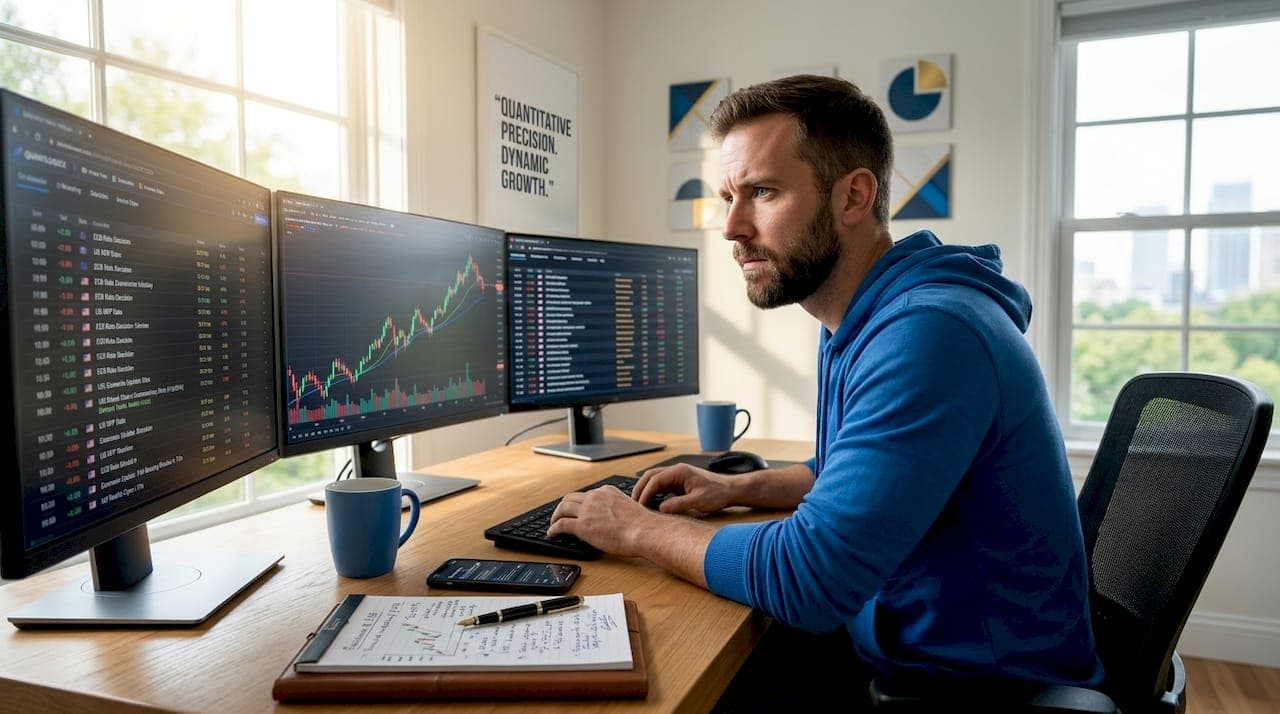
A structured day trading routine is defined as a repeatable three-phase sequence of pre-market preparation, disciplined session execution, and post-session review that builds consistency and removes reactive decision-making from your trading day. Most traders who struggle with impulsivity or inconsistent results lack a documented routine, not a better strategy. According to Topstep, trading starts long before any order is placed, and a consistent morning routine clears the head and sets a positive trading pace. Day trading routine best practices give you a repeatable framework so your results depend on process, not mood.
1. Day trading routine best practices start with a pre-market checklist
The pre-market phase is the highest-leverage 10 to 30 minutes of your trading day. Traders who build their opportunity pipeline before the market opens execute from a plan rather than reacting in-session, which directly improves consistency. Reacting to price without prior context is the single most common cause of impulsive entries.
A tight pre-market checklist covers five areas: economic calendar review, key level marking, open position check, daily goal setting, and risk limit definition. Tools like ForexFactory and Investing.com display scheduled news events so you know which sessions carry elevated volatility. A 10-minute pre-market checklist allocates roughly two minutes per section, keeping the process fast and repeatable without cutting corners.
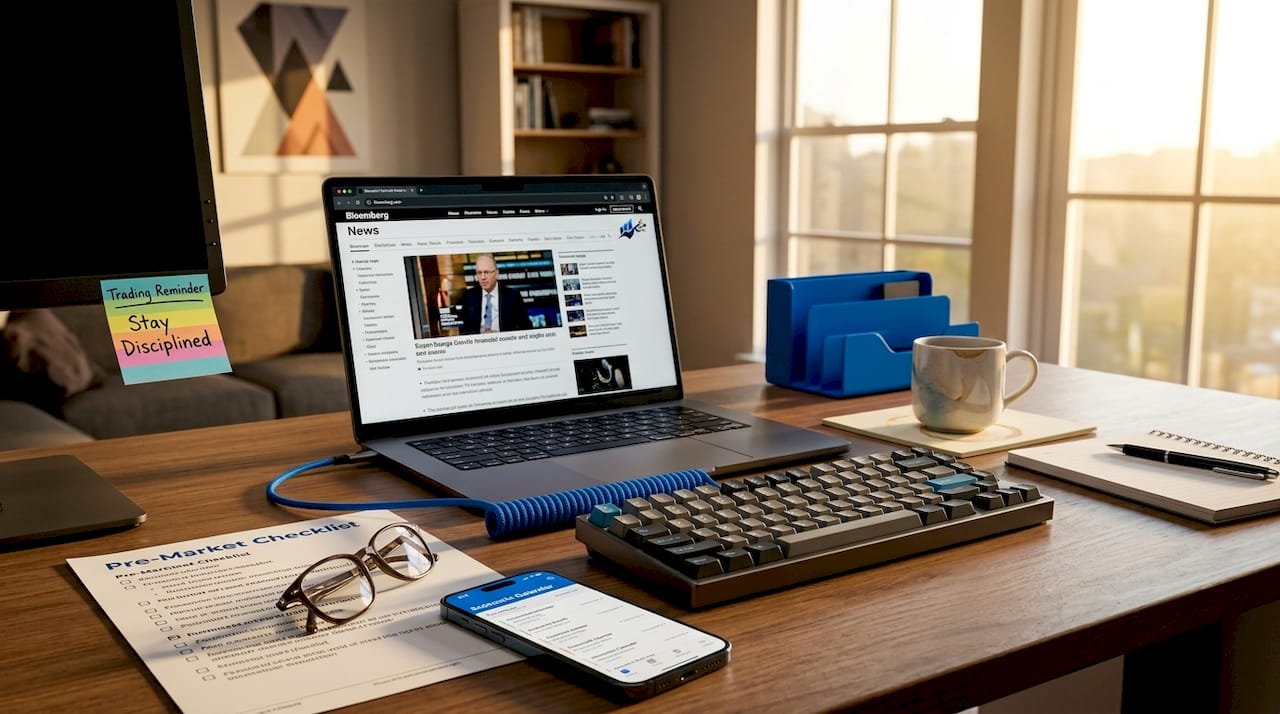
Start 30 to 45 minutes before market open. Mark your support and resistance levels on the chart the night before if possible, so the morning session is confirmation rather than construction. This habit alone reduces the number of decisions you make under pressure.
Pro Tip: Set price alerts at your key levels using TradingView or your broker platform before the session begins. This lets you step away from the screen and return only when price reaches a level worth watching, which cuts impulsive trades caused by staring at charts.
2. Conduct a mental state check before every session
Mental readiness is not a soft concept. A 5 to 10 minute pre-trade routine designed to reach a neutral mental state reduces anxiety and impulsive trades by cultivating a focused, calm zone before the first candle prints. Entering the session frustrated, distracted, or overconfident produces the same result as trading without a plan.
Rate your mental state on a simple 1 to 10 scale before each session. If you score below a 6, reduce your position size by half or skip the session entirely. This rule sounds extreme until you track how many of your worst trading days followed poor mental state scores. The data almost always confirms the pattern.
Techniques that work include five minutes of box breathing, a brief review of your trading plan, and writing down one specific goal for the session. The goal should be process-based, not profit-based. "Execute only A-grade setups" beats "make $500 today" as a session objective every time.
3. Use a 30-second trade checklist before every entry
Execution discipline separates profitable traders from breakeven traders. Before entering any trade, run through a six-point checklist covering setup validity, stop loss placement, position size, risk-to-reward ratio, news impact, and current emotional state. This takes 30 seconds and prevents the majority of low-quality entries.
Here is a practical version of that checklist:
- Does this setup match my documented trading plan criteria?
- Where is my stop loss, and is it at a logical level?
- What is my position size based on my risk rules?
- Is the risk-to-reward ratio at least 1:2?
- Are there any scheduled news events in the next 30 minutes?
- Am I calm and focused right now?
If you answer no to any of these, you skip the trade. No exceptions. Investopedia recommends limiting risk per trade to 1 to 2% of capital and setting a daily loss limit of approximately 3%. Once that daily limit is hit, the session ends. This rule preserves capital on bad days and prevents the spiral of revenge trading.
Pro Tip: Observe the first 15 minutes after market open without placing any trades. This observe-only period lets you read the session's character before committing capital, and it eliminates the impulsive early trades that often produce the day's worst results.
4. Cap your daily trade count to prevent overtrading
Overtrading is the most common way disciplined traders destroy their own routines. A documented example routine caps sessions at three to four trades maximum, with roughly two hours of active trading time. More trades do not mean more profit. They mean more commissions, more emotional decisions, and more exposure to low-probability setups.
Set your trade cap at the start of each session and write it down. When you hit the cap, close your platform or switch to read-only mode. The psychological pressure to "make back" a loss or "ride a hot streak" is exactly when the cap matters most. Traders who remove the option to overtrade by enforcing a hard cap report significantly fewer revenge trades and more consistent weekly results.
Pair your trade cap with a daily loss limit. If you lose 3% of your account in a session, the day is over regardless of how many trades you have taken. These two rules together form the core of loss prevention in any effective daily trading checklist.
5. Manage your emotional state during the session
Emotional management during live trading is an active practice, not a passive one. Check in with your mental state every 30 to 45 minutes during the session. If you notice frustration after a stop-out, anxiety about an open position, or excitement after a win, those are signals to pause before the next trade.
The most dangerous emotional state for a trader is not fear. It is overconfidence after a winning streak. Winning two or three trades in a row creates a false sense of certainty that leads to oversized positions or skipped checklist steps. Treat every trade as independent from the last, regardless of recent results.
A simple rule: if you feel the urge to break any rule in your trading plan, stop trading for 10 minutes. Write down what you are feeling and why. This brief pause interrupts the emotional feedback loop and returns you to a process-focused mindset. How to stay disciplined in trading comes down to building these interruption habits before you need them.
6. Conduct a post-session review within one hour
The post-session review is where real learning happens, and timing matters. Reviewing trades within one hour of your last trade captures the emotional and contextual details that fade quickly. Waiting until the next morning means you lose the nuance of why you made each decision, which is exactly the information you need to improve.
Your post-session review should cover four activities:
- Trade log: Record entry, exit, size, result, and setup type for every trade.
- Grade each trade: Score based on plan adherence, not profit or loss. A losing trade that followed your rules is a good trade. A winning trade that broke your rules is a bad trade.
- Lessons learned: Write one sentence about what you would do differently.
- Stats update: Track your discipline score, win rate, and average risk-to-reward over time.
The discipline score is calculated by dividing the number of rule-compliant trades by total trades taken, then multiplying by 100. A score of 80% or above means your process is sound. Below 70% signals a breakdown in routine adherence that needs attention before the next session.
| Review activity | Recommended time |
|---|---|
| Trade log entry | 5 minutes |
| Trade grading | 5 minutes |
| Lessons written | 3 minutes |
| Stats update | 2 minutes |
Weekly reviews go deeper. Once per week, look at your discipline score trend, identify your most common rule violations, and adjust your checklist if needed. Daily reviews build awareness. Weekly reviews build strategy.
7. Adapt your routine to the 2026 regulatory environment
The SEC's April 2026 amendment to FINRA Rule 4210 replaced day-trading-specific margin rules with a continuous intraday margin deficit monitoring standard. Brokerages must now monitor leverage exposure in real time and can block trades or issue margin calls mid-session if deficits exist. This change makes real-time risk monitoring a mandatory part of every trader's session routine, not an optional add-on.
Practical steps to stay compliant under the new standard:
- Check your available margin before the session opens, not just your account balance.
- Set position size limits that keep you well below your broker's intraday margin threshold.
- Use your broker's real-time margin display as a live risk gauge during the session.
- If your broker issues a margin warning mid-session, reduce exposure immediately rather than waiting for a forced liquidation.
The 2026 regulatory emphasis on continuous intraday monitoring means that traders who already practice disciplined position sizing and daily loss limits are naturally compliant. The rule change punishes traders who rely on maximum leverage without real-time awareness. Build margin checks into your pre-market and mid-session routine now.
8. Use technology to reinforce every phase of your routine
Technology does not replace discipline, but it enforces it when your willpower runs low. TradingView indicators, automated alerts, and position sizing calculators each remove a manual step from your routine and reduce the chance of skipping a critical check. Using price alerts at key levels enables stepping away from the screen and reduces continuous monitoring fatigue, which is one of the main reasons traders abandon their routines over time.
For the pre-market phase, ForexFactory and Investing.com handle economic calendar tracking. For execution, a scalping signal checklist integrated with your TradingView setup confirms entry criteria before you place an order. For post-session review, journaling tools like Edgewonk or TraderSync log trades automatically from your broker feed, cutting manual entry time to under two minutes.
Quantlogicx offers a TradingView indicator built specifically for traders who want signal confirmation without repaint. The tool's zero-repaint technology means the long and short signals you see at bar closure are the signals that actually fired, which makes post-session review accurate and trustworthy. Over 2,000 traders use the Quantlogicx algorithm across stocks, forex, and cryptocurrency to enforce entry discipline as part of their daily routine.
Pro Tip: Integrate an economic calendar app with push notifications and a mental state self-check tracker into your morning routine. These two tools cover the two most commonly skipped steps in a pre-market checklist: news awareness and emotional readiness.
Key takeaways
A profitable day trading routine requires pre-market preparation, rule-based execution, and same-day review working together as a single repeatable system.
| Point | Details |
|---|---|
| Pre-market checklist | Complete economic calendar, key levels, and mental state check 30 to 45 minutes before open. |
| Trade entry rules | Run a 30-second checklist and risk no more than 1 to 2% per trade before every entry. |
| Overtrading prevention | Cap sessions at three to four trades and stop trading when the daily loss limit is reached. |
| Post-session review | Log, grade, and review every trade within one hour to capture emotional context while it is fresh. |
| 2026 compliance | Monitor intraday margin deficits in real time per the updated FINRA Rule 4210 standard. |
Why I think most traders skip the one step that matters most
I have worked with hundreds of traders across stocks, forex, and crypto, and the pattern is almost universal. Traders invest hours building entry strategies and almost no time on post-session review. They treat the review as optional, something to do when they have extra time. They almost never have extra time.
The post-session review is the only phase of the routine that creates compounding improvement. Pre-market prep and execution discipline keep you from losing money. The review is what makes you better. Skipping it means you repeat the same mistakes across hundreds of sessions and wonder why your results plateau.
When I started treating the review as non-negotiable, my discipline score went from around 65% to above 85% within six weeks. Not because I found better setups. Because I finally understood which of my own behaviors were costing me money. The data was always there. I just was not looking at it.
The other thing I would push back on is the idea that a good routine needs to be long. The most effective daily trading checklist I have ever used takes 38 minutes total across all three phases. Simplicity is what makes it stick. If your routine feels like a burden, you will abandon it on the first bad day. Start with five items per phase and add only when a gap in your performance demands it.
No-trade days are also part of the routine. If your mental state score is below a 6, or if the market has no clean setups by mid-morning, closing the platform and calling it a day is the correct decision. The best traders I know treat a well-executed no-trade day as a win.
— Tran
How Quantlogicx supports your trading routine
Quantlogicx builds tools that fit directly into the execution and review phases of a structured trading routine.
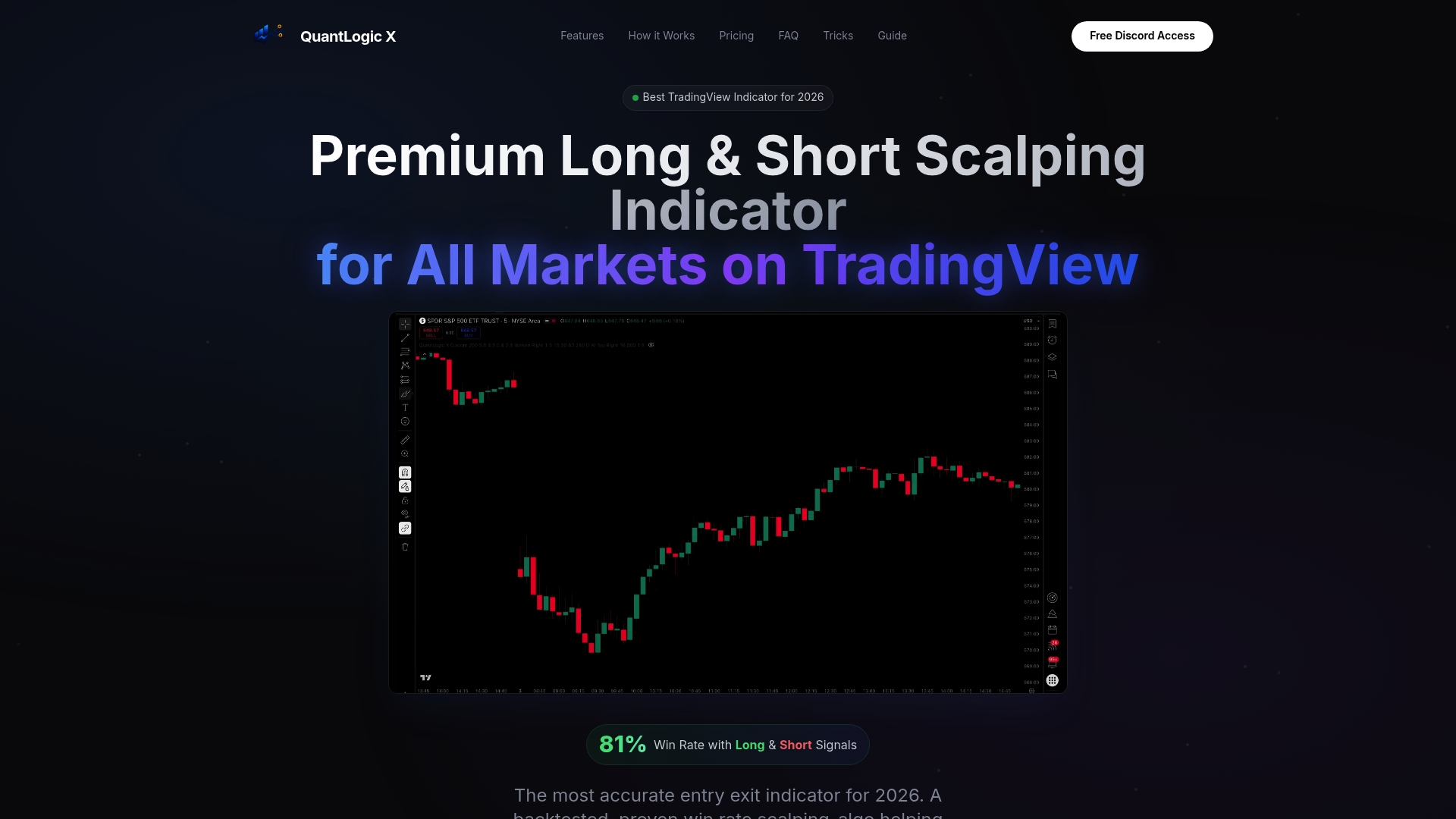
The Quantlogicx TradingView indicator delivers zero-repaint long and short signals with real-time alerts, so your entry checklist has a reliable confirmation layer built in. The indicator's 81% win rate across stocks, forex, and cryptocurrency gives you a signal source you can trust when grading trades in your post-session review. More than 2,000 traders use it to enforce the kind of entry discipline that separates consistent performers from reactive ones. If you want a tool that works with your routine rather than against it, explore the full indicator suite at Quantlogicx.
FAQ
What are the three phases of a day trading routine?
A day trading routine covers pre-market preparation, session execution, and post-session review. Together these three phases take roughly 30 to 40 minutes per day and create the structure that reduces impulsive trading.
How many trades should a day trader take per session?
Most documented best-practice routines cap sessions at three to four trades. Limiting trade count prevents overtrading, reduces emotional decision-making, and keeps position quality high.
When should I do my post-session review?
Complete your post-session review within one hour of your last trade. This timing preserves the emotional and contextual details that are critical for accurate trade grading and learning.
How does the 2026 FINRA Rule 4210 change affect my routine?
The April 2026 SEC amendment replaced day-trading margin rules with intraday margin deficit monitoring. Traders must now check available margin before the session and monitor leverage exposure in real time throughout the day.
What is a discipline score in trading?
A discipline score measures the percentage of trades that followed your documented trading plan. Divide rule-compliant trades by total trades and multiply by 100. A score above 80% indicates a healthy routine.