

Advanced scalping strategy types are distinct trading methods that exploit real-time order flow, market microstructure, and technical indicators to capture rapid, small profits with disciplined execution and strict risk controls. The order book and tape reading constitute roughly 80% of a professional scalper's edge, making execution precision far more important than directional prediction. Whether you trade stocks, forex, or crypto, the four core scalping types covered here give you exact entry and exit rules, risk frameworks, and the context to know which method fits your market conditions.
1. advanced scalping strategy types: a structured overview
Advanced scalping types exploit specific market microstructure layers, including Level 2 order book momentum, VWAP deviation reclaims, and opening range breakouts. Each type targets a different inefficiency, so knowing the differences is the first step toward consistent execution. The four primary categories are Level 2 Momentum Scalping, VWAP Deviation Scalping, Opening Range Breakout Scalping, and Advanced Pattern Scalping on micro timeframes. Spread scalping exists as a fifth category, though its viability for retail traders is severely limited in modern electronic markets.
Choosing the right type depends on your session timing, the instrument you trade, and your ability to read real-time data. A trader who cannot process Level 2 data quickly will struggle with momentum scalping but may thrive with VWAP deviation setups. Matching strategy type to skill set is not optional. It is the difference between a positive expectancy system and a slow account drain.

2. level 2 momentum scalping: reading the order book
Level 2 momentum scalping uses real-time order book data to identify supply and demand imbalances before price moves. The entry signal fires when price breaks a consolidation level and the order book confirms stacking bids (for longs) or stacking offers (for shorts). This is not a chart pattern strategy. It is a tape reading discipline.
Entry and exit criteria:
- Enter on a consolidation break with confirming bids or offers visible in Level 2
- Use Time and Sales data to verify real buying or selling pressure, not spoofed orders
- Exit immediately when the order book flips, meaning bids disappear on a long or offers stack on a short
- Exit if the stock gives back more than 50% of the initial move on a micro pullback setup
Risk controls:
- Limit risk per scalp to 0.1%–0.25% of account size with hard stops
- Use fixed fractional sizing so position size scales with account growth, not emotion
- Avoid this setup during low-volume midday sessions when order book signals are unreliable
Pro Tip: Watch for spoofed orders in Level 2. Large bids that vanish the moment price approaches them are a trap. Only trade when Time and Sales confirms actual transactions at those levels.
Level 2 momentum scalping works best during the U.S. cash open (9:30–10:30 a.m. ET) and the London/New York overlap in forex. Liquidity is high, spreads are tight, and order book signals carry more weight. Outside those windows, the signal quality drops sharply.
3. VWAP deviation scalping: fading and reclaiming the mean
VWAP deviation scalping is defined as entering trades when price deviates significantly from the Volume Weighted Average Price and then reclaims it, targeting a reversion to the mean. VWAP acts as the institutional benchmark for fair value during a session. When price stretches too far from it, a reversion trade offers a high-probability, short-duration setup.
How the setup works:
- Wait for price to deviate from VWAP and then form a reclaim candle that closes back above (for longs) or below (for shorts) the VWAP line
- Enter on the close of that reclaim candle, not before it closes
- Place stops no more than $0.10–$0.20 beyond the VWAP level for tight risk control
- Target $0.15–$0.30 above VWAP or the nearest resistance zone, whichever comes first
- Exit the full position if price fails to hold VWAP on the first retest
VWAP deviation setups are most reliable during the first two hours of the U.S. session and the final hour before close. Midday chop produces false reclaims that stop out positions repeatedly. The risk-to-reward profile on a clean VWAP reclaim typically runs 1:2 or better, which is favorable compared to most scalping types.
Combining VWAP with MACD for momentum confirmation or with RSI to identify overbought and oversold conditions sharpens the signal quality. A VWAP reclaim with a bullish MACD cross on the 1-minute chart is a much stronger setup than a VWAP reclaim alone.
4. opening range breakout scalping: the first 15 minutes
Opening range breakout (ORB) scalping is built on the principle that the high and low established in the first 5–15 minutes of the session define the day's initial supply and demand boundaries. A break above the opening range high signals institutional buying. A break below the low signals distribution.
Execution steps:
- Define the opening range using the first 5 or 15 minutes of price action
- Wait for a clean break and close above the opening range high on the 1-minute chart
- Enter on the first pullback to the breakout level, not on the initial spike
- Place your stop below the midpoint of the opening range candle
- Target a distance equal to one times the opening range height above the entry
- Scale out 50% of the position at the first target and trail the stop on the remainder
Pro Tip: The cleanest ORB setups occur on days with a pre-market catalyst, such as an earnings beat or a macro data release. Volume on the breakout candle should be at least twice the average. Low-volume breakouts fail at a much higher rate.
ORB scalping suits traders who want defined risk from the start of the session. The stop placement is mechanical, the target is calculated, and the entry is rule-based. For traders who struggle with discretionary decisions under pressure, ORB is one of the most structured scalping methods available.
5. advanced pattern scalping on micro timeframes
Advanced pattern scalping on micro timeframes targets three specific setups: micro gap fills, symmetrical triangle breakouts on 1-minute charts, and order book absorption traps. These advanced scalping patterns require faster decision-making than ORB or VWAP setups, but they offer more frequent opportunities throughout the session.
Key patterns and execution rules:
- Micro gap fill: Price gaps up or down at open and immediately begins filling the gap. Enter with a limit order at the gap edge, stop beyond the session high or low, target the full gap fill.
- Symmetrical triangle breakout: Identify a symmetrical triangle on the 1-minute chart. Enter on a confirmed break with a market order, stop inside the triangle, target equal to the triangle height projected from the breakout point.
- Order book absorption trap: Price pushes into a large limit order wall that absorbs selling or buying. Enter in the direction of the absorption when Time and Sales shows the wall holding. Exit immediately if the wall breaks.
| Pattern | Entry Type | Stop Placement | Typical Target |
|---|---|---|---|
| Micro Gap Fill | Limit order at gap edge | Beyond session high/low | Full gap fill |
| Symmetrical Triangle | Market order on break | Inside triangle boundary | Triangle height projected |
| Order Book Absorption | Limit order at wall | Beyond absorption level | $0.10–$0.20 from entry |
Hot session times for these patterns are the U.S. cash open and the London/New York overlap. Outside those windows, pattern failure rates rise significantly. Position sizing should reflect the tighter stop distances. A $0.10 stop with 0.25% account risk means a larger share count than most traders expect, so calculate size before entering.
6. spread scalping and inventory management
Spread scalping is defined as attempting to capture the bid-ask spread repeatedly by posting limit orders on both sides of the market. The concept sounds simple. The execution reality is brutal for most retail traders.
Spread scalping is fundamentally a queueing challenge with execution costs including fees, half-spread crossing, and adverse selection that erode profits without inventory discipline. Costs on both legs, maker-taker fees, and the risk of only one leg filling can make naive spread scalping a negative expectancy activity. This is not a warning to avoid the concept entirely. It is a call to understand the full cost structure before attempting it.
| Factor | Naive Spread Scalper | Professional Market Maker |
|---|---|---|
| Fee structure | Pays taker fees on both legs | Earns maker rebates |
| Adverse selection | Fills toxic flow regularly | Filters toxic flow with algorithms |
| Inventory management | Holds unhedged positions | Hedges inventory in real time |
| Net expectancy | Often negative | Positive with scale |
Spread scalping has become commoditized and is mainly profitable for market makers who manage inventory and adverse selection with sophisticated technology. For retail traders, the better path is to treat spread awareness as a cost management tool rather than a standalone strategy. Know your spread costs, favor limit orders where possible, and factor adverse selection into every setup you trade.
Key takeaways
Advanced scalping requires matching the right strategy type to your skill set, session timing, and instrument, not applying one method to every market condition.
| Point | Details |
|---|---|
| Order book drives edge | Level 2 and Time and Sales data provide roughly 80% of a professional scalper's execution advantage. |
| Risk per trade is fixed | Limit each scalp to 0.1%–0.25% of account size with hard stops and fixed fractional sizing. |
| Session timing matters | The U.S. cash open and London/New York overlap produce the highest-quality signals across all scalping types. |
| Spread scalping has limits | Retail traders face negative expectancy in spread scalping without maker rebates and real-time inventory hedging. |
| Log every trade | Automated trade logging with entry, exit, and stop details is required to identify and fix execution errors. |
Why i think most scalpers pick the wrong strategy first
Most traders who come to scalping pick Level 2 momentum as their starting point because it looks like the most sophisticated method. That is usually the wrong call. Level 2 reading takes months to develop as a reliable skill, and most traders burn through capital during that learning curve before they ever see consistent results.
My experience is that VWAP deviation and ORB scalping are better starting points. The rules are mechanical, the stops are defined, and the setups repeat daily. You can build a scalping signal checklist around them and execute without needing to interpret real-time order flow under pressure.
The traders I have seen succeed fastest are the ones who master one setup completely before adding a second. They know every failure mode, every false signal, and every market condition that kills their edge. That depth of knowledge in one setup beats shallow knowledge across five setups every time. Automated trade logging is not optional in this process. You cannot improve what you do not measure, and memory is a terrible trade journal.
The other thing most articles will not tell you: spread scalping is a dead end for retail traders in 2026. The infrastructure required to compete with market makers is not accessible to individual traders. Spend that energy on tape reading and VWAP setups instead. The trading discipline required to execute clean setups repeatedly is where the real edge lives.
— Tran
How Quantlogicx supports your scalping execution
Quantlogicx built its TradingView indicator specifically for scalpers who need reliable, no-repaint signals across stocks, forex, and crypto. The tool confirms entries at bar closure, which eliminates the false signals that plague most scalping indicators.
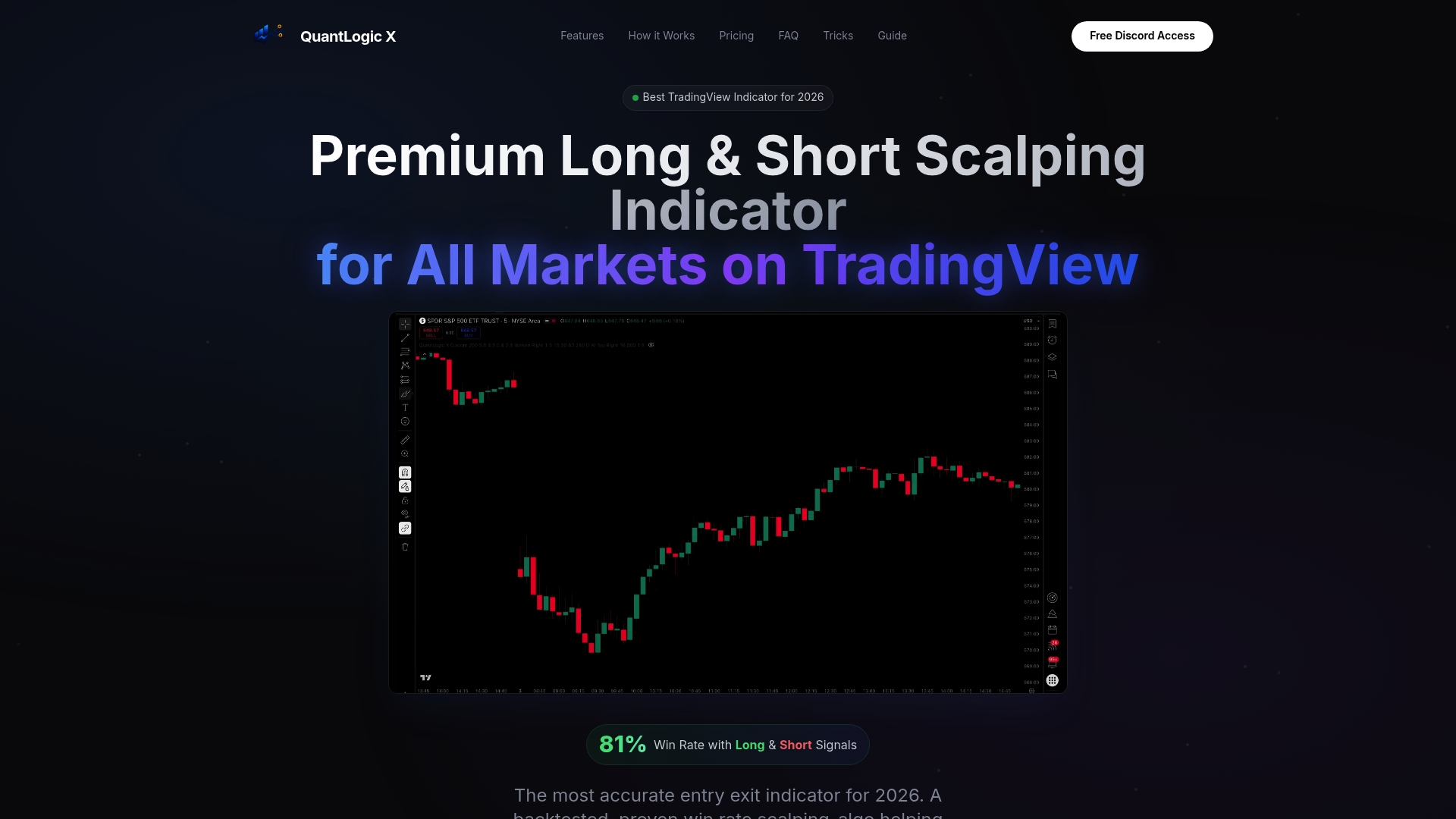
Over 2,000 traders use the Quantlogicx algorithm, with individual users recording gains of $8,200 in a single month. The indicator supports VWAP deviation confirmation, breakout timing, and momentum entries with real-time alerts that fire at the exact moment a setup qualifies. For traders who want to add a systematic signal layer to their scalping strategy on SPY or forex pairs, Quantlogicx delivers the precision that discretionary reading alone cannot guarantee. Explore the full indicator suite here and see how it fits your current setup.
FAQ
What is advanced scalping in trading?
Advanced scalping is a short-term trading discipline that uses real-time order flow, Level 2 data, VWAP, and technical patterns to capture small, rapid profits with strict risk controls. It differs from basic scalping by requiring precise entry and exit rules tied to specific market microstructure signals.
Which scalping strategy type is best for beginners?
Opening range breakout scalping is the most structured entry point for traders new to advanced methods. The stop placement is mechanical, the target is calculated from the opening range height, and the entry rules are rule-based rather than discretionary.
How much risk should i take per scalp trade?
Risk per scalp should be limited to 0.1%–0.25% of your account with hard stops set at $0.10–$0.20 per share. Fixed fractional sizing keeps losses manageable and allows the strategy to scale as the account grows.
Is spread scalping worth learning in 2026?
Spread scalping is not viable for most retail traders in 2026. Without maker rebates, real-time inventory hedging, and algorithms to filter adverse selection, the net expectancy is negative for individual traders operating without institutional infrastructure.
How do i know which scalping type fits my market?
Match strategy type to session timing and instrument liquidity. Level 2 momentum and ORB scalping work best during the U.S. cash open. VWAP deviation setups perform well in the first two hours and the final hour of the session. Scalping signals differ significantly across instruments, so test each type on your specific market before committing real capital.