

Scalping is a short-term trading method where traders open and close positions within seconds to minutes, targeting small price moves repeatedly throughout a session. Unlike swing trading or position trading, scalping demands constant attention, fast execution, and strict discipline on every single trade. Beginners often assume the speed makes it simple. The opposite is true. Scalping is widely considered the most demanding trading style to master. This beginner scalping guide step by step breaks down exactly what you need: the right tools, a repeatable strategy, sound risk management, and the mental discipline to execute without hesitation.
What tools, charts, and markets work best for beginner scalpers?
The right setup separates profitable scalpers from those who burn through capital in the first month. Before you place a single live trade, you need to understand which markets, timeframes, and tools give you the best odds.
Markets to focus on
High liquidity and tight spreads are non-negotiable for scalping. Forex pairs like EUR/USD and GBP/USD, and heavily traded stocks like SPY, AAPL, and NVDA, are the standard starting points. Thin markets with wide spreads eat your profit before the trade even moves in your favor. Trading costs like commissions, spreads, and slippage routinely consume scalping profits when traders ignore them. Choose markets where you can get in and out fast without paying a heavy toll on each trade.
Timeframes that work
Most scalpers use a 5-minute chart to read short-term direction and a 1-minute chart to time precise entries. The 5-minute chart shows you the trend. The 1-minute chart shows you where to pull the trigger. Using only the 1-minute chart without a higher timeframe filter is one of the most common beginner errors.
Core tools comparison
| Tool | Role in scalping |
|---|---|
| 5-minute chart with EMA | Confirms short-term trend direction |
| 1-minute chart | Times precise entry and exit |
| VWAP (Volume Weighted Average Price) | Identifies intraday value and bias |
| Level 2 order book | Shows real-time supply and demand depth |
| Time & Sales tape | Confirms momentum through actual transaction flow |
| Demo trading simulator | Builds execution speed without real capital risk |
Level 2 order book and Time & Sales tape reading are core skills every scalper must develop. They show you where buyers and sellers are stacking orders in real time, which is far more useful than any lagging indicator alone. Demo trading and simulators let you build these skills safely before you risk real money.
Pro Tip: Run at least 3 months on a simulator before going live. You need to build muscle memory for entries and exits, not just theory.
Step-by-step scalping strategy for beginners
A repeatable process beats improvisation every time. The following four steps form the core of any solid scalping approach, whether you are trading forex, stocks, or crypto.
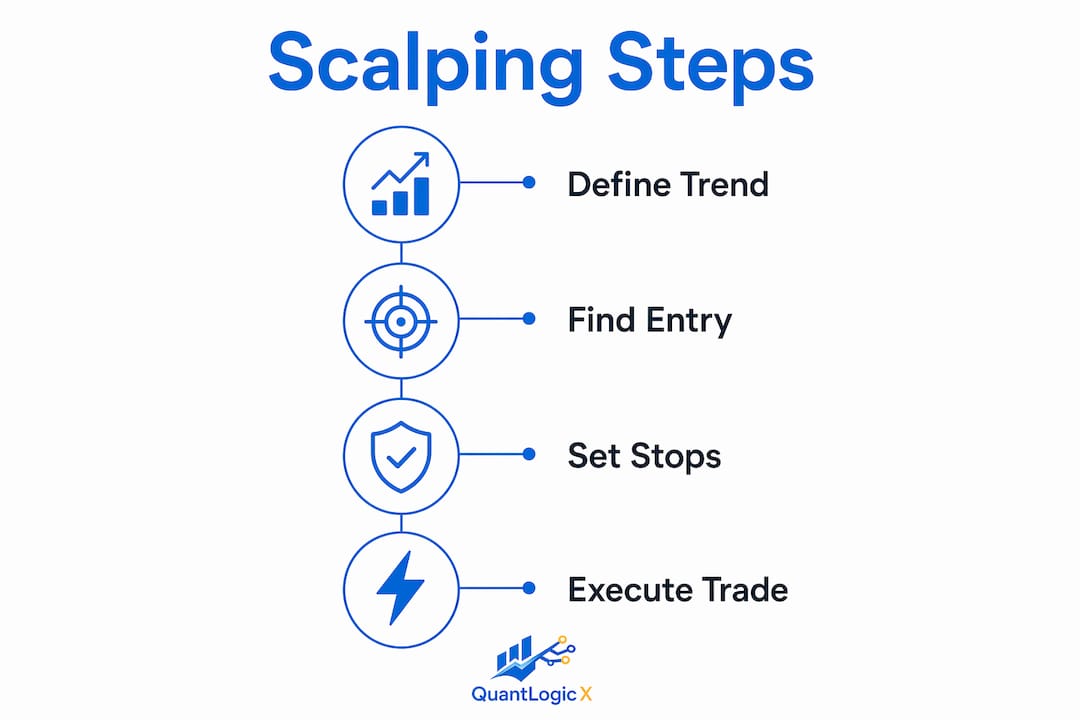
Step 1: Define the short-term trend on the 5-minute chart
Open your 5-minute chart and apply a 9 EMA and a 20 EMA. When the 9 EMA crosses above the 20 EMA and price holds above both, the short-term trend is up. When the 9 EMA crosses below the 20 EMA and price stays under both, the trend is down. Only trade in the direction of this trend. Fighting the trend on a 1-minute chart is the fastest way to string together losing trades.

Step 2: Identify a precise entry on the 1-minute chart
Switch to your 1-minute chart once the 5-minute trend is clear. Look for one of three entry signals: a pullback to the 9 EMA, a momentum candle breaking a recent high or low, or a break-and-retest of a key level. The pullback entry is the cleanest for beginners because it gives you a defined low-risk point. Do not chase a candle that has already moved 10 ticks away from your planned entry.
Step 3: Set your stop-loss and target before you enter
Define your stop-loss and profit target before you click buy or sell. Place your stop-loss below the most recent swing low for long trades, or above the most recent swing high for short trades. Your profit target should be at least 1.5 times your stop-loss distance. This 1:1.5 minimum reward-to-risk ratio keeps your account growing even when you lose more trades than you win.
Step 4: Execute and follow the plan
Click the entry, let the trade run to your target or stop. Do not move your stop-loss wider because the trade is going against you. Do not exit early because you feel nervous. The plan you built in steps 1 through 3 is your only guide. Emotional decisions during a live trade are the single biggest account killer for new scalpers.
| Step | Action | Key rule |
|---|---|---|
| 1 | Set trend on 5-minute chart | Trade with the EMA cross direction only |
| 2 | Find entry on 1-minute chart | Use pullback, momentum candle, or retest |
| 3 | Set stop-loss and target | Minimum 1:1.5 risk-to-reward ratio |
| 4 | Execute and hold the plan | No adjustments during the trade |
Pro Tip: Mark your entry, stop, and target on the chart before you enter. Seeing all three levels visually removes hesitation and keeps you honest.
How to manage risk and trading psychology in scalping
Risk management is the only part of scalping you fully control. Price direction is never guaranteed. Your position size and stop-loss placement always are.
Traders should risk no more than 0.1% to 1% of their account on any single scalp trade. That rule sounds conservative, but it keeps a losing streak from wiping out weeks of gains. A 10-trade losing streak at 1% risk costs you 10% of your account. The same streak at 5% risk costs you half your capital.
Key risk and psychology rules for beginner scalpers:
- Use real stop-loss orders, not mental stops. Mental stops get ignored the moment a trade moves against you.
- Cap your daily loss. Stop trading when you hit 3% account drawdown in a session. Fatigue and frustration compound losses fast.
- Limit session length. Scalping for more than 2 to 3 hours straight degrades decision quality. Short, focused sessions outperform marathon sessions.
- Track your emotional state. If you feel angry, anxious, or desperate to recover a loss, close your platform and step away.
- Separate one bad trade from your overall performance. One loss means nothing. A pattern of undisciplined losses means everything.
Scalping is psychologically demanding in ways that longer timeframe trading is not. Decisions happen in seconds. Mistakes are visible immediately. The traders who last are those who treat each trade as one data point in a large sample, not as a personal win or loss.
Common beginner mistakes in scalping and how to avoid them
Most beginners fail at scalping not because of bad strategy, but because of avoidable execution errors. Recognizing these mistakes early saves months of frustration.
- Chasing trades. You see a candle explode upward and buy at the top. The move is already over. Wait for the next setup instead of chasing the one you missed.
- Ignoring trading costs. Commissions and spreads on 20 to 30 trades per day add up fast. High-frequency trading costs must be calculated into your profit target before you enter, not after.
- Overtrading. Taking 40 trades in a session because you are bored or trying to recover losses is not scalping. It is gambling. Quality setups beat trade quantity every time.
- Skipping the journal. Writing down every trade, including your entry reason, result, and emotional state, is how you spot patterns in your mistakes. Traders who journal improve faster than those who do not.
- Jumping to live trading too soon. Most traders need 3–6 months of simulator practice before live trading produces consistent results. Skipping this step is expensive.
Successful scalpers focus on execution and real-time supply and demand rather than trying to predict where price will go next. That mental shift, from prediction to execution, is the single most important mindset change a beginner can make.
How can technology and practice sharpen your scalping skills?
Technology does not replace skill, but it accelerates how fast you build it. The right tools reduce noise and help you focus on high-quality setups.
Simulators like Tradovate's replay mode or ThinkorSwim's paper trading account let you practice on real historical data without risking capital. Spend 3 to 6 months here before going live. Use that time to drill your entry and exit process until it is automatic.
Scalping signal algorithms and TradingView indicators help beginners cut through chart noise. Quantlogicx, for example, is a TradingView indicator built specifically for scalping. It reports an 81% win rate and uses zero repaint technology, meaning the signals it generates do not change after the bar closes. Over 2,000 traders use the algorithm across stocks, forex, and crypto. For beginners, clear buy and sell signals reduce the cognitive load of reading multiple indicators at once. You can read more about how these tools work in this scalping signal algorithm guide.
Tracking your trade performance is equally important. Log your win rate, average win size, average loss size, and the setups that produce the best results. After 50 to 100 trades, patterns emerge. You will see which setups work for you and which ones drain your account. For a deeper look at advanced scalping strategy types, the Quantlogicx blog covers the full range of approaches used by active traders in 2026.
Key takeaways
Scalping requires a structured process, strict risk rules, and consistent practice before it produces reliable profits.
| Point | Details |
|---|---|
| Start with the right setup | Use 5-minute and 1-minute charts, VWAP, and EMAs on liquid markets with tight spreads. |
| Follow a four-step entry process | Confirm trend, find entry, set stop and target, then execute without deviation. |
| Risk no more than 1% per trade | Strict position sizing protects your account during inevitable losing streaks. |
| Practice on a simulator first | Spend 3–6 months on demo trading before committing real capital to live scalping. |
| Focus on execution, not prediction | Scalping success comes from managing entries and exits, not forecasting price direction. |
Scalping is harder than it looks, and that is actually good news
Scalping looked easy to me at first. Fast trades, quick profits, no overnight risk. That framing is wrong, and believing it cost me real money early on.
Scalping is a specialization built on proficiency with longer timeframes and the ability to handle extreme decision speed. The traders I have seen succeed at it almost always spent time trading daily and hourly charts first. They understood how trends form, how support and resistance work, and how to manage a losing trade before they ever tried to do it in 30 seconds on a 1-minute chart.
The good news is that the difficulty filters out the undisciplined. If you commit to the simulator, journal every trade, and treat scalping as a craft rather than a shortcut, you are already ahead of most beginners. The psychological demands are real, but they are manageable with structure. Set a daily loss limit. Keep sessions short. Review your trades every evening. Treat each session as practice, not as a performance.
The traders who last in scalping are not the fastest or the most aggressive. They are the most consistent. Build that consistency first, and the speed will follow naturally.
— Tran
Quantlogicx: a TradingView indicator built for scalpers
Beginners who want clear, reliable signals without reading five indicators at once will find Quantlogicx worth a close look.
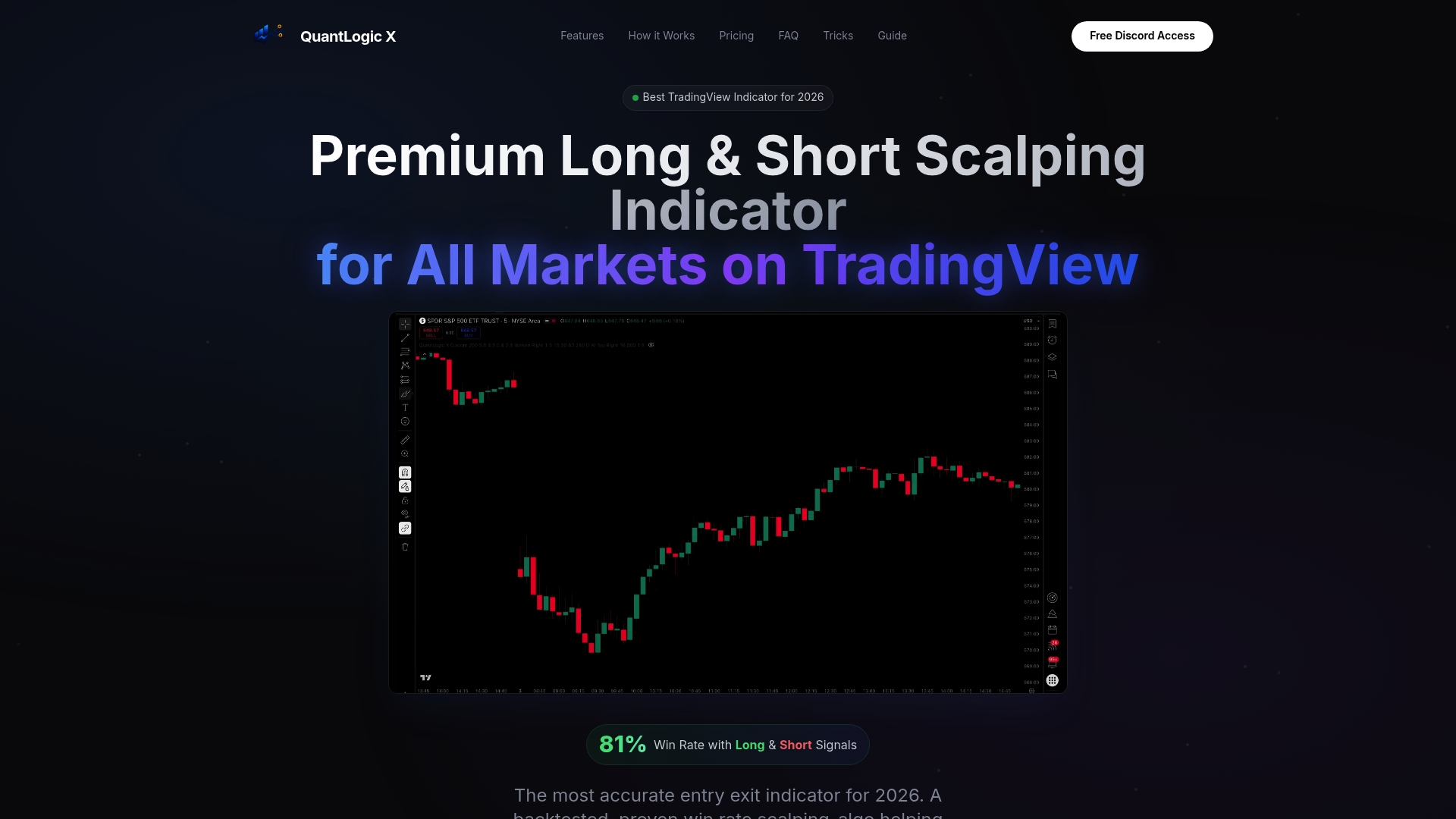
The Quantlogicx indicator runs directly on TradingView and generates long and short signals with zero repaint technology. That means the signal you see at bar close is the signal that stays. No second-guessing whether the arrow will disappear. The tool covers stocks, forex, and crypto, and includes real-time alerts so you never miss a setup. One user recorded $8,200 in gains within a single month using the algorithm. For beginners building confidence in their entries and exits, the Quantlogicx TradingView indicator removes much of the noise that makes early-stage scalping so difficult. You can also explore the SPY scalping strategy page for a market-specific application of the tool.
FAQ
What is scalping in trading?
Scalping is a short-term trading style where traders open and close positions within seconds to minutes, targeting small, repeated price gains throughout a session. It requires fast execution, strict risk management, and high focus.
How long does it take to become a profitable scalper?
Most traders need 3–6 months of simulator practice followed by 12–18 months of live trading before reaching consistent profitability. Skipping the simulator phase significantly increases early losses.
What is the best timeframe for scalping?
The 5-minute chart sets the trend direction and the 1-minute chart times the entry. Using both together gives you context and precision, which neither chart provides on its own.
How much should I risk per scalp trade?
Risk no more than 0.1% to 1% of your total account on any single trade. This rule keeps a losing streak from causing serious damage to your capital base.
Do I need a special indicator to scalp?
No indicator is required, but tools like Quantlogicx simplify signal reading for beginners by generating clear buy and sell signals with zero repaint technology. Check the scalping signal checklist for a structured approach to evaluating any scalping setup.