

Cryptocurrency trading is the process of buying and selling digital assets through exchanges that match buyers and sellers using order books and price-driven orders. Traders profit by capitalizing on price movements over short periods, from hours to months, which separates trading from long-term investing. Understanding how cryptocurrency trading works means grasping three core mechanics: order execution, trading pairs, and risk management. Regulated exchanges require Know Your Customer (KYC) identity verification before any trade can occur. Spot trading on reputable platforms is the safest entry point for anyone new to crypto trading for beginners.
What are the basic steps to start cryptocurrency trading safely?
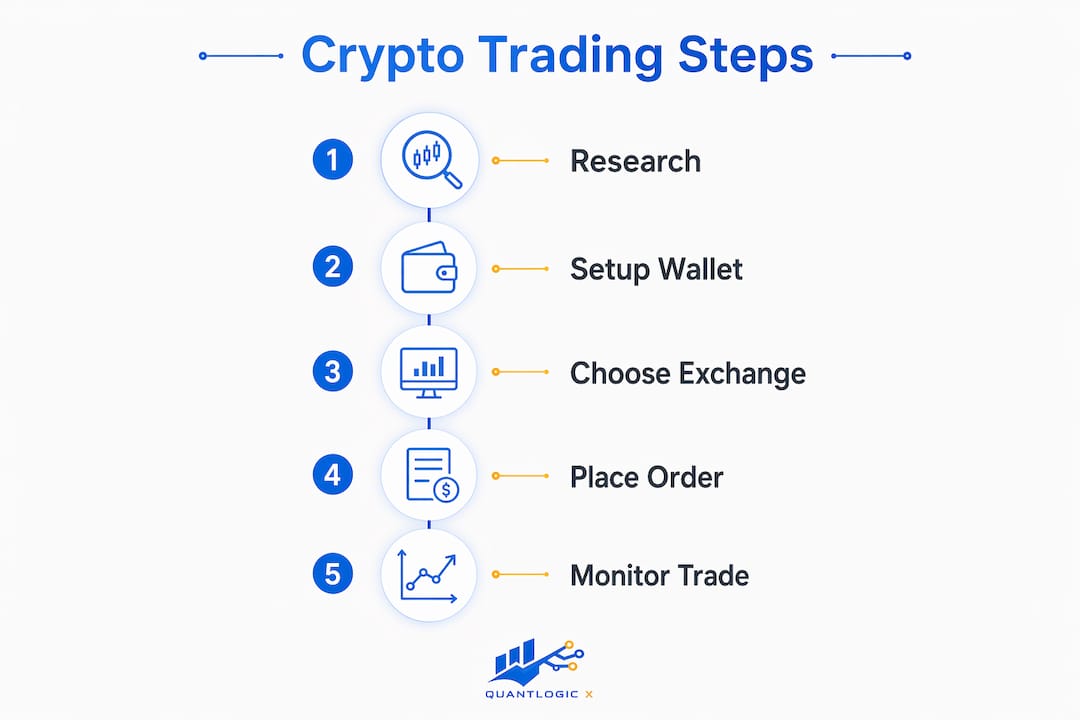
Getting started requires a clear sequence of steps. Skipping any one of them increases your exposure to fraud, platform failure, or poor execution. Follow this process before placing your first real trade.
- Register on a reputable exchange. Choose a platform that operates under regulatory oversight in your country. Check listings of trusted crypto sites before committing to any exchange.
- Complete KYC verification. Exchanges require government-issued ID and sometimes proof of address. This process is mandatory under anti-money laundering regulations and protects both you and the platform.
- Link a bank account or payment method. Most exchanges accept bank transfers, debit cards, or wire transfers. Fees vary by method, so check the fee schedule before depositing.
- Make a small test deposit. Send the minimum amount the platform allows. This confirms the deposit process works before you move larger funds.
- Perform a test withdrawal. Test trades confirm platform liquidity and withdrawal reliability before you commit meaningful capital. This step catches platform issues that deposit-only testing misses.
- Start with spot trades only. Buy a small amount of a major asset like Bitcoin or Ethereum. Spot trading means you own the actual asset, with no leverage or contract expiry to manage.
Pro Tip: Custodial wallets (held by the exchange) are convenient but carry counterparty risk. Once you hold more than a few hundred dollars in crypto, move assets to a non-custodial wallet where you control the private keys.
Beginners are strongly advised to start exclusively with spot trading because it avoids the complex risks of liquidation and contract expiry tied to futures, margin, and leverage products. That single rule prevents the most common and costly beginner mistakes.

How do cryptocurrency trades actually execute?
Every trade on a centralized exchange runs through an order book. Understanding this mechanism is the difference between getting the price you expect and paying more than you planned.
What is an order book?
An order book is a live list of all open buy and sell orders for a trading pair, organized by price. Buy orders (bids) stack below the current market price. Sell orders (asks) stack above it. The gap between the highest bid and the lowest ask is called the spread. When a buyer and seller agree on a price, the exchange matches the orders and the trade executes.
Trading pairs explained
Every crypto trade involves a pair of assets. BTC/USDT means you are buying or selling Bitcoin priced in Tether (a stablecoin pegged to the US dollar). ETH/BTC means you are trading Ethereum against Bitcoin. Choosing the right pair affects your exposure to price swings in both assets simultaneously.
Order types and their trade-offs
| Order Type | How it works | Best used when |
|---|---|---|
| Market order | Executes immediately at the best available price | Speed matters more than exact price |
| Limit order | Executes only at your specified price or better | You want price control and can wait |
| Stop-loss order | Triggers a market sell when price drops to a set level | Protecting against large downside moves |
Most beginners skip learning order types before trading, which leads to poor execution and unnecessary losses. A limit order gives you price control. A market order gives you speed. Neither is always better; the right choice depends on your situation.
Pro Tip: Always use limit orders when trading low-volume pairs. Thin order books mean a market order can fill across several price levels, costing you more than the displayed price.
Slippage and liquidity
Slippage occurs when large orders fill across multiple price levels, pushing the average execution price beyond the quote you saw on screen. This happens most often in thinly traded pairs with low liquidity. Sticking to high-volume pairs like BTC/USDT or ETH/USDT reduces slippage significantly.
What trading strategies should new traders understand?
Strategy is not about finding a magic formula. It is about having a repeatable process that you can measure, adjust, and improve over time.
- Spot trading vs. derivatives. Spot trading means you own the asset outright. Derivatives like futures and options use leverage, which amplifies both gains and losses. New traders should master spot trading before touching leveraged products.
- Fundamental analysis. This approach evaluates a cryptocurrency's underlying value: the team behind it, its use case, network activity, and market adoption. It suits medium to long-term positioning.
- Technical analysis. This method reads price charts using indicators like moving averages, RSI (Relative Strength Index), and volume patterns to identify entry and exit points. Most short-term traders rely heavily on technical analysis.
- Position sizing. Never risk more than a fixed percentage of your total capital on a single trade. A common rule is risking no more than 1–2% of your account per trade. This keeps a losing streak from wiping out your account.
- Stop-loss orders. Set a stop-loss on every trade before you enter. Decide your maximum acceptable loss in advance, not in the heat of the moment.
- Trading journal. Maintaining a trading journal is a professional necessity. It tracks your entries, exits, reasoning, and outcomes. Over time, patterns emerge that show you where your strategy works and where it fails.
Crypto traders typically hold assets for hours to months, while investors hold for years. That distinction shapes every decision, from which analysis method you use to how you set your stop-loss levels. Knowing which category you fall into prevents strategy confusion.
Understanding trading indicator performance helps you evaluate whether your signals are actually adding value or just creating noise.
What are the hidden costs and risks in cryptocurrency trading?
Most new traders focus on the buy price and ignore everything else. That is a costly mistake. The real total cost of a trade includes multiple layers of friction.
- Maker/taker fees. Exchanges charge different fees depending on whether your order adds liquidity (maker) or removes it (taker). Taker fees are almost always higher.
- Spread. The difference between the bid and ask price is a cost you pay on every trade, even if the exchange advertises zero commission.
- Withdrawal fees. Moving crypto off an exchange to your own wallet carries a network fee. These vary by blockchain and can be significant during periods of high network congestion.
- Tax reporting. In the United States, the IRS treats cryptocurrency as property. Every trade is a taxable event. Ignoring this creates serious liability at tax time.
The true total cost of a trade includes spread, maker/taker fees, withdrawal fees, and tax obligations. All of these must factor into your net profitability calculation, not just the price difference between your buy and sell.
Centralized exchanges vs. peer-to-peer platforms
Centralized exchanges offer deep liquidity, customer support, and regulatory protections. Peer-to-peer platforms generally lack the liquidity, consumer protections, and customer service standards of regulated exchanges, often resulting in worse bid-ask spreads. For most traders, especially beginners, a regulated centralized exchange is the safer and more cost-effective choice.
Leverage trading carries the additional risk of liquidation. If the market moves against a leveraged position by a set percentage, the exchange automatically closes the trade and you lose your entire margin. This can happen within minutes during a volatile market move.
Key takeaways
Cryptocurrency trading works by matching buyers and sellers through order books, and success depends on understanding execution mechanics, controlling costs, and applying a disciplined strategy from the first trade onward.
| Point | Details |
|---|---|
| Start with spot trading | Spot trades carry no liquidation risk, making them the right starting point for new traders. |
| Complete KYC and test withdrawals | Verify your exchange works before committing real capital by testing deposits and withdrawals first. |
| Learn order types before trading | Using limit orders instead of market orders reduces slippage and improves execution quality. |
| Account for all trading costs | Spread, fees, withdrawals, and taxes all reduce net profit and must be calculated in advance. |
| Keep a trading journal | Recording every trade reduces emotional decisions and reveals which strategies actually work over time. |
Why most beginners get the fundamentals backwards
New traders almost always start in the wrong place. They open an account, deposit money, and immediately look for a hot coin to buy. The order book, the fee structure, the withdrawal process — none of it gets a second thought until something goes wrong.
I have seen this pattern play out repeatedly. The trader who skips the test withdrawal discovers the problem when they need to exit a position fast. The trader who never learned limit orders wonders why their fills are always worse than expected. These are not bad luck. They are predictable outcomes from skipping the fundamentals.
The traders who build lasting results treat the first month as a learning period, not a profit period. They run small spot trades, study their order book, and track every single trade in a journal. That journal becomes the most valuable tool they own, because it turns subjective feelings into objective data.
Spot trading is not a beginner's consolation prize. It is where real skill gets built. Leverage and derivatives make sense only after you have proven you can trade profitably without them. The market will always be there. The capital you lose rushing into leverage will not come back easily.
The mindset shift that matters most: treat each trade as a data point, not a lottery ticket. That single change separates traders who improve from traders who just keep losing with more confidence.
— Tran
Quantlogicx signals for smarter crypto trade timing
Knowing how cryptocurrency trading works is the foundation. Executing trades at the right moment is where most traders struggle.
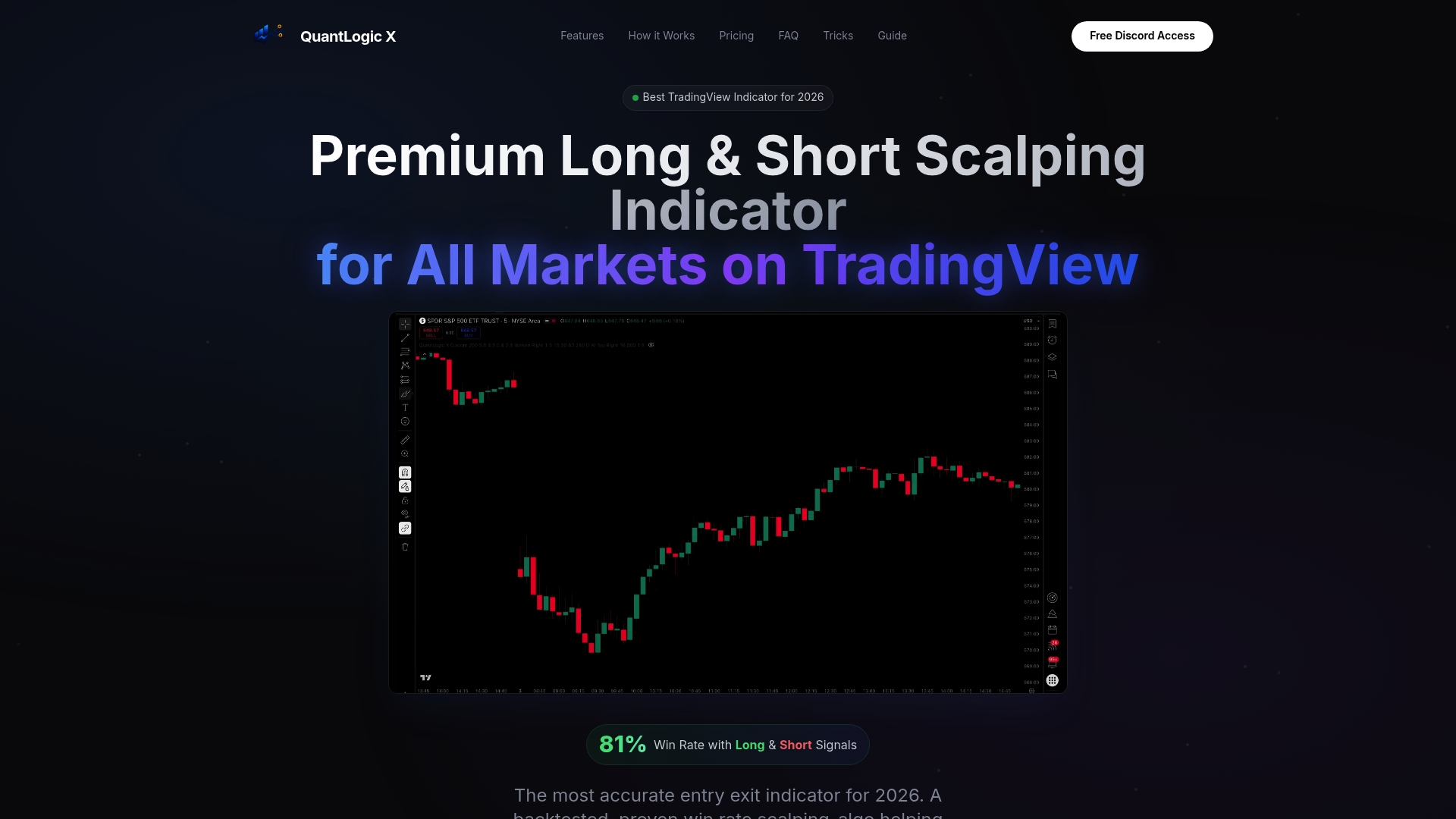
Quantlogicx offers a TradingView indicator built specifically for identifying long and short signals across crypto, forex, and stocks. The algorithm uses zero repaint technology, meaning signals stay fixed at bar closure and do not shift after the fact. Over 2,000 traders use the Quantlogicx system, with individual users recording gains of $8,200 within a single month. Real-time alerts notify you the moment a signal fires, so you never miss an entry. If you are ready to add a signal layer to your spot trading process, the Quantlogicx crypto indicator is built for exactly that. You can also explore the full buy and sell indicator suite to see how it fits your strategy.
FAQ
What is cryptocurrency trading?
Cryptocurrency trading is the buying and selling of digital assets through exchanges that match buyers and sellers using order books and price orders. Traders aim to profit from short-term price movements rather than holding assets for years.
How does a crypto order book work?
An order book lists all open buy and sell orders for a trading pair, organized by price. When a buyer's bid matches a seller's ask, the exchange executes the trade automatically.
What is the difference between spot trading and leverage trading?
Spot trading means you buy and own the actual asset with no borrowed funds. Leverage trading uses borrowed capital to amplify position size, which also amplifies losses and carries the risk of full liquidation.
Why do beginners lose money in crypto trading?
Most beginners lose by skipping order book mechanics and order type education before trading, which leads to poor execution. Hidden costs like spreads, fees, and taxes further erode profits that beginners fail to account for.
How much does it actually cost to make a crypto trade?
The true cost of a trade includes the spread, maker or taker fees, potential withdrawal fees, and tax obligations on any realized gain. Calculating all four before entering a trade gives you an accurate picture of your net profitability.