

Day trading is the practice of buying and selling financial instruments within a single trading session, closing all positions before the market closes to profit from short-term price movements. This is the core definition of what is day trading explained in its simplest form. Unlike long-term investing, day trading demands active attention, fast decisions, and a clear strategy. Retail traders now account for over 25% of U.S. equity volume as of 2025. That number shows how mainstream short-term trading has become on exchanges like the NYSE and NASDAQ.
How does day trading work vs. other trading styles?
Day trading means you open and close every position within the same trading day. You never hold a stock overnight. This is the single biggest rule that separates day traders from swing traders and long-term investors.
Here is how the main trading styles compare:
- Day trading: All positions opened and closed within one session. No overnight risk.
- Scalping: A faster subset of day trading. Traders hold positions for seconds to minutes, targeting tiny price moves. See the scalping signal checklist for a breakdown of what effective scalping setups look like.
- Swing trading: Positions held for days to weeks. Traders accept overnight risk in exchange for larger moves.
- Long-term investing: Positions held for months or years. The goal is wealth building, not daily income.
Day traders focus heavily on the first 30–60 minutes after the market opens. Volume and volatility peak at the open, which creates the price swings traders need to profit. Understanding the daily session structure helps beginners know exactly when to look for setups.
Day traders use three core order types. A market order fills immediately at the current price. A limit order fills only at your specified price or better. A stop-loss order exits your position automatically if the price moves against you by a set amount. Mastering these three tools is day trading basics in practice.

Pro Tip: Never enter a trade without a stop-loss already placed. Skipping this step is the fastest way to turn a small loss into a catastrophic one.
What day trading strategies do traders actually use?
Day trading strategies are repeatable frameworks that tell you when to enter, when to exit, and how much to risk. The two most widely used approaches are Opening Range Breakout and price action trading.
Opening range breakout (ORB)
The Opening Range Breakout strategy uses the high and low established in the first 5, 15, or 30 minutes of the trading session as key levels. When price breaks above the opening range high with strong volume, traders go long. When it breaks below the opening range low, traders go short.
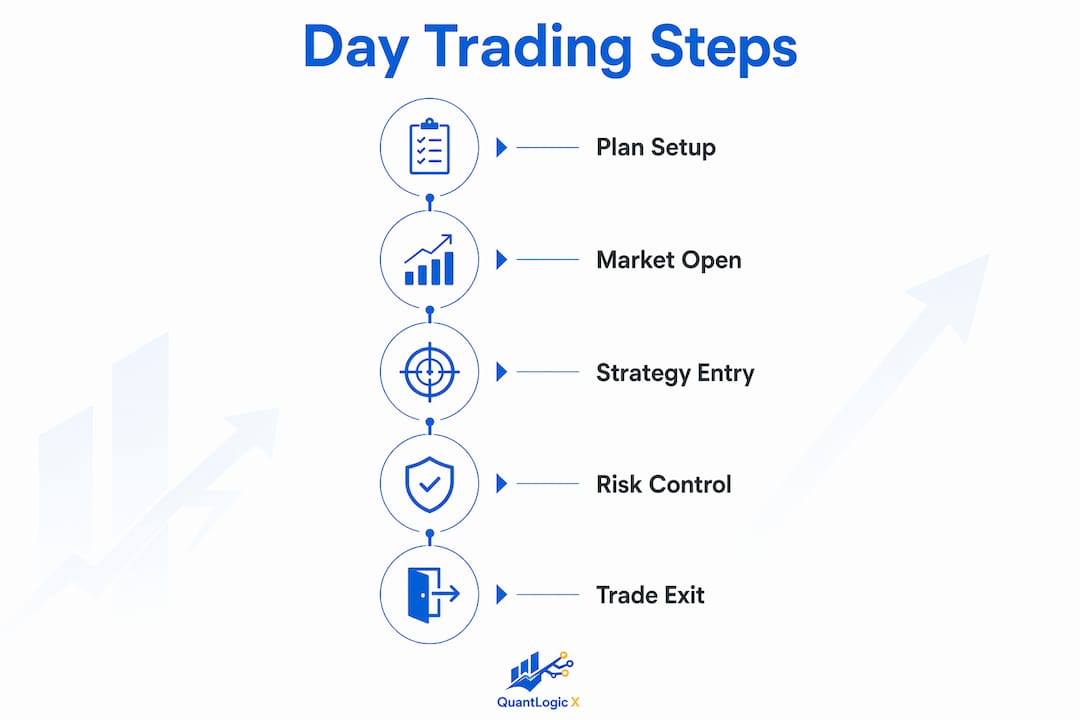
The ORB strategy targets a 40–60% win rate with a 2:1 reward-to-risk ratio. That means for every dollar you risk, you aim to make two. A 50% win rate with a 2:1 ratio is mathematically profitable over time.
One critical rule: do not enter the moment price pokes above or below the level. Wait for a candle close beyond the level before entering. This single habit eliminates most false breakout losses that trap beginners.
Price action trading
Price action trading means reading the chart itself rather than relying on lagging indicators like moving averages. Traders identify support and resistance levels from 3–6 months of price history and watch how price behaves around those zones. A strong rejection at resistance is a short signal. A bounce off support is a long signal.
This approach builds real market intuition. Traders who master price action can read any market, including stocks, forex, and crypto, without needing a complex indicator setup.
Using relative volume to confirm signals
Relative Volume, or RVOL, compares today's volume to the average volume for the same time period. A breakout on high RVOL is a strong signal. A breakout on low volume is a red flag and often signals a reversal. Volume confirmation is the difference between a high-probability trade and a trap.
Here is a quick comparison of the two main strategies:
| Strategy | Best For | Win Rate Target | Key Confirmation |
|---|---|---|---|
| Opening Range Breakout | Volatile open conditions | 40–60% | High RVOL, candle close beyond level |
| Price Action Trading | Any session, any market | Varies by setup | Support/resistance reaction |
Pro Tip: Combine both approaches. Use price action to identify key levels, then apply ORB rules at the open for a higher-conviction entry.
For a deeper look at structuring your profit targets and risk ratios, the framework matters as much as the entry signal.
What are the rules, risks, and costs of day trading?
Day trading carries real financial risk. Understanding the rules and costs before you start is not optional. It is the foundation of staying in the game long enough to get good.
The pattern day trader rule
The Pattern Day Trader (PDT) rule is a U.S. regulation enforced by FINRA. If you execute more than 3 day trades in a 5-business-day period using a margin account, you must maintain at least $25,000 in equity. Falling below that threshold locks you out of day trading until you restore the balance. This rule applies to U.S. stock traders using margin accounts at brokers like TD Ameritrade, Charles Schwab, and Interactive Brokers.
Key risks to know
- Margin amplifies losses. Trading on margin means borrowing money from your broker. Gains are larger, but so are losses. Frequent intraday trading carries significant risk of losing your entire investment, especially on margin.
- Short-term price movements are unpredictable. Even the best setups fail. No strategy wins 100% of the time.
- Overtrading destroys accounts. Taking too many low-quality trades is one of the most common beginner mistakes.
Costs that eat into profits
Every trade has a cost. Commissions, bid-ask spreads, and platform fees all reduce your net return. Taxes also hit day traders hard. In the U.S., profits from positions held less than one year are taxed as ordinary income, not at the lower long-term capital gains rate. Tracking stock trading discipline and keeping detailed trade logs helps you manage both your psychology and your tax exposure.
How can beginners prepare for day trading?
Preparation separates traders who survive from those who blow up their accounts in the first month. Follow these steps before risking real money.
- Start with a simulator. Paper trading on platforms like TradingView or thinkorswim lets you practice without financial risk. Aim to simulate for 2–3 months and accumulate at least 50 trades before going live. That sample size gives you real data on your strategy's performance.
- Understand your capital requirements. Professional traders recommend starting with at least $50,000 for U.S. stock day trading. That amount covers the PDT rule, allows proper position sizing, and gives you room to survive drawdowns without panic.
- Build a daily routine. Consistent preparation before the open is what separates disciplined traders from gamblers. Review key levels, check the economic calendar, and identify your top two or three setups for the day. A structured day trading routine reduces impulsive decisions.
- Set hard risk limits. Decide your maximum loss per trade and per day before you open your platform. Most professionals risk no more than 1% of their account on a single trade.
- Use technology to your advantage. Real-time alerts, volume scanners, and signal tools help you spot setups faster. Understanding how trade signals work gives you a structural edge over traders who rely on gut feel alone.
Pro Tip: Treat your simulator results like real money. If you would not take a trade with real capital, do not take it in simulation either. Sloppy sim habits become sloppy live habits.
The role of AI in trading psychology is also growing. Tools that track your emotional patterns and flag overtrading tendencies are becoming standard for serious traders in 2026.
Key takeaways
Day trading is a skill-based practice that rewards preparation, discipline, and a clear strategy over impulsive action.
| Point | Details |
|---|---|
| Core definition | Day trading means opening and closing all positions within one session, with no overnight holdings. |
| PDT rule requirement | U.S. margin account traders need $25,000 minimum equity to make more than 3 day trades in 5 days. |
| Top strategies | Opening Range Breakout and price action trading are the two most practical frameworks for beginners. |
| Volume confirmation | Always check Relative Volume before entering a breakout trade to avoid false moves. |
| Preparation first | Simulate at least 50 trades over 2–3 months before risking real capital to build a reliable sample size. |
The hard truth about day trading nobody tells you
Most beginners come to day trading expecting fast money. What they find instead is a steep learning curve that punishes impatience and rewards people who treat it like a profession.
I have seen traders with solid strategies fail because they could not follow their own rules under pressure. The strategy was never the problem. The discipline was. Day trading is 30% technical skill and 70% behavioral control. That ratio surprises most people.
The biggest mistake I see beginners make is chasing lagging indicators. Moving averages, RSI, MACD. These tools tell you what already happened. Price action and volume tell you what is happening right now. Learning to read a chart without a wall of indicators is the single most valuable skill you can develop.
Start smaller than you think you need to. Build your sample size in simulation. When you go live, trade the smallest position size your broker allows. Your only goal in the first three months is to not lose money while you learn. Profits come after consistency. Consistency comes after repetition.
— Tran
How Quantlogicx helps day traders act on better signals
Day trading demands fast, accurate decisions. Quantlogicx was built specifically for traders who need clear signals without the noise of traditional indicators.
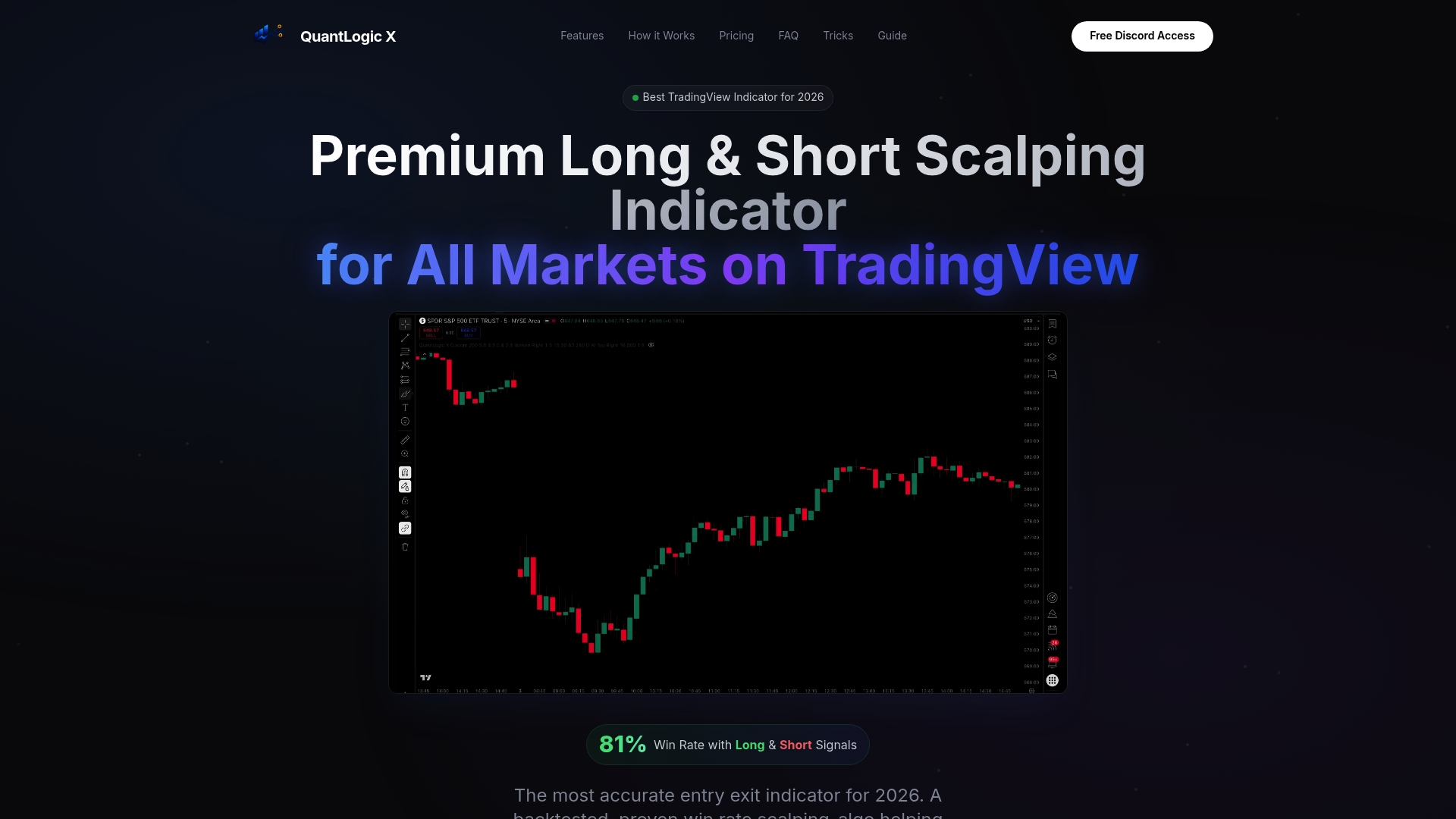
The Quantlogicx TradingView indicator delivers zero-repaint long and short signals confirmed at bar close, so you never act on a signal that disappears after the fact. Over 2,000 traders use it across stocks, forex, and crypto, with individual users recording gains like $8,200 in a single month. Whether you are applying an Opening Range Breakout setup or reading price action levels, Quantlogicx gives you a reliable buy/sell signal to confirm your read. Real-time alerts mean you never miss a setup. If you are serious about day trading, explore Quantlogicx on TradingView and see what a clean, no-repaint signal looks like in practice.
FAQ
What is day trading in simple terms?
Day trading is buying and selling a financial instrument, such as a stock or currency pair, within the same trading day. All positions are closed before the market closes, so there is no overnight exposure.
Is day trading profitable for beginners?
Day trading is profitable for a small percentage of traders, but most beginners lose money in their first year. Success requires a tested strategy, strict risk management, and significant practice before trading real capital.
What is the pattern day trader rule?
The PDT rule requires U.S. traders using margin accounts to maintain at least $25,000 in equity if they execute more than 3 day trades within any 5-business-day period. Falling below this threshold restricts further day trading.
How much money do i need to start day trading?
The legal minimum for U.S. margin accounts is $25,000 due to the PDT rule, but professional traders recommend starting with at least $50,000 to allow proper position sizing and survive normal drawdowns.
What is the best strategy for day trading beginners?
The Opening Range Breakout strategy is one of the most beginner-friendly approaches. It uses the first 15–30 minutes of the session to define key levels, then enters on confirmed breakouts with high Relative Volume.