

Market hours define the liquidity and volatility conditions that determine whether a day trade succeeds or fails. The clock is not neutral. Every hour of the trading day carries a different risk profile, spread cost, and probability of a clean directional move. Understanding how market hours affect day trading is the single most underrated edge available to active traders. This guide breaks down each session by volume, spread behavior, and strategy fit so you can stop trading by the clock and start trading by the conditions.
How market hours affect day trading performance
The trading day follows a U-shaped volume curve. Volume peaks at the open, collapses at midday, and surges again into the close. Each phase creates a distinct environment with different rules.
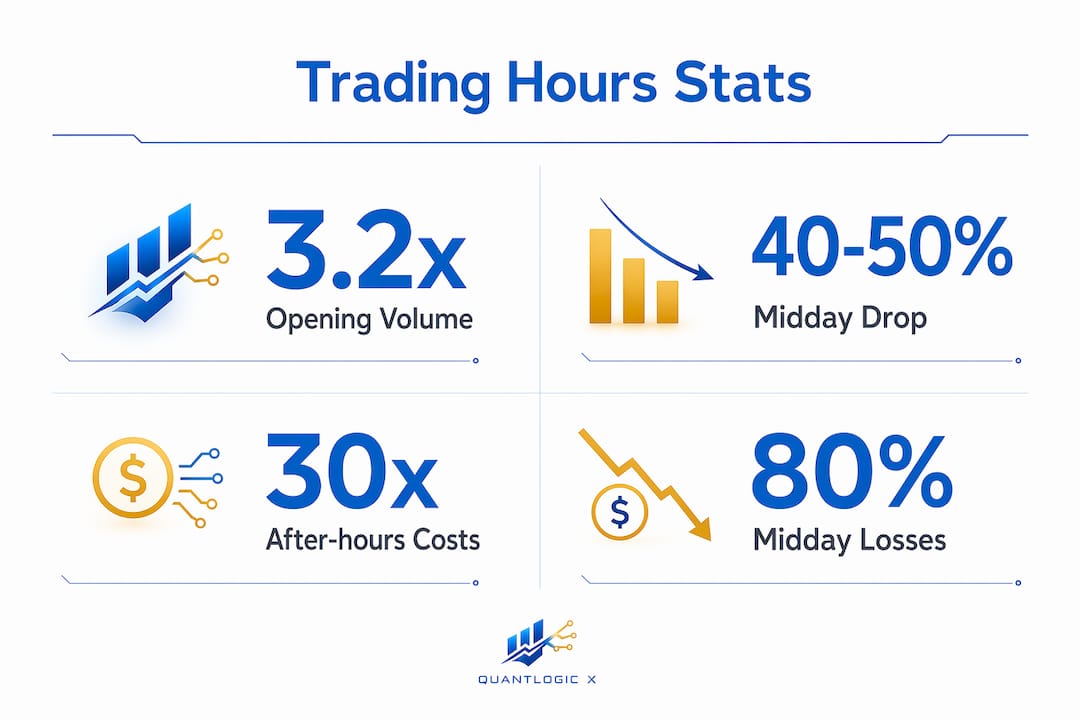
The opening session from 9:30 AM to 11:00 AM ET is the most active window of the day. Volume runs 3.2x higher than the midday average. That concentration of activity creates tight spreads, fast price discovery, and strong directional moves. Traders who know their setups can execute with minimal slippage and capture meaningful intraday swings.

The midday session from 11:30 AM to 1:30 PM ET is the opposite. Volume drops 40–50% and bid-ask spreads widen noticeably. Breakout strategies fail more often during this window because there is not enough conviction behind price moves. Many retail traders keep firing orders during this period and bleed edge without realizing it.
The closing session from 3:00 PM to 4:00 PM ET brings a second surge of institutional activity. Closing auctions represent 9–16% of daily volume in US markets. That concentration makes the close one of the cleanest execution windows of the day, especially for traders who want to capture institutional order flow.
| Session | Time (ET) | Volume Level | Spread Width | Best Use |
|---|---|---|---|---|
| Opening | 9:30–11:00 AM | 3.2x midday average | Tight | Momentum and breakout trades |
| Midday | 11:30 AM–1:30 PM | 40–50% below peak | Wide | Review and planning only |
| Closing | 3:00–4:00 PM | Institutional surge | Moderate | Trend continuation and auction plays |
| Extended hours | Pre/post market | Very low | Very wide | Avoid unless experienced |
Pro Tip: Track your own P&L by hour for two weeks. Most traders discover that 80% of their losses cluster in the midday window.
What are the risks of trading pre-market and after-hours?
Extended hours trading runs before 9:30 AM and after 4:00 PM ET. The sessions exist, but the conditions are hostile for most day traders.
Liquidity thins out dramatically outside regular market hours. Execution costs can run up to 30 times higher than during peak morning hours, with spreads expanding from $0.01 at 10:00 AM to $0.30 or more after the close. That spread alone can erase the profit target on a typical scalp trade before price even moves.
The participant mix also changes. Institutional desks reduce activity, leaving a thinner pool of retail traders and algorithmic systems. Price moves in extended hours often look decisive but reverse sharply once regular session volume returns. A stock that gaps up 3% pre-market on earnings news may fill that gap within the first 15 minutes of the open.
Key risks in extended hours sessions:
- Spreads are wider, increasing entry and exit costs on every trade
- Lower volume means a single large order can move price significantly
- Price action is less reliable as a signal of true directional intent
- Stop orders may execute at prices far from the intended level
- News-driven moves often reverse once the regular session opens
Pro Tip: If you trade earnings plays in pre-market, size down to 25% of your normal position. The spread cost alone justifies the reduction.
How should day traders adjust strategies by session?
Aligning your day trading strategies with session conditions is not optional. It is the difference between a consistent edge and a random outcome.
The opening session rewards preparation and speed. Volatility runs 3–4 times higher at the open than at midday. That volatility creates opportunity, but it also creates traps. The first 5–15 minutes after 9:30 AM often include "Judas Swings," which are false directional moves driven by institutional order flow absorbing overnight information. Entering too early means trading noise, not signal.
Here is a session-by-session strategy framework:
- 9:30–9:45 AM ET. Watch only. Let price establish a range and identify the direction of institutional flow. Do not place new trades during this window.
- 9:45–10:30 AM ET. Begin trading with full position sizing. Momentum setups and breakouts from the opening range carry the highest probability here.
- 10:00–11:00 AM ET. The "Silver Bullet" window. This 60-minute period produces the most reliable setups for US stock day traders. Focus on clean structure breaks and liquidity grabs.
- 11:30 AM–1:30 PM ET. Stop entering new trades. Use this time to review your morning trades, update your watchlist, and plan afternoon setups.
- 3:00–4:00 PM ET. Re-engage with full attention. Institutional rebalancing creates directional moves with real follow-through. Trend continuation setups work well here.
- After 4:00 PM ET. Close positions or hold intentionally with reduced size. Do not open new trades unless you have a specific catalyst and experience with extended hours conditions.
Stop-loss placement also needs to adapt to session timing. Delaying stop placement until after the first 30 minutes reduces premature stop-outs on winning trades. The opening volatility spike will trigger tight stops that would have been fine 20 minutes later.
Pro Tip: Build your daily trading routine around the two peak windows. Treat the midday as mandatory downtime, not wasted time.
What are the execution cost implications of different trading hours?
Execution cost is the hidden tax on every trade. Most traders focus on entry and exit price but ignore the spread and slippage that erode returns throughout the day.
During peak liquidity hours, spreads on liquid US stocks run as low as $0.01. At 10:00 AM on a stock like SPY, the bid-ask spread is essentially invisible. That tight spread means your fill is clean and your cost basis is accurate. The math works in your favor.
Outside those windows, the math flips. Spreads can widen to 30 times their peak-hour level during midday and extended hours. A $0.01 spread becoming $0.30 means you are already down $0.30 per share before price moves at all. On a 100-share position, that is $30 in hidden cost per trade.
The annual impact compounds fast. Traders who ignore time-of-day effects lose 5–10% of annual returns to execution inefficiencies alone. That is not a small rounding error. For a $50,000 account, it represents $2,500 to $5,000 in preventable losses every year.
Closing auctions offer a partial solution for larger orders. Auction price impact runs between 3.2 and 7.2 basis points for orders representing 0.5% of average daily volume. That is significantly lower than the impact of executing the same order in continuous trading during a low-volume period.
Practical execution cost rules:
- Trade liquid instruments during peak hours to keep spreads at their minimum
- Avoid market orders during the first 5 minutes of the session when spreads are widest
- Use limit orders during midday if you must trade, and expect partial fills
- Size down during extended hours to limit the dollar impact of wider spreads
- Check the trading session structure for any instrument before trading it
Key Takeaways
Trading session timing is the most controllable variable in day trading, and concentrating activity in peak liquidity windows directly reduces execution costs and improves strategy success rates.
| Point | Details |
|---|---|
| Opening session is highest probability | Volume runs 3.2x above midday average, creating tight spreads and strong directional moves. |
| Midday session destroys edge | A 40–50% volume drop widens spreads and increases breakout failure rates significantly. |
| Closing auctions offer clean fills | Institutional rebalancing at close creates reliable momentum and lower price impact for larger orders. |
| Extended hours carry extreme costs | Spreads can run 30x wider than peak hours, erasing profit targets before price moves. |
| Time-indifference costs 5–10% annually | Ignoring session timing creates consistent return drag through slippage and execution inefficiency. |
Why I stopped trading the midday session entirely
Most traders think discipline means taking fewer bad trades. I think it means not trading at all during certain hours.
The midday session taught me that lesson the hard way. For months, I kept entering trades between 11:30 AM and 1:30 PM because I felt like I was missing moves. What I was actually doing was paying wider spreads, getting chopped by false breakouts, and building bad habits around low-quality setups. The moment I blocked that window on my calendar and treated it as non-negotiable downtime, my win rate on the day's remaining trades improved noticeably.
The opening session is also more dangerous than most traders admit. The "Judas Swing" is real. I have watched price break a key level convincingly at 9:32 AM, trigger a wave of retail entries, and then reverse completely by 9:45 AM. Waiting until after 9:45 AM feels like leaving money on the table. It is not. It is avoiding a trap that institutional flow sets every single morning.
The closing session is where I find the most consistent setups. Institutional rebalancing creates real directional commitment. Price does not chop the same way it does at midday. The moves have follow-through because the participants behind them have size and conviction. Aligning your entries with that flow, rather than fighting it, is what separates traders who grind out consistent results from those who wonder why their edge disappears.
My honest recommendation: build your trading schedule around two windows, not the full day. Trade the open with caution and the close with confidence. Ignore everything in between unless you have a specific, tested reason to be in the market.
— Tran
Quantlogicx helps you trade the right hours, not just the right setups
Knowing when to trade matters as much as knowing what to trade. Quantlogicx is built for traders who want both.
The Quantlogicx TradingView indicator identifies high-probability entry signals aligned with peak liquidity windows, giving you clear long and short signals exactly when market conditions favor clean execution. Over 2,000 traders use it across stocks, forex, and cryptocurrency, with individual users recording gains like $8,200 in a single month. The zero-repaint technology means every signal is confirmed at bar close, so you are never chasing a phantom entry. If you want a tool that respects session timing and delivers reliable signals during the windows that actually matter, the Quantlogicx indicator is worth a close look.
FAQ
What time of day is best for day trading?
The best time for day trading is 9:45 AM to 10:30 AM ET, after the initial volatility spike settles. The closing window from 3:00 PM to 4:00 PM ET is the second most reliable period for directional setups.
Why is midday trading risky for day traders?
Midday volume drops 40–50% below peak levels, which widens spreads and reduces the reliability of breakout signals. Most experienced traders avoid new entries between 11:30 AM and 1:30 PM ET.
How do extended hours affect execution costs?
Execution costs outside peak liquidity windows can run up to 30 times higher than during the morning session, with spreads expanding from $0.01 to $0.30 or more. That spread increase makes most scalping strategies unprofitable in extended hours.
What is the Silver Bullet trading window?
The Silver Bullet window is the 10:00 AM to 11:00 AM ET period, recognized as the most reliable 60-minute window for US stock day traders. It combines strong liquidity with cleaner price structure after the opening volatility subsides.
How much do trading hours affect annual returns?
Traders who ignore time-of-day effects and trade uniformly throughout the day lose an estimated 5–10% of annual returns to execution inefficiencies and slippage during low-liquidity periods.