

Stock trading signals are defined as alerts that trigger a buy or sell decision based on technical indicators, fundamental analysis, or algorithmic logic. If you want to know how to start trading stocks signals the right way, the answer is not to follow commands blindly. It starts with understanding what each signal means, why it was generated, and how to manage the risk around it. Platforms like TradingView and MetaTrader have made signal-based trading accessible to beginners, but accessibility without education is a fast path to losses. This guide walks you through everything you need before placing your first signal-based trade.
What are stock trading signals and what should beginners look for?
A trade signal is a trigger to buy or sell a security, generated from technical indicators, price patterns, or algorithms. The signal itself is just the starting point. What separates a useful signal from a useless one is the information attached to it.
High-quality trading signals include seven core components: the asset being traded, the direction (buy or sell), the entry price level, a stop loss, a take profit target, a timeframe, and a rationale explaining why the signal was generated. Each element serves a specific purpose. The entry level tells you where to get in. The stop loss defines your maximum acceptable loss. The take profit sets your exit target. The timeframe tells you how long the trade is expected to play out.
The difference between a simple alert and a full trade ticket matters enormously for beginners. A simple alert says "buy Apple." A full trade ticket says "buy Apple at $192.50, stop loss at $189.00, take profit at $198.00, based on a breakout above the 20-day moving average on the 4-hour chart." The second version gives you everything you need to calculate your risk before entering.
- Asset: Identifies exactly which stock or instrument to trade
- Direction: Specifies long (buy) or short (sell)
- Entry point: The price at which to open the trade
- Stop loss: The price at which to exit if the trade moves against you
- Take profit: Your target exit price for a winning trade
- Timeframe: How long the trade setup is expected to remain valid
- Rationale: The technical or fundamental reason behind the signal
Pro Tip: Before subscribing to any signal service, request a sample signal. If it lacks a stop loss or rationale, skip it entirely. Incomplete signals make consistent risk management impossible.
What do you need before you start using stock trading signals?
Preparation separates traders who survive their first year from those who blow up their accounts in the first month. Before you act on a single signal, four things need to be in place.
A brokerage account that supports signal integration. Platforms like NAGA allow you to receive and act on signals directly within the trading interface. You want a broker that offers real-time order execution, access to charting tools, and clear fee structures. Slow execution on a signal-based trade can turn a profitable setup into a losing one due to slippage.

Basic chart reading skills. You do not need to be a technical analysis expert, but you must be able to identify support and resistance levels, read candlestick patterns, and understand moving averages. Signals generated on TradingView reference these concepts constantly. If you cannot verify a signal on a chart yourself, you are flying blind.
A defined risk limit per trade. Capping losses at 1 to 2% per trade is the standard recommendation across professional trading education resources. This means if you have a $5,000 account, you risk no more than $50 to $100 on any single trade. This rule keeps a losing streak from destroying your capital before you have time to learn.
Paper trading practice. Stock simulators let you practice trading signals without risking real money. Investopedia's Stock Simulator and TradingView's paper trading mode are both free. NerdWallet recommends simulated trading as the standard workflow before committing real capital. Paper trading the exact signal rules for dozens of trades gives you real performance data without financial consequences.
| Prerequisite | Why it matters |
|---|---|
| Brokerage with signal integration | Enables fast, accurate order execution when a signal fires |
| Chart reading basics | Lets you verify signals independently before acting |
| 1-2% risk cap per trade | Protects capital during the learning curve |
| Paper trading practice | Builds confidence and reveals flaws in your approach before real money is at risk |
| Signal source evaluation | Filters out scams and unreliable providers before you commit |
How to use trading signals step-by-step
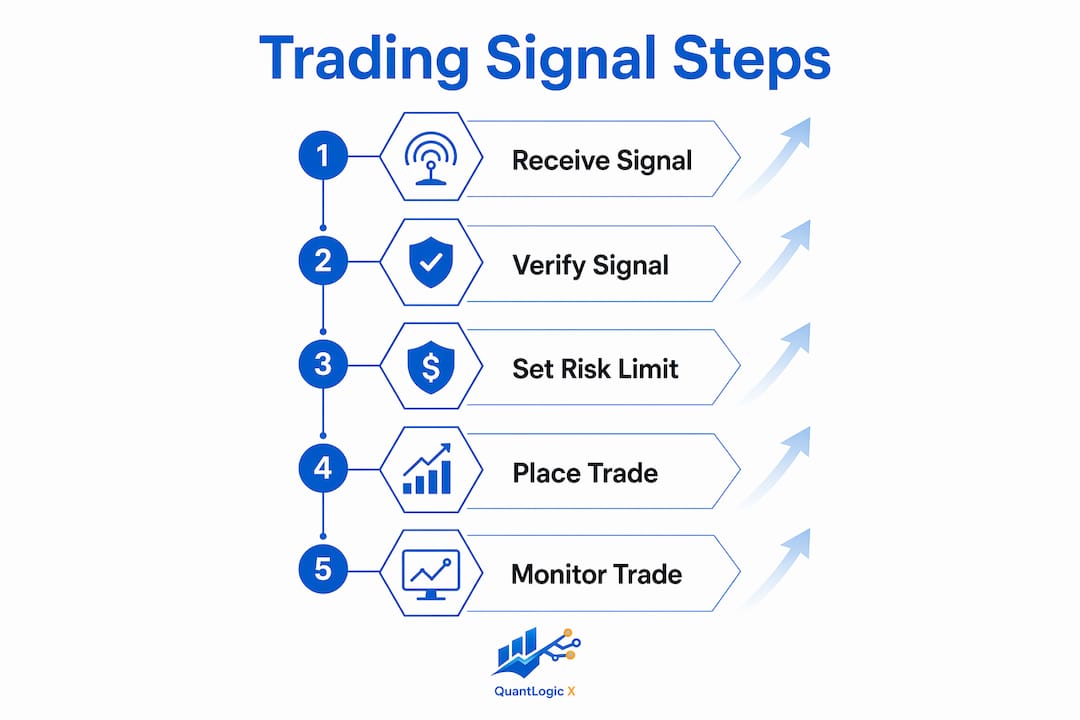
Using signals effectively is a process, not a reflex. Follow these steps every time a signal arrives, especially in your first months of trading.
-
Receive the signal and read every component. Note the asset, direction, entry, stop loss, take profit, and timeframe. Do not skip the rationale. Understanding why the signal was generated is how you learn to eventually generate your own.
-
Verify the signal on your own chart. Open the asset on TradingView or your broker's platform. Confirm that the price action supports the signal's logic. If the signal says a breakout is occurring but the chart shows the price is still below resistance, wait. Confirming signals independently is the single most important habit you can build as a beginner.
-
Calculate your position size before entering. Use the entry and stop loss levels to determine how many shares to buy so that your total risk stays within your 1 to 2% limit. For example, if your entry is $50 and your stop loss is $48, your risk per share is $2. On a $5,000 account with a 1% risk limit ($50), you buy 25 shares. This math must happen before every trade.
-
Execute the trade with a limit order when possible. Market orders on volatile stocks can fill at prices far from the signal's entry level. A limit order locks in your intended entry price and prevents slippage from distorting your risk calculation.
-
Record the trade in a journal. Write down the signal source, the entry, the stop loss, the take profit, the rationale, and the outcome. Reviewing your journal weekly reveals patterns. You will see which signal sources perform consistently and which ones waste your time. You can use a spreadsheet or a dedicated tool like trading indicator performance tracking methods to formalize this process.
-
Review and adjust. After 20 to 30 trades, analyze your journal. Adjust position sizes, refine which signals you act on, and drop sources with poor track records.
Pro Tip: Never increase your position size after a winning streak. Overconfidence after early wins is one of the most common reasons beginner traders give back their gains quickly.
Common mistakes and scams to avoid with trading signals
The biggest beginner error is treating signals as guaranteed profits. No signal guarantees success, and any provider claiming otherwise is either uninformed or dishonest. Signals are probability tools, not certainties.
Ignoring the full trade ticket is the second most costly mistake. Without stop-loss and timeframe details, your risk per trade is unmeasurable. You cannot evaluate whether a signal source has a real edge if you are not tracking the complete trade parameters. Beginners who skip this step often discover their "winning" signal service is actually unprofitable once slippage and fees are factored in.
The scam problem is serious and growing. The FBI has issued direct warnings about fraudsters who target retail investors through investment clubs on social media and messaging apps. These schemes follow a predictable pattern: a group promotes a stock heavily, early buyers sell at the peak, and latecomers absorb the losses. Nova Scotia's Securities Commission similarly warns that ramp-and-dump schemes are widespread on platforms like Telegram and Discord.
"Fraudsters use social media and messaging apps to create the appearance of a legitimate investment community, then coordinate buying to inflate a stock's price before selling their own shares at a profit." — FBI Investment Scam Alert, 2025
Watch for these red flags in any signal service:
- Promises of guaranteed returns or specific profit percentages
- Pressure to act immediately without time to verify
- No explanation of the signal's logic or methodology
- Anonymous providers with no verifiable track record
- Signals delivered exclusively through Telegram or WhatsApp groups
Independent verification is your defense. Before acting on any signal, check the stock's fundamentals, look at the broader market trend, and confirm the technical setup on your own chart. Reading how trade signals generate alerts helps you understand what legitimate signal logic looks like, which makes spotting fraudulent ones much easier.
Key takeaways
Successful stock signal trading requires understanding signal components, verifying every alert independently, and capping risk at 1 to 2% per trade before executing a single position.
| Point | Details |
|---|---|
| Know all seven signal components | Entry, stop loss, take profit, and rationale are non-negotiable for consistent trading. |
| Paper trade before risking capital | Simulators on TradingView and Investopedia let you test signals without financial risk. |
| Cap risk at 1-2% per trade | Position sizing based on stop loss distance protects your account during the learning phase. |
| Verify every signal independently | Confirming signals on your own chart prevents blind execution and builds real skill. |
| Avoid unverified social media signals | FBI-flagged pump-and-dump schemes target beginners through Telegram and Discord groups. |
Why signals work best when you understand them first
I have seen traders burn through accounts in weeks because they treated signals like lottery tickets. The signal fires, they buy, they hope. That is not trading. That is gambling with extra steps.
What actually works is treating every signal as a hypothesis. The signal says "buy here." Your job is to ask: does the chart agree? Does the broader market support this move? Is my risk defined? When I started applying this framework consistently, my win rate did not change dramatically. What changed was that my losses got smaller and my winners ran longer, because I was only acting on setups I understood.
Paper trading is not optional for beginners. It is the only way to build a real track record without financial consequences. I recommend running at least 30 paper trades with any new signal source before committing real money. Thirty trades gives you a statistically meaningful sample. Fewer than that, and you are drawing conclusions from noise.
The traders I have seen succeed long-term share one trait: they are skeptical of easy wins. They read the stop-loss mechanics behind every trade. They journal obsessively. They drop signal sources that underperform without emotional attachment. Signals are a tool. Like any tool, they work when used correctly and cause damage when used carelessly.
— Tran
How Quantlogicx helps new traders get reliable signals
Quantlogicx built its TradingView indicator specifically for traders who want clear, reliable buy and sell signals without the noise of traditional indicators. The tool operates on zero repaint technology, meaning the long and short signals you see at bar closure are final. They do not shift or disappear after the fact, which is a critical feature for beginners learning to trust their signals.
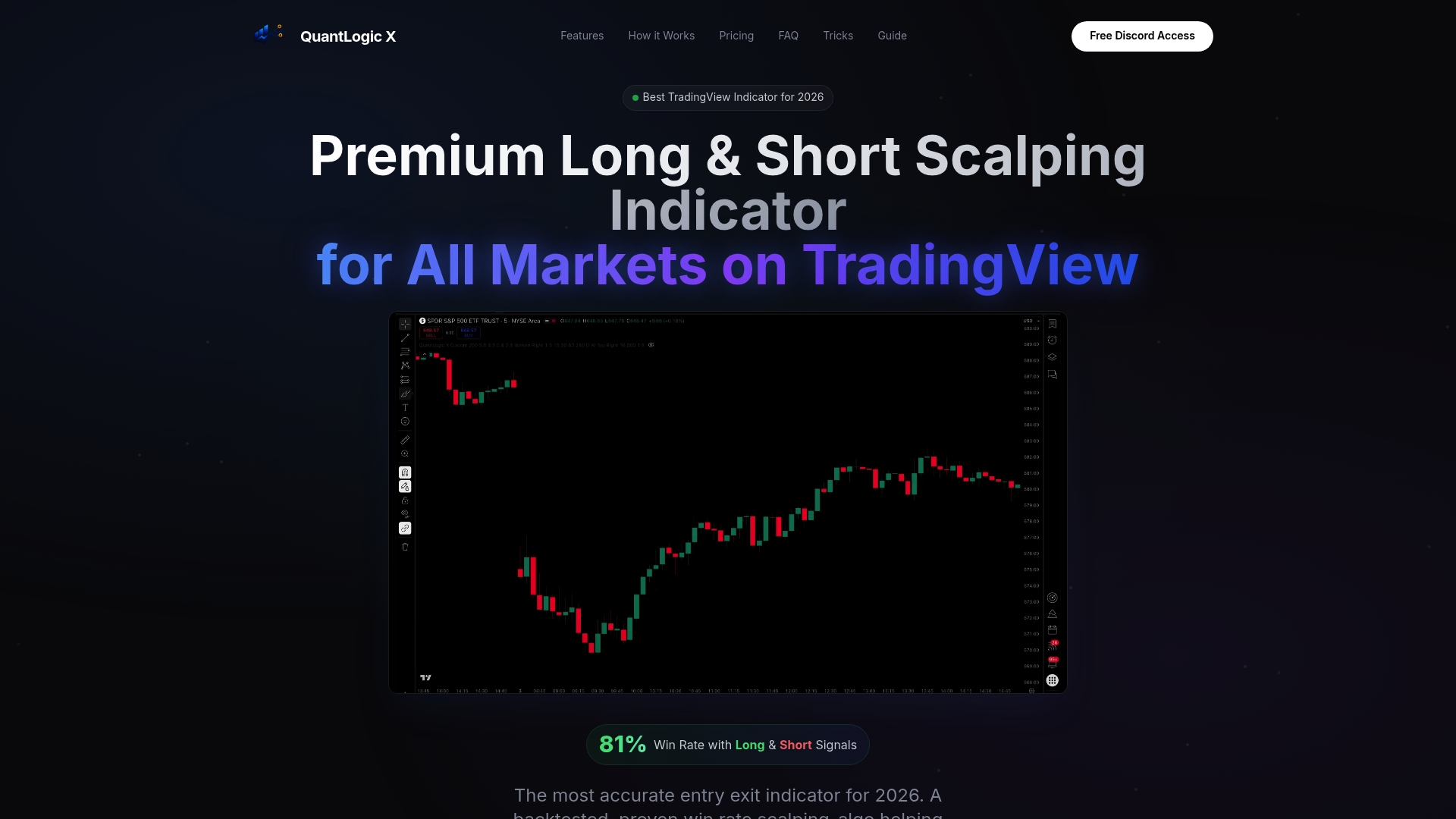
Over 2,000 traders use the Quantlogicx algorithm across stocks, forex, and cryptocurrency, with individual users recording gains of $8,200 within a single month. The indicator integrates directly with TradingView's real-time alert system, so you receive notifications the moment a signal fires. For beginners who want straightforward signals with built-in risk context, the Quantlogicx TradingView indicator is worth exploring as a structured starting point.
FAQ
What is a stock trading signal?
A stock trading signal is a trigger to buy or sell a security, generated by technical indicators, algorithms, or fundamental analysis. Quality signals include an entry price, stop loss, take profit, and a rationale explaining the setup.
How do I verify a trading signal before acting on it?
Open the asset on your charting platform and confirm that the price action matches the signal's logic. Check the broader market trend and the stock's recent fundamentals before executing any trade.
What is the safest way to practice using trading signals?
Paper trading on platforms like TradingView or Investopedia's Stock Simulator lets you test signals with zero financial risk. Running 20 to 30 paper trades before using real money is the standard recommended workflow.
How do I spot a fake or scam trading signal service?
The FBI warns that fraudulent signal services often operate through social media and messaging apps, promise guaranteed returns, and pressure users to act fast. Any service without a transparent methodology or verifiable track record should be avoided.
How much should I risk per trade when starting with signals?
Capping risk at 1 to 2% per trade is the standard guideline for beginners. On a $5,000 account, that means risking no more than $50 to $100 on any single position, calculated using the distance between your entry and stop loss.