

A multi-market scalping signal strategy is a system that applies synchronized entry and exit signals across several instruments and timeframes to capture high-probability, short-duration trades. Unlike single-market scalping, this approach treats your trading setup as a sensor array, scanning dozens of assets with the same standardized signal grammar. State-of-the-art signal engines report win rates in the 60–65% range for mean-reversion setups when volatility and trend regime filters are active. The result is a more consistent equity curve and fewer catastrophic drawdowns than you get from betting everything on one market.
What core tools power a multi-market scalping signal strategy?
The best scalping systems for multiple markets combine three layers: a signal engine, a multi-asset dashboard, and regime-aware filters. Each layer does a different job, and removing any one of them degrades the whole system.
Signal engines and indicators
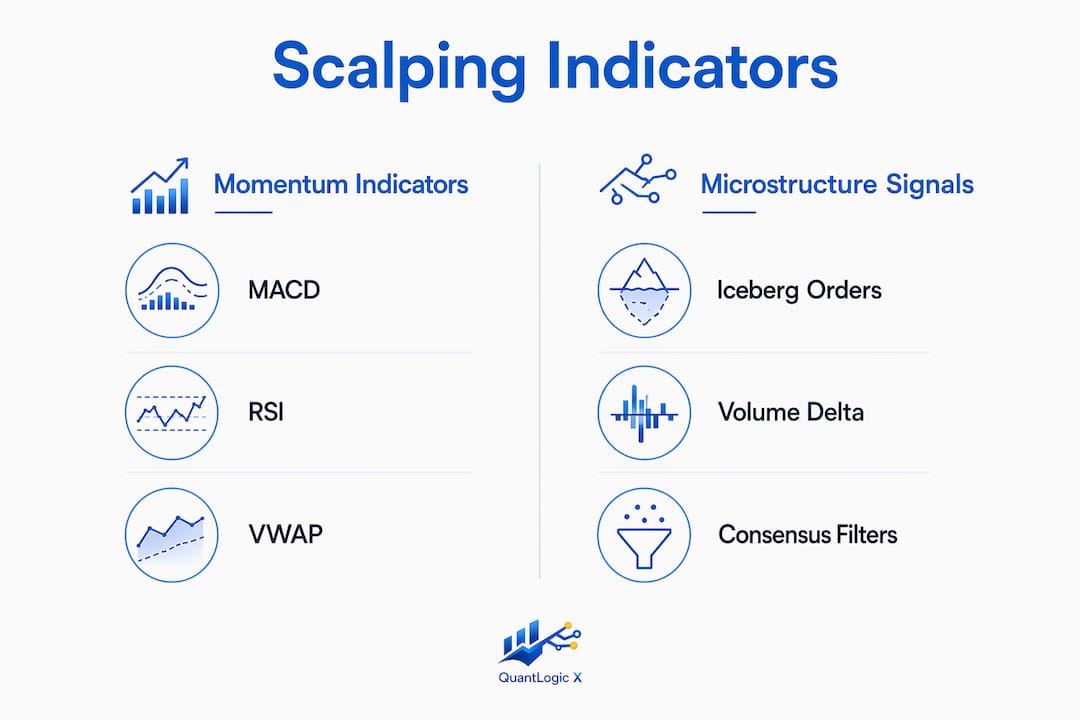
The signal engine is the foundation. Classic indicators like RSI, MACD, VWAP, and Bollinger Bands remain useful, but their default settings rarely suit scalping. For MACD specifically, optimized scalping settings run 5-35-5 on a 1-minute chart and 8-17-9 on a 5-minute chart. Those tighter parameters reduce lag and improve sensitivity to short-term momentum shifts.
VWAP anchors intraday price to volume-weighted fair value, making it the go-to filter for confirming whether a scalp entry is with or against institutional flow. Bollinger Bands flag volatility contractions before breakouts. RSI identifies overbought and oversold conditions that align with mean-reversion setups. Used together, these indicators form a consensus layer rather than a single trigger.
The real edge, though, comes from microstructure signals like iceberg orders and cumulative volume delta. These reveal where institutional money is actually moving, not where a lagging average says it moved three bars ago. A scalping signal algorithm built on order flow outperforms one built purely on moving averages.
Multi-asset dashboards and consensus filters
Professional multi-market dashboards monitor 28–30 instruments simultaneously, applying a "Rule of 7" consensus filter across 9 timeframes to confirm macro trend alignment before any signal fires. That filter alone eliminates a large share of false entries. The same dashboards include anti-overtrade daily lockouts that default to halting new trades after 5 consecutive losses. That is not a soft suggestion. It is a hard circuit breaker built into the system.

Pro Tip: Never run more than 30 instruments on a single dashboard without a consensus filter. Signal flooding without a filter produces noise, not edge.
The table below compares four common indicator types by their multi-market applicability.
| Indicator | Type | Multi-market use | Repaint risk |
|---|---|---|---|
| MACD (5-35-5) | Momentum | High, works on forex, crypto, futures | Low |
| VWAP | Volume/price | Moderate, intraday sessions only | None |
| Bollinger Bands | Volatility | High, asset-agnostic | None |
| Order flow delta | Microstructure | Very high, reveals institutional intent | None |
How do you build and execute a multi-timeframe scalping strategy?
Building a scalping strategy for multiple markets follows a clear sequence. Skipping steps creates gaps in your logic that show up as losses during live trading.
- Select your asset universe. Start with 6–10 instruments across uncorrelated categories: two forex majors, two equity index futures, and two crypto pairs. Correlation below 0.6 between any two assets is the target.
- Define your signal grammar. Choose one standardized signal set and apply it to every asset. Applying a single signal across many markets to find which assets respond best outperforms hunting for a different indicator on each chart.
- Layer your timeframes. Use M5 for entry timing and H4 as a swing filter. M5 momentum setups paired with H4 swing filters show minimal correlation between trades and improved expectancy. Target 15–25 trades per month per instrument. More than that and you are forcing setups.
- Validate with the Rule of 7. Before entering, confirm that at least 7 of 9 timeframes on your dashboard agree on trend direction. This consensus filter cuts false signals without eliminating too many valid ones.
- Size stops with ATR. Set your stop loss at 1.5 times the current 14-period ATR. ATR-based stop sizing normalizes risk across instruments with different volatility profiles. A fixed pip stop that works on EUR/USD will be too tight on Bitcoin and too wide on a low-volatility equity future.
- Apply the 3-5-7 rule. The 3-5-7 risk management rule limits risk per trade to 3%, total exposure to 5%, and portfolio risk to 7%. These caps prevent a single bad session from destroying weeks of gains.
- Log and review. After each session, record which instruments fired signals, which triggered, and which hit target. Weekly review of that log is how you identify which assets in your universe are actually responding to your signal grammar.
Pro Tip: If three instruments fire signals within the same 5-minute bar, take only the one with the cleanest H4 alignment. Simultaneous signals on correlated assets are not three opportunities. They are one opportunity with three times the risk.
You can find a detailed signal validation checklist that reinforces these steps for live execution.
What are the common pitfalls in multi-market scalping?
Cognitive overload is the most common failure mode. Adding more charts does not add more edge. It adds more noise. Traders who monitor 20 charts without a dashboard filter end up paralyzed at the moment a signal fires, or worse, they enter on impulse rather than confirmation.
Stateful indicators solve part of this problem. They assign quality scores to setups and limit each order block to at most two alerts: one preparation alert and one entry alert. That structure prevents you from re-entering the same exhausted setup three times in a row.
Cross-instrument margin exposure is the second major risk. Aggregate exposure limits per currency group prevent margin spikes when correlated instruments move against you simultaneously. For example, holding large positions in EUR/USD, GBP/USD, and AUD/USD at the same time means you are effectively tripling your USD exposure. Limiting aggregate lot size across USD-based pairs is a direct fix.
The following warning signs indicate you should stop trading for the day:
- Five consecutive losses triggered the daily lockout
- Three or more instruments are showing conflicting signals on the H4 timeframe
- Your total open exposure has crossed the 5% threshold from the 3-5-7 rule
- You are considering a trade that does not meet the Rule of 7 consensus filter
Regime awareness separates consistent scalpers from those who blow up. A mean-reversion signal in a trending market is not a signal. It is a trap.
Pro Tip: Label each trading day as "trending" or "range-bound" before the session opens. Use the H4 ADX reading above 25 as your trending threshold. Adjust your signal grammar accordingly.
How does multi-market scalping differ from single-market scalping?
Single-market scalping concentrates all your edge on one instrument. When that market enters a regime your strategy was not built for, your results collapse. A multi-market approach distributes that regime risk across many instruments, so a trending day in EUR/USD does not destroy your entire session if GBP/JPY is ranging cleanly.
The sensor array concept formalizes this. You apply one standardized signal grammar to 35 or more futures markets, then let the data show you which markets are responding. That is fundamentally different from tweaking a different indicator for each chart. Standardization creates testability. Testability creates confidence.
The table below compares key performance characteristics between the two approaches.
| Metric | Single-market scalping | Multi-market scalping |
|---|---|---|
| Regime sensitivity | High, one bad regime ends the day | Low, losses spread across instruments |
| Signal frequency | High per instrument | Moderate per instrument, high overall |
| Equity curve | Choppy during regime shifts | Smoother due to diversification |
| Correlation risk | None | Requires active management |
| Edge source | Microstructure of one market | Standardized grammar across many |
Being regime-aware is the critical differentiator. A multi-market scalping system that cannot distinguish a trending market from a ranging one will misfire on both. Regime filters built into the signal engine solve this at the system level, not the trader level. That is a meaningful structural advantage over manual single-market approaches. For a deeper comparison of how scalping signals differ from swing-based approaches, the scalping vs. swing trading breakdown is worth reading.
Key takeaways
A multi-market scalping signal strategy delivers consistent results only when signal quality, regime awareness, and cross-instrument risk management work together as a system.
| Point | Details |
|---|---|
| Use a standardized signal grammar | Apply one signal set across all instruments instead of hunting for different indicators per chart. |
| Layer M5 entries with H4 filters | Pairing short-term momentum with a swing filter improves expectancy and reduces false entries. |
| Size stops with ATR | Set stop loss at 1.5x the 14-period ATR to normalize risk across volatile and quiet instruments. |
| Apply the 3-5-7 rule | Cap per-trade risk at 3%, total exposure at 5%, and portfolio risk at 7% to protect capital. |
| Manage aggregate exposure | Limit lot size per currency group, not per pair, to prevent correlated margin spikes. |
What I've learned from trading across multiple markets at once
The biggest mistake I see traders make is treating multi-market scalping as a volume game. More signals, more charts, more trades. That logic feels right until you watch a week of gains disappear in a single correlated drawdown.
What actually works is ruthless standardization. Pick one signal grammar, backtest it across your full asset universe, and cut the instruments that do not respond. You will likely end up with 6–8 markets that consistently fire clean setups, not 30. That smaller universe is easier to manage and far more profitable than a bloated watchlist.
Regime awareness changed how I trade more than any indicator ever did. Knowing whether a market is trending or ranging before the session opens determines which signals I trust. A mean-reversion entry in a strong trend is not a bad trade. It is the wrong trade for the wrong regime.
The traders I have seen succeed with multi-market trading signals are not the ones with the most sophisticated tools. They are the ones who review their logs weekly, cut underperforming instruments without sentiment, and stop trading the moment their daily lockout triggers. Discipline at the system level beats cleverness at the chart level every time.
— Tran
Quantlogicx: multi-market signals built for active traders
Quantlogicx built its TradingView indicator specifically for scalping across stocks, forex, and cryptocurrency. The tool delivers long and short signals with zero repaint technology, meaning every signal is confirmed at bar closure and does not shift after the fact.
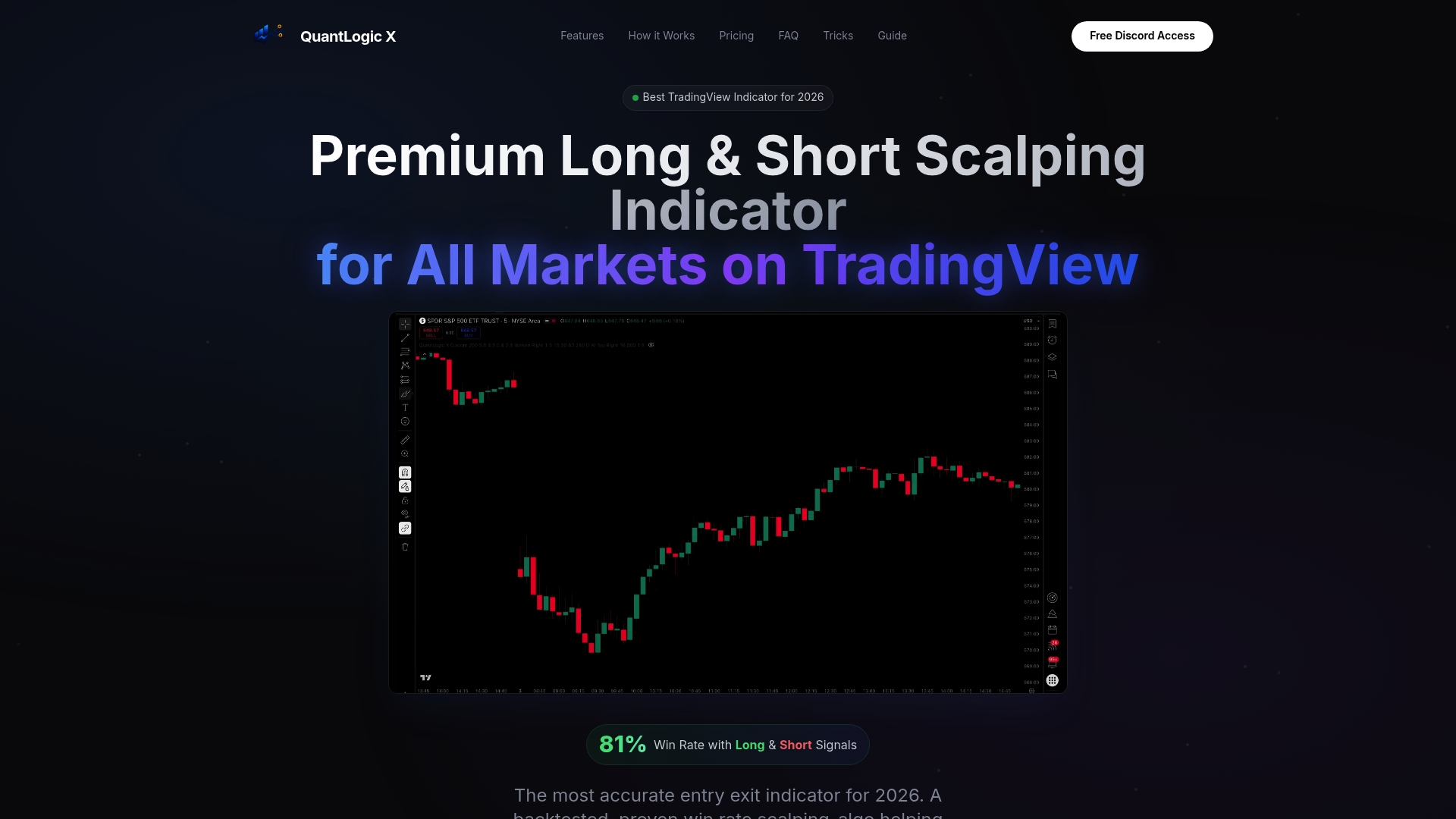
Over 2,000 traders use the Quantlogicx algorithm, with individual users reporting gains of $8,200 within a single month. The indicator fires real-time alerts and integrates directly into TradingView, making it compatible with the multi-timeframe setups described throughout this guide. Whether you are running a 6-instrument universe or scaling up to 30, the Quantlogicx multi-market indicator gives you a reliable signal layer without the noise of traditional lagging tools. See the full feature set and pricing at quantlogicx.com.
FAQ
What is a multi-market scalping signal strategy?
A multi-market scalping signal strategy applies one standardized set of entry and exit signals across multiple instruments and timeframes to capture short-duration, high-probability trades. It reduces regime risk by distributing exposure across uncorrelated markets.
How many markets should I scalp at once?
Start with 6–10 instruments across uncorrelated categories. Professional dashboards monitor up to 28–30 instruments, but beginners get better results with a tighter universe until their signal grammar is proven.
What MACD settings work best for scalping?
Use 5-35-5 on a 1-minute chart and 8-17-9 on a 5-minute chart. These optimized MACD settings reduce lag and improve sensitivity to short-term momentum without generating excessive noise.
How do I manage risk across multiple instruments?
Apply the 3-5-7 risk rule: limit each trade to 3% risk, total open exposure to 5%, and portfolio risk to 7%. Also cap aggregate lot size per currency group to prevent correlated margin spikes.
What is the Rule of 7 in multi-market scalping?
The Rule of 7 requires that at least 7 of 9 timeframes on your dashboard confirm trend direction before you enter a trade. This consensus filter eliminates the majority of false signals without removing too many valid setups.