

Scalping profitability is the net income a trader earns after subtracting all execution costs, including spreads, commissions, and slippage, from the gross gains generated across dozens or hundreds of short-term trades. This is not the same as win rate. A trader can win 70% of trades and still lose money if costs eat the margin on every position. Understanding what is scalping profitability explained in full requires looking past chart gains and into the actual ledger. Fewer than 10–15% of scalpers achieve sustainable long-term profitability. That number sets the tone for everything that follows.
What factors impact scalping profitability?
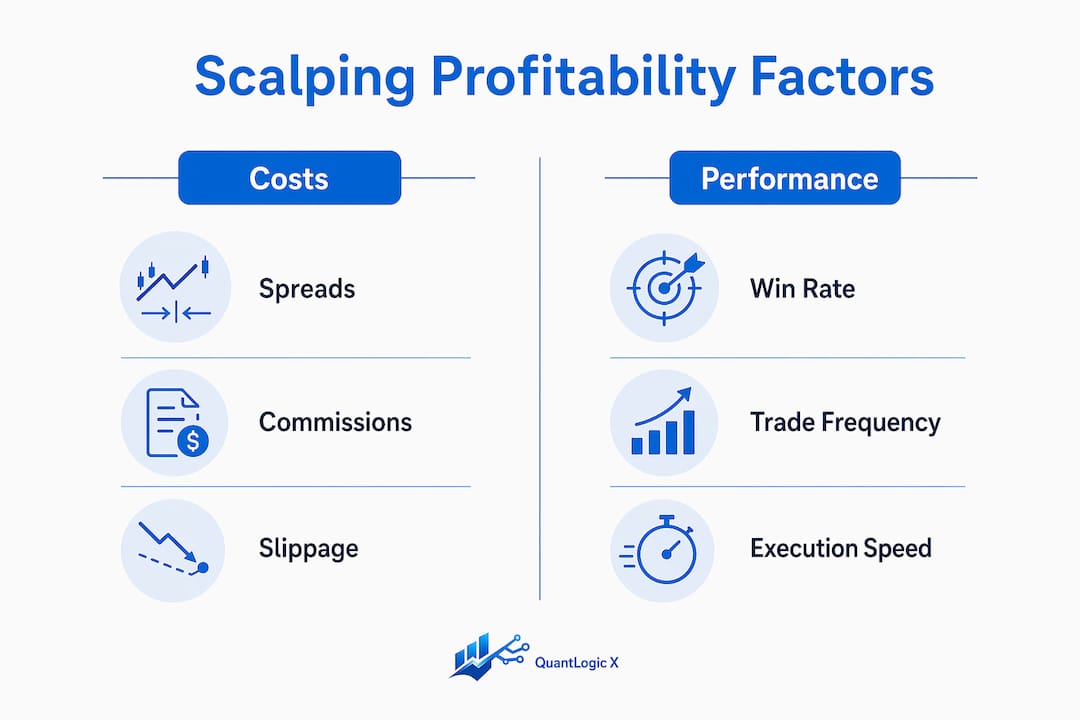
Scalping profitability is determined by the gap between gross trade gains and total execution friction. Execution friction is the combined drag of spreads, commissions, and slippage on every single trade. Because scalpers execute dozens of trades per session, even small per-trade costs compound into significant losses over time.
The core cost components
Three costs define your real profit margin as a scalper:
- Spread: The difference between the bid and ask price. On EUR/USD with a 1.2-pip spread, you start every trade already behind.
- Commission: A flat or per-lot fee charged by the broker per round trip. ECN brokers charge explicit commissions but offer tighter spreads.
- Slippage: The difference between your intended entry price and your actual fill. This is especially damaging during news events when spreads widen sharply and can turn a profitable system into a losing one.
Broker type matters more than most beginners realize. ECN brokers route orders directly to liquidity providers, giving you tighter spreads and faster fills. Market-maker brokers take the other side of your trade, which creates a conflict of interest and often results in worse execution. For scalping, ECN access is not optional. It is a baseline requirement.
Trade frequency also cuts both ways. More trades mean more opportunities to accumulate small gains, but they also mean more exposure to execution costs. A scalper making 50 trades per day at $2 commission per round trip pays $100 in commissions before a single dollar of profit is counted.

Infrastructure compounds this further. Professional scalpers rely on ECN brokers and VPS hosting to minimize latency and get the best possible fills. A VPS server co-located near exchange servers can shave milliseconds off execution time. At the speed scalping operates, milliseconds translate directly into money.
Pro Tip: Before you evaluate any scalping strategy, calculate your total cost per round trip in dollar terms. If your average target gain per trade is $10 and your cost per trade is $4, your effective profit margin is 60% before any losses. That math changes everything.
How profitable is scalping realistically?
Scalping trading profitability follows a clear distribution: most traders lose, a small group breaks even, and a very small group profits consistently. Typical sustainable monthly returns for disciplined retail scalpers run 3–8%, with exceptional months reaching 12–15%. Those numbers assume proper risk management, low-cost execution, and adequate capital.
The capital floor matters more than most guides admit. Minimum viable capital for effective scalping typically ranges from $5,000 to $10,000. Below that threshold, trading costs consume 3–5% per round trip, making consistent profitability nearly impossible regardless of strategy quality.
Profit factor: the metric that actually matters
Win rate is a vanity metric for scalpers. Profit Factor is the number that tells the real story. Profit Factor is calculated as gross profit divided by gross loss, after all fees and slippage are included.
"A Profit Factor of 1.0 means you break even. Below 1.0 means you lose money. The goal is not to maximize it, but to sustain it."
Professional scalpers target a Net Profit Factor between 1.1 and 1.4, with 1.3 or above considered strong. A Profit Factor of 1.5 or higher is possible but rare at scale and often reflects a short sample size rather than a durable edge.
| Profit Factor | What It Means | Sustainability |
|---|---|---|
| Below 1.0 | Losing money after costs | Not viable |
| 1.0–1.1 | Breaking even or marginal | Fragile |
| 1.1–1.3 | Modest net profit | Acceptable |
| 1.3–1.5 | Strong net profit | Solid edge |
| Above 1.5 | High net profit | Rare, verify sample size |
Most retail scalpers overestimate win rates and underestimate trading costs. The result is a trader who sees green on the chart but red in the account. Gross profit visibility on charts does not equal net ledger profitability after fees and execution costs. That gap is where most scalpers fail.
What scalping strategies improve profitability?
Scalping strategy profits come from discipline, timing, and cost control, not from finding a magic entry signal. The following practices separate profitable scalpers from the majority who lose.
-
Trade during peak liquidity windows. The first hour after major market opens (New York at 9:30 AM ET, London at 8:00 AM GMT) offers the tightest spreads and highest volume. Scalping during off-hours widens spreads and increases slippage.
-
Target asymmetric risk-reward ratios. Maintaining asymmetric risk-reward ratios matters more than chasing high win rates for sustainable profits. A 1:1.5 risk-reward ratio with a 55% win rate produces a positive expectancy. A 1:0.8 ratio with a 70% win rate does not.
-
Track net profit, not gross win rate. Log every trade with the actual fill price, not the signal price. Calculate your real cost per trade monthly. If your net Profit Factor drops below 1.1, the strategy needs adjustment before you scale up.
-
Avoid trading through scheduled news events. Economic releases like Non-Farm Payrolls or Fed rate decisions cause spreads to spike. A system that works perfectly in normal conditions can produce catastrophic losses in a 30-second news window.
-
Use algorithmic signal tools to remove hesitation. Delayed entries cost pips. Tools like the Quantlogicx scalping signal algorithm generate real-time long and short signals that remove the cognitive delay between setup recognition and execution.
Pro Tip: Build a scalping signal checklist and review it before every session. Consistent pre-trade routines reduce impulsive entries, which are the single biggest source of avoidable losses for retail scalpers.
How do trading costs and broker selection affect profitability?
Net profitability is dictated more by broker execution friction than by signal logic or win rates. That claim sounds extreme until you run the numbers. A strategy with a 60% win rate and a 1:1.2 risk-reward ratio produces a Profit Factor of roughly 1.44 in theory. Add a 1.5-pip spread and $3 commission per round trip, and that same strategy can fall below 1.0.
ECN vs. market-maker brokers for scalping
| Feature | ECN Broker | Market-Maker Broker |
|---|---|---|
| Spread | Raw (0.0–0.3 pips typical) | Fixed or wider (1.0–2.0 pips) |
| Commission | Yes, per lot | Usually none |
| Order routing | Direct to liquidity pool | Internalized |
| Slippage risk | Low | Higher |
| Best for scalping | Yes | No |
Hidden costs add another layer of damage. Payment for order flow (PFOF) and slippage on stop-loss orders worsen effective risk-reward ratios in ways that never appear on a broker's advertised fee schedule. PFOF means your broker sells your order flow to a third party, which can result in slightly worse fills on every trade. Over hundreds of trades, that adds up.
Order routing speed is the final variable. Direct market access (DMA) platforms execute orders faster than standard retail platforms. For scalpers targeting 5–10 pip moves, a 200-millisecond execution delay can mean the difference between a filled order at your price and a slipped fill that cuts your profit in half.
What psychological challenges do scalpers face?
Scalping demands exceptional mental bandwidth and stamina due to the frequency and speed of decisions required. A scalper making 40 trades in a four-hour session is making a high-stakes decision every six minutes, while simultaneously monitoring price, spread, position size, and risk.
The psychological demands break down into specific, manageable categories:
- Decision fatigue: Cognitive quality degrades over a trading session. Trades placed in the final hour of a session are statistically worse than those placed in the first hour for most retail traders.
- Revenge trading: A string of losses triggers an emotional response to recover quickly. This leads to oversized positions and entries outside the system's rules.
- Overconfidence after wins: A profitable morning session creates a false sense of invincibility. Traders extend their session, take lower-quality setups, and give back gains.
- Paralysis during volatility: Sudden price spikes cause hesitation. Delayed entries or exits in a fast-moving market produce worse fills than a disciplined, pre-planned response.
Physical and psychological endurance are as critical as trading strategy for sustained scalping success. Scheduled breaks, hard daily loss limits, and defined session end times are not optional add-ons. They are core components of a profitable scalping operation.
Key takeaways
Scalping profitability is determined by net profit after all costs, not by win rate, and only a disciplined minority of traders achieve it consistently.
| Point | Details |
|---|---|
| Net profit is what counts | Gross chart gains mean nothing until spreads, commissions, and slippage are subtracted. |
| Profit Factor over win rate | Target a Net Profit Factor of 1.3 or above to confirm a real, sustainable edge. |
| Broker choice is critical | ECN brokers with direct market access reduce execution friction and protect your margin. |
| Capital floor matters | Below $5,000 in trading capital, costs per round trip destroy profitability regardless of strategy. |
| Psychology is a system component | Decision fatigue and revenge trading are measurable threats to net returns, not soft concerns. |
The uncomfortable truth about scalping profitability
I have watched traders spend months refining entry signals while completely ignoring the cost side of the equation. That is the most common and most expensive mistake in scalping. The signal is maybe 30% of the outcome. The other 70% is execution quality, broker infrastructure, position sizing, and the mental discipline to follow the plan when the market moves against you.
The traders I have seen succeed long-term are not the ones with the most sophisticated indicators. They are the ones who treat scalping like a business with a cost structure. They know their average cost per round trip to the decimal. They track Profit Factor weekly, not just win rate. They stop trading at a defined daily loss limit, even when every instinct says the next trade will recover it.
There is also a capital reality that most guides skip. Starting with $2,000 and trying to scalp your way to financial freedom is not a plan. It is a way to pay tuition to the market. The math on costs versus gains simply does not work below a meaningful capital base.
My honest recommendation is to treat the first three months of scalping as a data collection exercise, not a profit-generating one. Track every metric. Identify your real cost per trade. Build your Profit Factor baseline. Only then should you consider scaling position size. The traders who skip this step are the ones who make up the 90% failure statistic.
— Tran
How Quantlogicx supports your scalping edge
Scalping profitability lives or dies on signal timing and execution speed. Quantlogicx was built specifically for traders who need both.
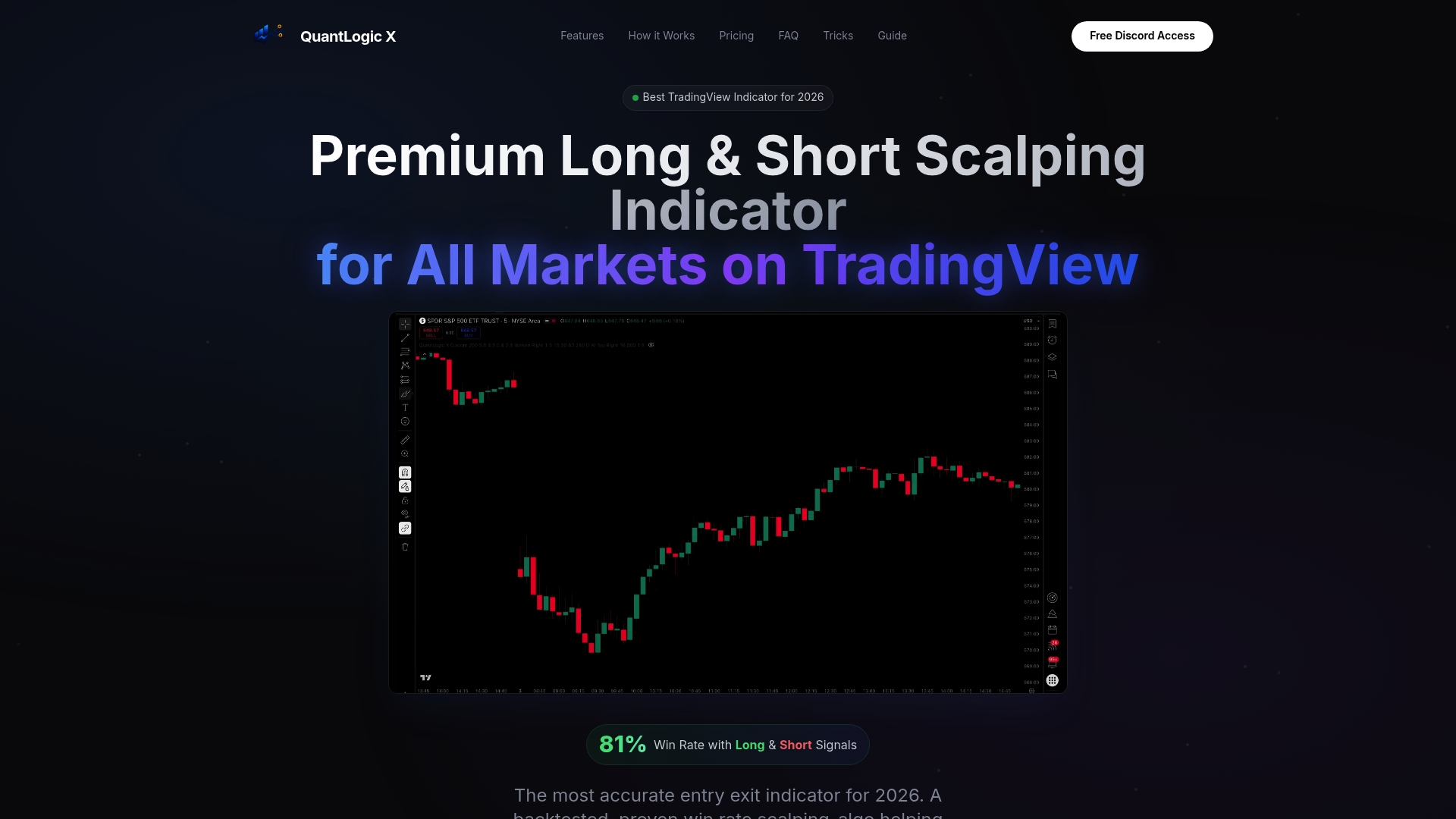
The Quantlogicx TradingView indicator delivers zero-repaint long and short signals across stocks, forex, and crypto, with an 81% win rate verified at bar closure. Over 2,000 traders have used the algorithm, with individual users recording gains of $8,200 in a single month. Real-time alerts remove the hesitation that costs scalpers pips on every delayed entry. Whether you are trading SPY, EUR/USD, or Bitcoin, the Quantlogicx signal suite gives you a structured, data-backed edge without the noise of traditional indicators.
FAQ
What is scalping profitability in simple terms?
Scalping profitability is the net income remaining after all trading costs, including spreads, commissions, and slippage, are deducted from gross trade gains. A positive net result across many small trades defines a profitable scalping operation.
How profitable is scalping for retail traders?
Disciplined retail scalpers typically achieve monthly returns of 3–8%, with exceptional months reaching 12–15%. Fewer than 10–15% of scalpers sustain profitability long-term.
What is a good profit factor for scalping?
A Profit Factor of 1.3 or above is considered strong for scalping. Professional scalpers target a range of 1.1–1.4 after all fees and slippage are included in the calculation.
Is scalping worth it for beginners?
Scalping is viable for beginners who start with adequate capital (at least $5,000), use an ECN broker, and track net profit rather than win rate. Without those foundations, execution costs make consistent profitability unlikely.
How do i reduce costs to improve scalping profits?
Use an ECN broker with direct market access, avoid trading during high-volatility news events, and calculate your real cost per round trip before evaluating any strategy. Lower execution friction directly raises your net Profit Factor.