

Scalping is defined as a short-term trading method where positions are held for seconds to minutes, targeting small, repeated price gains across dozens or hundreds of trades per session. Position trading, by contrast, holds trades for weeks to months, targeting large directional moves driven by macro trends. Understanding how scalping strategy differs from position trading is not just academic. It determines your screen time, risk exposure, technology needs, and whether your personality is even suited to the approach. These two strategies sit at opposite ends of the trading spectrum, and choosing the wrong one is one of the most common and costly mistakes new traders make.
How scalping strategy differs from position trading: timeframes and trade frequency
The most visible contrast between scalping and position trading is how long you hold a trade and how often you trade.
Scalpers work on 1-second to 1-minute charts, reacting to micro price movements with precision. Position traders use daily to weekly charts, reading broader market structure and trend direction. The chart timeframe is not just a preference. It defines the entire decision-making process, from entry triggers to exit logic.

| Factor | Scalping | Position Trading |
|---|---|---|
| Chart Timeframe | 1-second to 1-minute | Daily to weekly |
| Trades Per Month | 200–600 | 1–3 |
| Screen Time | 6–10 hours/day | 1–2 hours/week |
| Trade Duration | Seconds to minutes | Weeks to months |
Scalpers log 6–10 hours of screen time daily, while position traders need only 1–2 hours per week. That difference reshapes your entire lifestyle, not just your trading routine. A scalper's workday looks more like an air traffic controller's than a traditional investor's.
- Scalping generates 200–600 trades per month, requiring fast, repeatable execution
- Position trading produces 1–3 trades per month, requiring patience and conviction
- Scalpers close all positions before the market closes, avoiding overnight exposure
- Position traders carry trades through nights, weekends, and news events
Pro Tip: If you are testing scalping for the first time, start by paper trading on a 1-minute chart for two full weeks before risking real capital. Track your reaction time and decision quality under pressure.
How do risk management strategies differ between scalping and position trading?
Risk management is where the two strategies diverge most sharply in psychological demand.
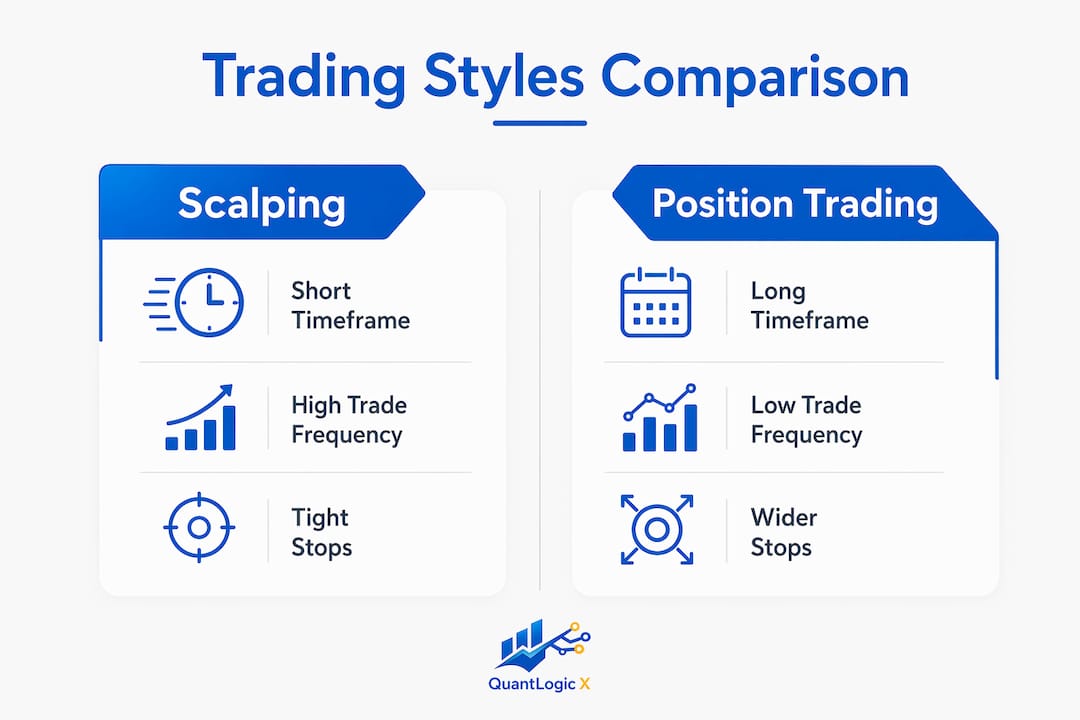
Scalpers use tight stop losses, often just a few ticks or cents from entry. They accept that many individual trades will be losers. The edge comes from winning slightly more often, or winning slightly more per trade, across a high volume of setups. Position traders may endure 15% drawdowns mid-trade without exiting, because the macro thesis is still intact. That requires a completely different mental framework.
Here is how risk behavior breaks down across both styles:
- Scalping: Stop loss is tight, often 0.1%–0.3% from entry; losses are frequent but small
- Scalping: High loss frequency is expected and built into the strategy's math
- Position trading: Stop loss is wide, often 5%–15% from entry; losses are rare but larger in dollar terms
- Position trading: Position sizing with wider stops forces smaller position sizes to maintain the same risk percentage per trade
The psychology of each style is genuinely different. Scalpers must detach emotionally from individual losses and focus on process. Position traders must resist the urge to exit early when a trade moves against them temporarily. Neither is easier. They are just different types of discipline.
Position trading psychology centers on tolerating unrealized drawdowns without reacting prematurely to volatility. That patience is a skill, not a personality trait, and it can be developed with practice.
Pro Tip: Before committing to either style, simulate 20 trades in your chosen timeframe and track how you feel when a trade moves 2% against you. Your gut reaction tells you more than any backtest.
What analysis inputs drive scalping vs position trading decisions?
The information each trader uses to make decisions is fundamentally different, and that gap is wider than most beginners expect.
Scalpers depend on order flow, Level 2 data, tape reading, and short-term technical indicators like VWAP, moving averages on 1-minute charts, and momentum oscillators. Scalpers execute multiple setups daily based on real-time price action and momentum shifts. A scalper's decision cycle runs in seconds. There is no time for fundamental research mid-trade.
Position traders operate on a completely different information diet:
- Macroeconomic data: GDP reports, inflation figures, central bank decisions, and employment data form the foundation of a position trade thesis
- Fundamental analysis: Earnings, revenue growth, sector rotation, and balance sheet strength inform stock selection
- Technical confirmation: Weekly and daily chart patterns confirm entry timing once the macro thesis is established
- Patience for setup: Position trading setups average 1–3 per month, so missing one is not a crisis
- Macro patience: Position trading approaches investor thinking, relying on theses that play out over weeks rather than reacting to short-term noise
The practical implication is clear. A scalper who tries to factor in a Federal Reserve announcement mid-trade will freeze. A position trader who tries to react to every 1-minute candle will overtrade and destroy their edge. Each strategy demands a specific type of attention, and mixing them is a reliable path to losses.
What lifestyle and psychological factors should you consider?
Choosing between scalping and position trading is as much a life decision as a trading decision.
Scalping demands intense, sustained focus for hours at a time. Trader comfort with quick, tight stops and fast exits signals scalping aptitude. If you thrive under pressure, make fast decisions confidently, and can sit at a screen for six or more hours without losing concentration, scalping may suit you. If that description sounds exhausting rather than energizing, it is a signal worth taking seriously.
Position trading suits traders who can hold through volatility without second-guessing their thesis. Overnight risk exposure, including price gaps and swap costs in forex, is a core operational challenge. Position traders must plan for scenarios where the market opens 3%–5% against them due to a weekend headline. That is not a flaw in the strategy. It is a built-in cost of holding for larger moves.
Consider these factors honestly before choosing a style:
- Time availability: Can you commit 6–10 hours of focused screen time daily, or do you have a job, family, or other obligations?
- Stress response: Do you perform better under rapid-fire pressure or with time to think and plan?
- Capital size: Scalping requires lower drawdown tolerance per trade but higher transaction volume; position trading requires capital to absorb wider stops
- Learning curve: Scalping has a steeper short-term learning curve; position trading rewards patience and research skills
For a deeper look at stock trading discipline practices that apply across both styles, the psychological fundamentals remain consistent regardless of timeframe.
Pro Tip: Most experienced traders recommend starting with daily charts and position trading before attempting scalping. The slower pace lets you build pattern recognition and risk discipline without the pressure of split-second decisions.
How do transaction costs and technology impact each strategy?
Transaction costs are a minor consideration for position traders and a make-or-break factor for scalpers.
Slippage and commissions materially reduce scalping edge, turning a theoretical 2:1 risk-reward ratio into roughly 1.14:1 effective after costs. That compression means a scalping strategy that looks profitable in backtesting can lose money in live trading if execution is sloppy. Position trading amortizes those same costs across a much larger price move, so a $5 commission on a trade targeting a $500 gain is essentially noise.
| Cost Factor | Scalping Impact | Position Trading Impact |
|---|---|---|
| Commissions | High: paid on every trade | Low: spread across large moves |
| Slippage | Critical: can erase edge | Minimal: entry precision less critical |
| Spread | Significant on each entry | Negligible relative to target |
| Platform Speed | Execution speed is essential | Analysis tools matter more |
Technology requirements also split sharply. Scalpers use direct-access platforms like DAS Trader Pro and Sterling Trader Pro with hotkeys to minimize execution time. A 0.5-second delay in order entry can turn a winning scalp into a loss. Position traders benefit more from macro analysis tools, risk management software, and charting platforms that support multi-timeframe analysis.
Scalping backtests must model slippage and fill imperfections realistically, since 30%–40% of trades may not fill as expected. That is a sobering number for anyone building a scalping system on paper results alone.
Pro Tip: For scalping, always test your strategy on a live demo account with real market spreads before going live. Backtested results without realistic slippage modeling are almost always overstated.
Key takeaways
Scalping and position trading require entirely different skill sets, tools, and psychological profiles, making strategy selection one of the most consequential decisions a trader makes.
| Point | Details |
|---|---|
| Trade frequency gap | Scalpers execute 200–600 trades monthly; position traders take 1–3 trades monthly. |
| Screen time commitment | Scalping demands 6–10 hours daily; position trading requires only 1–2 hours weekly. |
| Risk management style | Scalpers use tight stops with frequent small losses; position traders tolerate wider drawdowns via position sizing. |
| Cost sensitivity | Transaction costs and slippage are critical for scalpers but negligible for position traders targeting large moves. |
| Lifestyle fit | Choose based on your available time, stress tolerance, and comfort with fast versus patient decision-making. |
Why most traders pick the wrong strategy first
I have watched traders blow accounts not because their strategy was wrong, but because they chose a style that did not match who they are. A position trader trying to scalp is like a marathon runner entering a sprint. The fitness is there, but the mechanics are completely different.
The most common mistake I see is new traders gravitating toward scalping because it looks exciting and fast. The reality is that scalping forces dozens of decisions daily under real financial pressure, and most people are not wired for that without significant preparation. The traders who succeed at scalping long-term are not the ones who are most aggressive. They are the ones who are most consistent and most disciplined about cutting losses fast.
Position trading gets underestimated because it looks passive. Holding a trade for six weeks while it moves against you by 8% before reversing is one of the hardest things to do in markets. It requires genuine conviction in your thesis and the emotional maturity to separate short-term noise from long-term signal.
My honest recommendation: spend at least three months on daily charts before you ever open a 1-minute chart with real money. The pattern recognition you build at the slower pace transfers directly to faster timeframes. The reverse is rarely true.
Technology helps both styles, but it does not replace the foundational work. A solid scalping signal algorithm can sharpen your entries, but only if you already understand what you are looking for and why.
— Tran
Get cleaner signals for both scalping and position trades
Whether you are executing rapid scalps or holding multi-week positions, signal quality determines your edge. Quantlogicx built its TradingView indicator specifically to solve the noise problem that plagues both styles.
The Quantlogicx indicator uses zero repaint technology, meaning every long and short signal confirmed at bar close stays on the chart. Over 2,000 traders use it across stocks, forex, and cryptocurrency, with individual users recording gains of $8,200 in a single month. The real-time forex signals feature works equally well for scalpers needing fast entry confirmation and position traders waiting for high-conviction setups. If you want signals you can actually trust, explore Quantlogicx and see the live results for yourself.
FAQ
What is scalping in trading?
Scalping is a trading strategy where positions are held for seconds to minutes, targeting small price movements across a high volume of trades. Scalpers typically execute 200–600 trades per month using 1-minute or shorter charts.
How does scalping differ from position trading in risk?
Scalpers use tight stop losses and accept frequent small losses as part of their edge. Position traders tolerate wider drawdowns, sometimes 15% or more mid-trade, and manage risk primarily through position sizing rather than tight stops.
Can you use the same indicators for scalping and position trading?
Some indicators like moving averages and RSI apply to both styles, but the settings and chart timeframes differ significantly. Scalpers need fast, responsive signals on 1-minute charts, while position traders rely on weekly and daily chart confirmations.
Which strategy is better for beginners?
Position trading is better suited for beginners because the slower pace allows time to analyze decisions, learn from mistakes, and build risk discipline without the pressure of split-second execution. Most experienced traders recommend starting on daily charts before attempting scalping.
How do transaction costs affect scalping vs position trading?
Transaction costs are critical for scalpers because frequent trades amplify the impact of spreads and commissions, potentially turning a 2:1 risk-reward into roughly 1.14:1 effective. Position traders spread those same costs across much larger price moves, making them far less significant.