

Scalping is defined as a short-term trading method where traders capture small price moves across dozens or hundreds of trades per session. The ways to maximize returns scalping tools offer come down to three pillars: execution speed, order flow intelligence, and automated risk controls. Platforms like DAS Trader Pro, Sterling Trader Pro, and Lightspeed Trader give professional scalpers direct market access with hotkey-driven order entry. Limiting risk to 0.1%–0.25% per trade is the standard that separates accounts that survive from accounts that blow up.
What essential scalping tools and data feeds do you need to maximize returns?
The foundation of any high win rate scalping workflow is Level 2 order book data combined with Time and Sales tape reading. These two feeds show you exactly where buyers and sellers are stacking orders in real time. Chart indicators alone cannot replicate that. Reading Level 2 and order flow to detect institutional absorption is the key differentiator between profitable scalpers and retail traders who rely on lagging signals.
Platforms that give you a real edge
DAS Trader Pro, Lightspeed Trader, and Sterling Trader Pro are the three platforms most professional equity scalpers use. Each offers direct market access, fully customizable hotkeys, and sub-second order routing. Hotkey customization is not a convenience feature. Even a one-second delay in order entry drastically reduces profitability at the volume scalpers trade.

For crypto and forex scalpers, TradingView paired with a broker API gives you advanced charting plus automated signal execution. Quantlogicx integrates directly with TradingView, delivering zero-repaint long and short signals that confirm at bar close. Over 2,000 traders use the Quantlogicx algorithm across stocks, forex, and crypto.
Minimum hardware and software requirements
Your setup determines your ceiling. Professional scalpers use wired internet connections, not Wi-Fi, to eliminate packet loss. Multi-monitor displays let you watch Level 2, Time and Sales, and your chart simultaneously without toggling windows.
- Internet: Wired ethernet, under 10ms latency to your broker's server
- Monitors: Two monitors minimum; three is the professional standard
- Platform: DAS Trader Pro, Lightspeed Trader, or Sterling Trader Pro for equities
- Data feed: Direct exchange feed, not a delayed or aggregated feed
- Order entry: Hotkeys mapped for buy, sell, stop, and bracket orders
Pro Tip: Upgrade to direct API-based order routing if you place 15 or more trades daily. API execution cuts order entry time from over 5 seconds manually to under 1 second, which compounds across every session.
How does automation improve scalping execution and efficiency?
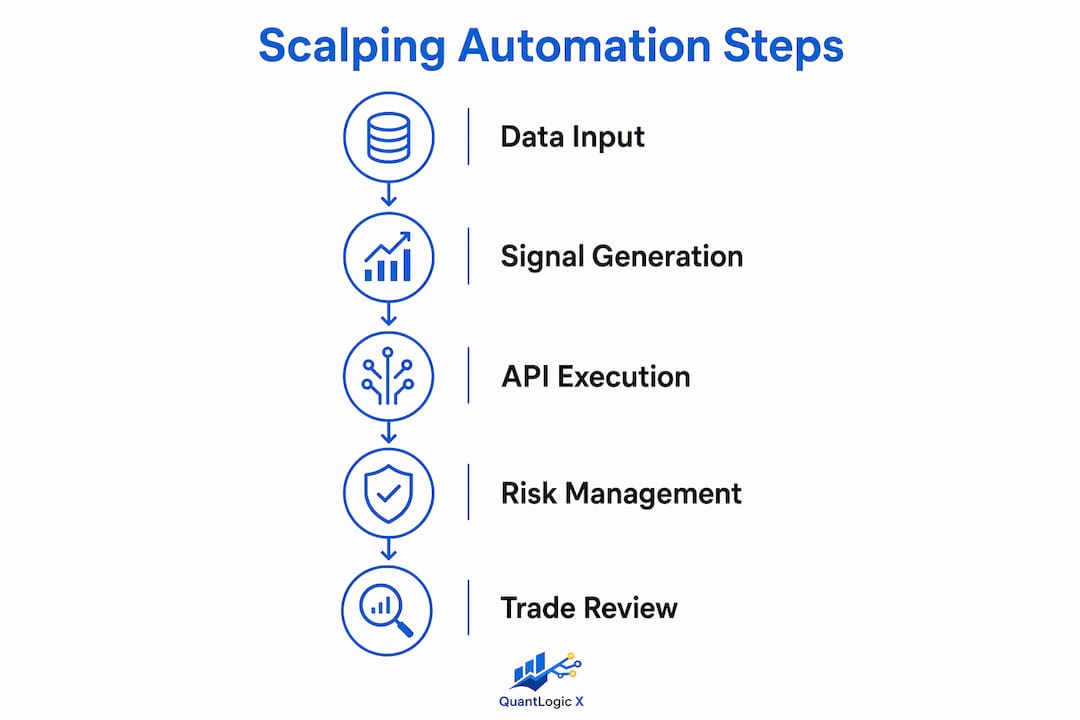
Automation removes the two biggest enemies of scalping consistency: hesitation and emotional override. API-based automated order entry with preset bracket orders fires your stop loss and take profit the instant your entry fills. You no longer have to manually place protective orders under pressure.
Volatility-adjusted stops vs. fixed stops
Fixed tick stops fail scalpers because volatility changes throughout the session. Volatility-adjusted stops of 1.2x to 1.8x ATR(14) adapt to current market conditions automatically. The most common default is 1.5x ATR(14), with profit targets set at 1R to 2.5R depending on immediate market structure. This approach keeps your stop placement logical rather than arbitrary.
Order flow concepts every scalper must know
Absorption is the single most important concept in professional execution frameworks. Absorption happens when a large seller is present at a price level but price refuses to drop. Institutions are absorbing the sell pressure. Recognizing absorption in the Level 2 book lets you enter before the breakout, not after it.
| Factor | Manual execution | Automated execution |
|---|---|---|
| Order entry speed | 3–5 seconds average | Under 1 second |
| Stop loss placement | Manual after fill | Preset bracket, fires instantly |
| Emotional override risk | High | Eliminated at order level |
| Consistency across trades | Variable | Uniform every trade |
| Best for | Under 10 trades/day | 15+ trades/day |
Pro Tip: Use TradingView's alert-to-webhook feature to trigger automated entries from your scalping indicator signals. This keeps your execution consistent whether you are watching the screen or stepped away briefly.
What step-by-step workflow builds a high win rate scalping strategy?
A scalping signal checklist before each trade prevents impulsive entries. Professional scalpers maintain a 55%–70% win rate to overcome transaction costs while executing many trades per session. That win rate is not accidental. It comes from a repeatable pre-trade process.
The five-step execution sequence
- Set your risk limits. Cap each trade at 0.1%–0.25% of account capital. Set a hard daily max loss before the session opens.
- Confirm the signal. Look for volume acceleration, a tape reading cue, and momentum confirmation. All three should align before entry.
- Enter via hotkey. Use your pre-mapped hotkey to fire the order. Do not type manually under live conditions.
- Bracket immediately. Your stop loss and take profit should be preset. Confirm they are active the moment your fill confirms.
- Monitor and exit. Watch price action for 30–60 seconds. If the trade does not move as expected, exit at break-even.
Profit targets, stops, and risk/reward ratios
Typical profit targets for equity scalpers are $0.05–$0.25 per share or equivalent small tick moves in futures and crypto. The risk/reward ratio in scalping is tighter than swing trading, typically 1:1 to 1.3:1. That ratio works because the win rate is high and the trade frequency is high.
| Metric | Typical range |
|---|---|
| Profit target per share | $0.05–$0.25 |
| Stop distance | 1.2x–1.8x ATR(14) |
| Risk/reward ratio | 1:1 to 1.3:1 |
| Win rate target | 55%–70% |
| Risk per trade | 0.1%–0.25% of capital |
Pro Tip: The scratch trade is your most underused tool. If price stalls within 30–60 seconds of entry, exit at break-even. Time in a trade is a hidden cost. Exiting flat beats exiting at a loss every time.
Which mistakes most damage scalping returns and how do you fix them?
Revenge trading is the fastest way to destroy a scalping account. Stopping after 2–3 consecutive losses prevents the emotional spiral that turns a bad morning into a blown account. Hard session loss caps are not optional. They are the rule that keeps you in the game tomorrow.
The indicator overload trap
Stacking too many signals causes analysis paralysis. The rule of three solves this: one trend filter, one momentum trigger, and one volatility stop. That combination gives you enough confirmation without freezing your decision process in a sub-second window. Simplified signal sets are what make scalping decisions fast enough to be profitable.
Fee structure: the silent profit killer
Most retail scalpers ignore fees until they wonder why a winning strategy loses money. Maker/taker fee differences mean identical strategies can produce profits or losses depending on order type. Professional scalpers operate at maker rebate tiers and use limit orders aggressively. Taker fees on every entry and exit compound into a significant drag across hundreds of trades per week.
Common mistakes that cut scalping returns:
- Entering trades without all three signal confirmations present
- Using market orders when limit orders would qualify for maker rebates
- Trading through low-volume midday hours when spreads widen
- Ignoring daily loss limits and continuing to trade after the cap is hit
- Reviewing trades only when losing, not systematically after every session
Systematic trade review separates traders who improve from traders who repeat the same errors. Log every trade with entry reason, exit reason, and outcome. Review weekly, not just when something goes wrong.
Key Takeaways
Scalping returns depend on execution speed, order flow intelligence, and strict risk controls working together as one system.
| Point | Details |
|---|---|
| Risk per trade | Limit each trade to 0.1%–0.25% of capital to survive losing streaks. |
| Order flow over indicators | Level 2 and absorption detection beat lagging chart indicators for entry timing. |
| Automate bracket orders | API-based execution fires stops and targets in under 1 second, removing emotional override. |
| Rule of three signals | Use one trend filter, one momentum trigger, and one volatility stop to avoid paralysis. |
| Scratch trades save capital | Exit at break-even if price stalls within 30–60 seconds. Time in trade is a cost. |
What 10 years of scalping taught me about tools and discipline
The traders I have watched fail consistently shared one trait: they believed better tools would fix poor discipline. They chased indicators, upgraded platforms, and added more data feeds. None of it helped until they fixed the behavior underneath.
The real shift happens when you treat execution as a system, not a skill you improvise. Automation changed my own approach more than any single indicator. Once bracket orders fired automatically, I stopped second-guessing exits. That one change alone improved consistency more than months of indicator testing.
Win rate matters less than most traders think. A 60% win rate with a 1:1 risk/reward ratio is profitable. A 70% win rate with poor fee management and revenge trading is not. The math only works when every variable is controlled, including your own psychology.
My honest advice: start with the scalping profitability fundamentals before adding complexity. Master Level 2 reading, set your daily loss cap, and automate your exits. Add tools only when your base process is already working. Tools amplify what you already do. They do not replace the process.
— Tran
How Quantlogicx helps scalpers act on better signals faster
Scalpers who have the right execution framework still need reliable signal confirmation. Quantlogicx delivers exactly that through its TradingView indicator, which generates zero-repaint long and short signals confirmed at bar close. The 81% win rate the platform reports comes from over 2,000 active traders across stocks, forex, and crypto, with individual users recording gains like $8,200 in a single month.
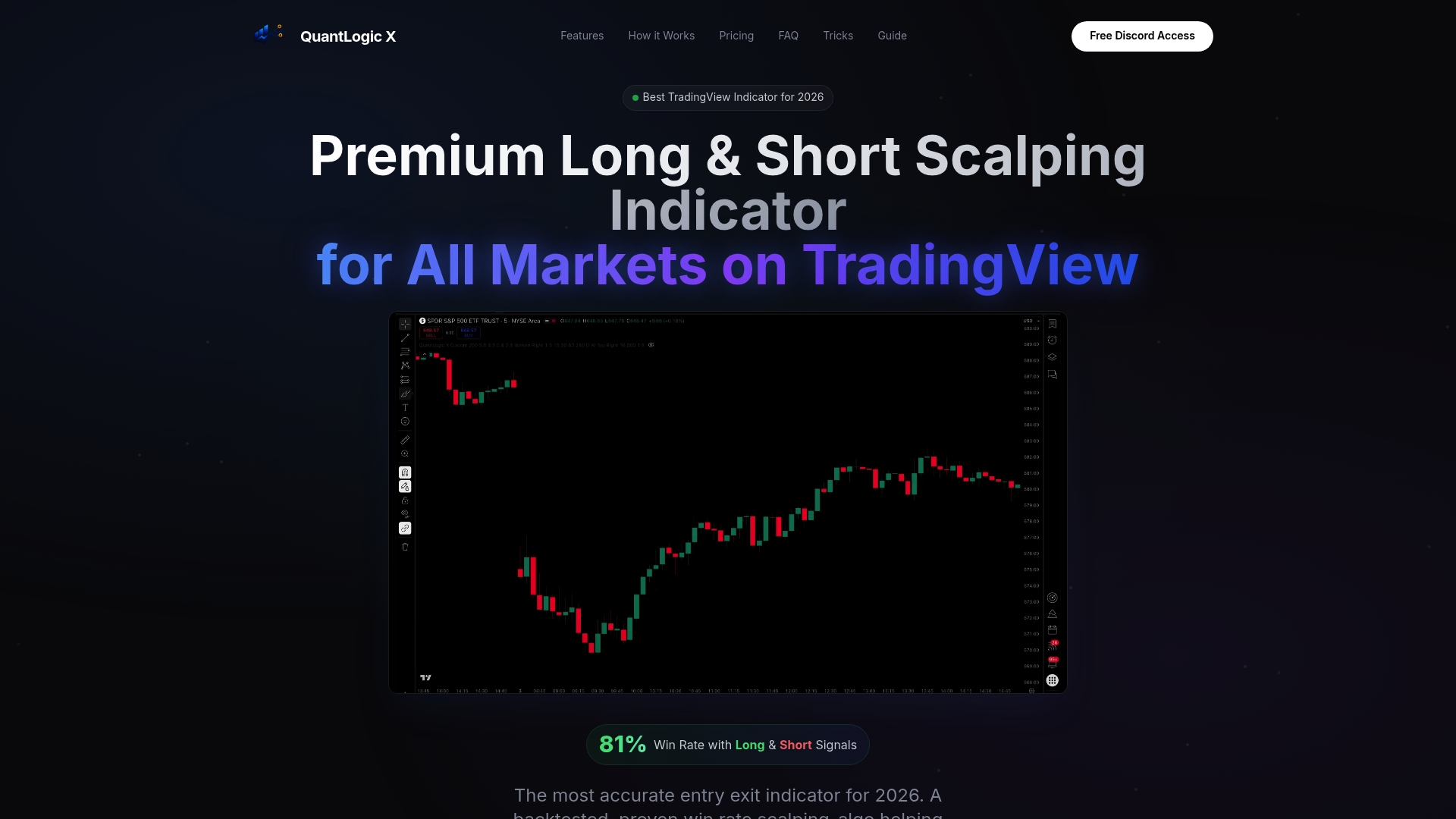
Quantlogicx integrates with TradingView's alert system, so you can connect signals directly to your broker API for automated execution. Real-time alerts fire the moment a signal confirms, keeping your reaction time as short as possible. Traders looking for the best buy-sell indicator for scalping in 2026 will find Quantlogicx built specifically for the speed and accuracy this style of trading demands. Explore the full indicator at Quantlogicx.
FAQ
What is the best risk per trade for scalping?
Professional scalpers limit risk to 0.1%–0.25% of total account capital per trade. This range keeps individual losses small enough that a losing streak does not threaten the account.
Why is Level 2 data more important than chart indicators for scalping?
Level 2 order book data shows real-time institutional order flow and absorption, which reveals where price is likely to move before it moves. Chart indicators lag price by definition and cannot show that information.
How many signals should a scalping setup use?
The rule of three is the professional standard: one trend filter, one momentum trigger, and one volatility stop. More signals create analysis paralysis in sub-second decision windows.
What is a scratch trade and when should you use it?
A scratch trade is an exit at break-even when price fails to move as expected within 30–60 seconds of entry. It preserves capital and avoids the hidden cost of holding a stalled position.
Does automation actually improve scalping returns?
Yes. API-based execution cuts order entry time from over 5 seconds to under 1 second and eliminates emotional override on stop and target placement. Traders placing 15 or more trades daily see the largest benefit.