

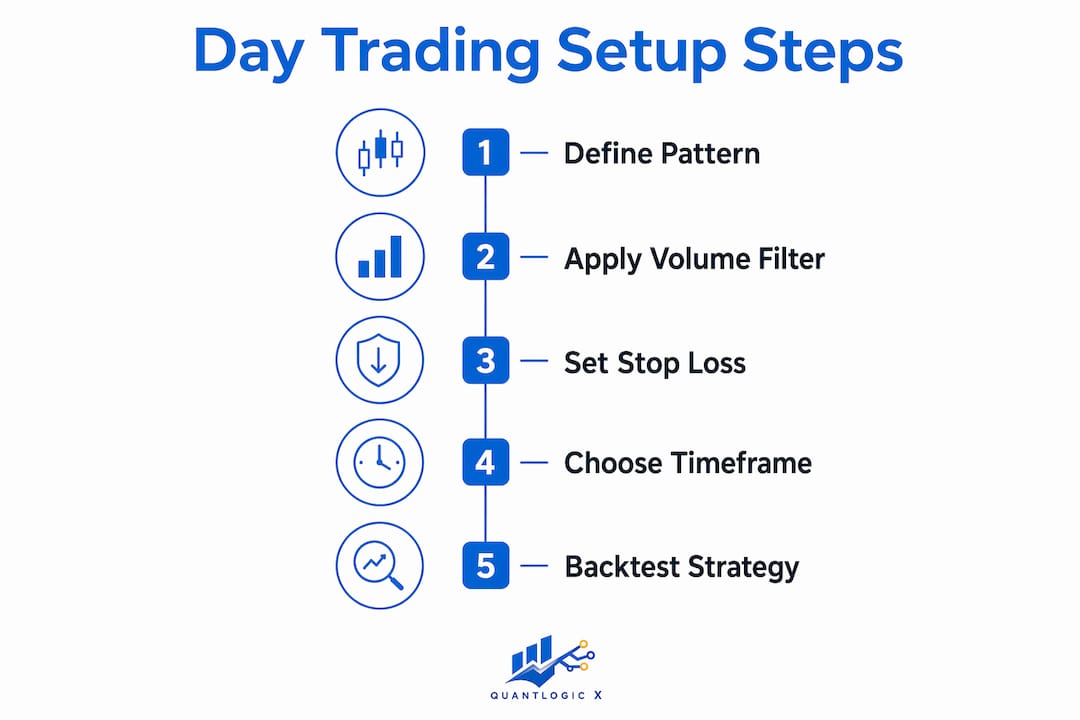
A day trading setup is a predefined checklist of price, volume, and market context conditions that must all be present before you place a trade. It is not a buy signal, a gut feeling, or a strategy. Think of it as the "green light" criteria your trade must pass before you touch the order button. Brokers like Fidelity, regulatory bodies like FINRA, and professional traders all treat the setup as the foundation of disciplined intraday trading. Without one, you are reacting to noise rather than acting on a plan. This guide breaks down every layer of an effective day trading setup, from the patterns and volume filters that define it, to the equipment and regulations that shape how you execute it.
What is a day trading setup, and how does it work?
A day trading setup is a repeatable set of predefined market conditions, including price context, volume behavior, and a specific entry trigger, that a trader must confirm before opening a position. The setup does not tell you the trade will be profitable. It tells you the conditions are favorable enough to take the risk according to your rules.
The distinction between a setup, a signal, and a strategy confuses most beginners, and that confusion is expensive. Here is how the three relate:
- Setup: The broader context and conditions checklist. Example: a stock is above its 9 EMA, volume is running at 1.8x its 20-day average (RVOL of 1.8), and price is consolidating just below a key resistance level. All boxes checked. You are now in "ready" mode.
- Signal: The specific moment to act within the setup. Example: price breaks above resistance on a strong candle with expanding volume. That is your trigger to enter.
- Strategy: The full plan that governs everything. It dictates which markets you trade, which setups you use, how much you risk per trade, and how you manage open positions.
Setups come before signals in every quality trade. Entering on a signal alone, without confirming the setup conditions first, produces low-quality trades because you lack the context to know whether the signal is meaningful or just random price movement.
A practical example: a breakout signal on a stock with below-average volume is far less reliable than the same breakout on a stock with RVOL above 1.5. The signal looks identical on the chart. The setup context is what separates a high-probability trade from a coin flip.

Trading setups are not guarantees but rule-based entry frameworks within a larger strategy that includes market selection, timeframe choice, and risk controls. Understanding this keeps you from over-trading and chasing every move.
What are the key components of effective day trading setups?
Effective setups pair recurring price patterns with volume filters and clear invalidation levels, with backtesting on 200 or more historical runs recommended before trading any setup live. That number matters because fewer than 200 samples gives you statistically unreliable win rate data.
Classic setup patterns worth knowing
The four patterns that appear most frequently in professional day trading playbooks are breakout, fade, range, and gap-and-go.
Breakout setups trigger when price moves decisively above a resistance level or below a support level on strong volume. The setup conditions require consolidation near the level, RVOL above 1.5, and a clear stop below the breakout point.
Fade setups work in the opposite direction. You trade against an overextended move, typically after a gap or spike, when volume begins to dry up and price shows reversal candles. The invalidation level is the high of the spike.
Range setups apply when price is bouncing between defined support and resistance. You buy near support and sell near resistance, with stops just outside the range boundaries.
Gap-and-go setups focus on stocks that open significantly higher or lower than the prior close, then continue in the gap direction after a brief consolidation. Volume confirmation is non-negotiable here.
Volume filters and invalidation levels
| Setup Type | RVOL Minimum | Invalidation Level | Ideal Timeframe |
|---|---|---|---|
| Breakout | 1.5x | Below breakout candle low | 1-minute to 5-minute |
| Fade | 0.8x (declining) | Above spike high | 1-minute to 2-minute |
| Range | 1.0x | Outside range boundary | 5-minute to 15-minute |
| Gap-and-go | 2.0x | Below consolidation low | 1-minute to 5-minute |
Choosing the right chart timeframe depends on your intended holding period. Scalpers holding for seconds to minutes use 1-minute charts. Traders holding for 30 to 90 minutes use 5-minute or 15-minute charts. Mixing timeframes without a rule creates confusion about which signal to act on.
Pro Tip: Before trading any setup live, run it through at least 200 historical chart examples and record your win rate, average winner, and average loser. A setup with a 55% win rate and a 2:1 reward-to-risk ratio is mathematically profitable even if it feels uncomfortable in the moment.
How to operationalize your day trading setup: tools and workspace
Fidelity identifies broker selection and workspace optimization as the first critical steps for intraday trading readiness, before any strategy execution begins. Your setup is only as reliable as the environment you execute it in.
Here is how to build a functional day trading workspace from the ground up:
-
Choose a broker and platform with real-time data. Fidelity's Active Trader Pro integrates order management and real-time data in one workspace, which is critical for confirming volume and price action simultaneously. Other platforms offer similar functionality, but confirm your broker provides Level 2 quotes and time-and-sales data before committing.
-
Set up your monitors. Two monitors is the practical minimum for day trading. One screen runs your charts and setups. The second handles your order entry, news feed, and watchlist. Three monitors is the standard for traders managing multiple positions simultaneously.
-
Secure your internet connection. Wired Ethernet with at least 25 Mbps download speed and a ping under 50 ms is the baseline requirement. Latency matters more than raw speed because a delayed fill on a fast-moving breakout can turn a winning trade into a losing one.
-
Build redundancy into your setup. Test a mobile hotspot as a backup connection during live trading hours. Backup connectivity is necessary to manage risk if your primary connection drops mid-session. Losing your connection during an open position is a real operational risk, not a theoretical one.
-
Organize your workspace for mental clarity. A cluttered desk creates a cluttered decision process. Keep only the charts and tools you need for your active setups visible. Close unrelated browser tabs and notifications during trading hours.
-
Use a scalping signal checklist to standardize your pre-trade review. Running through a written checklist before each trade forces you to confirm every setup condition rather than skipping steps when the market moves fast.
Pro Tip: Test your full setup, including platform, data feed, and backup internet, during pre-market hours before your first live trading day. Discovering a latency problem at 9:31 AM is far more costly than finding it at 8:45 AM.
What regulatory and risk management factors shape day trading setups?
Regulation directly determines how many trades you can legally make and how much capital you need to make them. Ignoring this layer is one of the most common and costly beginner mistakes.
Key regulatory and risk factors every new day trader must understand:
- Pattern Day Trader (PDT) rule: FINRA historically defined a pattern day trader as anyone who executes four or more day trades within five business days in a margin account, requiring a minimum $25,000 equity balance to continue trading.
- 2026 regulatory amendments: Recent FINRA amendments propose removing the $25,000 minimum equity requirement in favor of intraday margin requirements. This shift changes how frequently traders can enter positions legally and reshapes viable setup playbooks, especially for beginners with smaller accounts.
- Intraday margin requirements: Under the proposed framework, traders must meet intraday margin thresholds per position rather than maintaining a fixed account minimum. This means your position sizing rules become part of your setup criteria, not an afterthought.
- Stop losses as regulatory compliance tools: Embedding a hard stop loss into every setup is not just risk management. It is how you control your intraday margin exposure under the new framework.
- Heightened intraday risk: Intraday trading requires strict money management because losses accumulate quickly without discipline. A single oversized position can wipe out multiple winning trades in one session.
"The regulatory shift from a fixed equity minimum to intraday margin requirements means beginners can now access day trading with smaller accounts, but the discipline required to manage margin exposure per trade is actually higher, not lower."
Understanding how regulatory rules connect to your account setup is the difference between building a sustainable trading practice and blowing up an account in the first month.
Key takeaways
A day trading setup is the predefined conditions checklist that separates disciplined, rule-based trading from emotional, reactive decision-making.
| Point | Details |
|---|---|
| Setup vs. signal | A setup defines conditions; a signal is the trigger to act only after all conditions are met. |
| Volume confirmation | Use RVOL filters of 1.5 to 2.0 to confirm setup validity before entering any trade. |
| Workspace requirements | Wired Ethernet under 50 ms ping and a backup connection are non-negotiable for reliable execution. |
| Regulatory awareness | FINRA's 2026 amendments replace the $25,000 PDT minimum with intraday margin rules, reshaping beginner setup playbooks. |
| Mechanical discipline | Profitable traders use a playbook of 2 to 3 setups with fixed rules rather than improvising across dozens of patterns. |
Why most beginners get setups wrong before they even start
Most beginners treat a trading setup as a synonym for a trade idea. They see a stock moving, feel urgency, and enter. That is not a setup. That is a reaction. The difference in long-term results between those two behaviors is enormous.
Professional day traders use a finite playbook of 2 to 3 setups with mechanical rules for entries, stops, and profit targets rather than improvising constantly. I have watched traders with access to every indicator imaginable underperform traders who mastered a single breakout setup on the 5-minute chart. The edge is not in complexity. It is in repetition and recognition.
The other mistake I see constantly is treating the workspace as optional. Your setup is a mental and physical system. If your data feed lags, your charts are disorganized, or your order entry platform is unfamiliar, you will hesitate at the exact moment you need to act. That hesitation costs money.
The regulatory changes in 2026 are genuinely good news for beginners with smaller accounts, but they come with a hidden trap. Removing the $25,000 barrier makes day trading accessible to more people, which means more underprepared traders will enter the market. The discipline required to manage intraday margin exposure per position is actually more demanding than simply maintaining a minimum balance. Beginners who treat the rule change as a green light without building a proper setup framework first will find out quickly why the $25,000 rule existed in the first place.
Start with one setup. Backtest it on 200 historical examples. Learn what it looks like when it works and when it fails. Then build your workspace around executing that one setup reliably. That is how you build a trading entry signal process that actually holds up under live market pressure.
— Tran
Take your setup execution further with Quantlogicx
Building a solid setup framework is the foundation. Having a tool that identifies those conditions in real time is what separates traders who execute consistently from those who second-guess every entry.
Quantlogicx's Long & Short TradingView Indicator is built specifically for traders who want clear, no-repaint signals that confirm setup conditions at bar close. Over 2,000 traders use it across stocks, forex, and cryptocurrency, with individual users recording gains of $8,200 in a single month. The indicator's 81% win rate complements the manual setup work you do, giving you a second layer of confirmation before you pull the trigger. Visit Quantlogicx to see how it fits your setup playbook.
FAQ
What is a day trading setup in simple terms?
A day trading setup is a checklist of specific market conditions, including price pattern, volume level, and context, that must all be present before you enter a trade. It is the pre-trade filter that separates planned trades from impulsive ones.
How is a setup different from a trading signal?
A setup defines the conditions that must exist before a trade is valid. A signal is the specific trigger, such as a breakout candle, that tells you to act once those conditions are already confirmed.
What do you need for a day trading setup to work reliably?
You need a defined price pattern, a volume filter like RVOL above 1.5, a clear stop-loss level, a compatible trading platform with real-time data, and a stable wired internet connection with a backup option.
Does the 2026 FINRA rule change affect my day trading setup?
Yes. The proposed removal of the $25,000 PDT minimum equity requirement in favor of intraday margin rules means beginners can trade with smaller accounts, but position sizing and stop-loss placement become even more critical components of every setup.
How many setups should a beginner day trader learn?
Start with one or two setups and master them before adding more. Profitable traders typically operate from a mechanical playbook of two to three setups with fixed rules, which builds the pattern recognition needed for consistent execution.