

A non-repainting indicator is a trading tool that generates signals which stay fixed once a price bar closes, giving traders consistent data that does not change after the fact. This stability is the foundation of honest backtesting and confident trade execution. The core principle behind non-repainting behavior is called confirmed-bar logic: signals are only plotted using data from fully closed candles, never from bars still forming. Quantlogicx builds its TradingView indicator on this exact principle, locking long and short signals at bar closure so traders see what actually happened, not a revised version of history.
What is a non-repainting indicator and how does it differ from repainting?
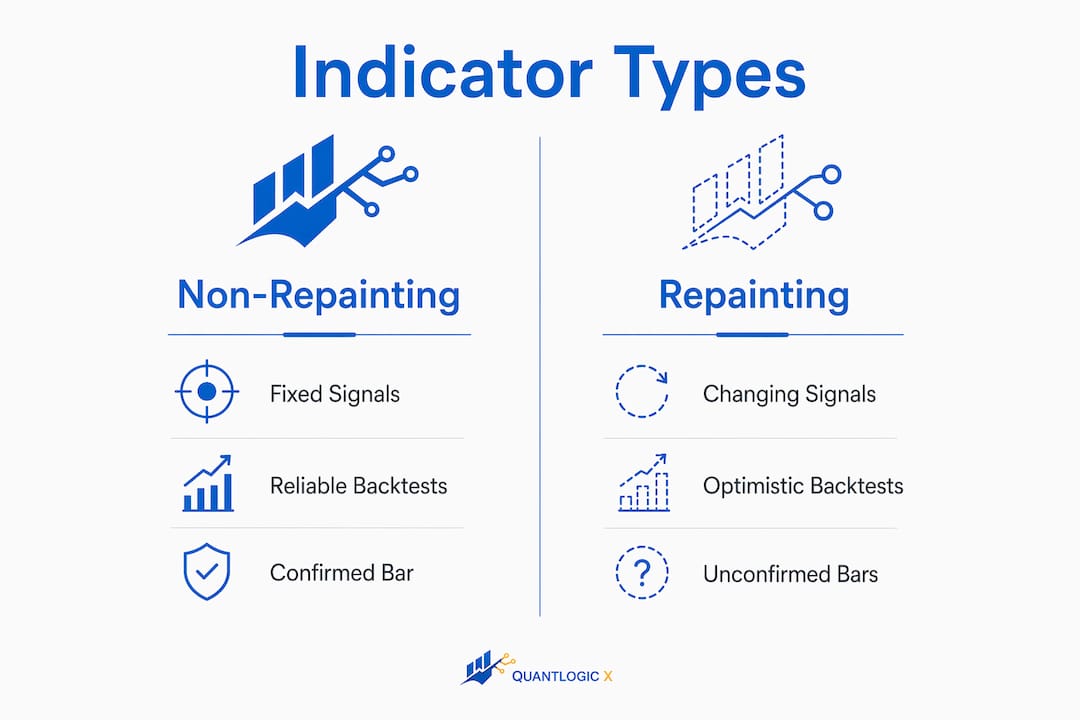
A non-repainting indicator locks confirmed signals after candle close, preventing any signal from moving or disappearing once the bar is finalized. That single behavior separates reliable indicators from misleading ones. Repainting indicators, by contrast, modify historical signals after price bars close. A buy arrow that appeared at bar open may vanish or shift to a different price level by the time the candle closes. Traders who rely on those signals are making decisions based on data that no longer reflects what the chart showed in real time.

The practical damage from repainting is significant. When you run a backtest on a repainting indicator, the historical chart shows signals exactly where price moved favorably. That creates the illusion of accuracy. In live trading, those same signals never existed at the moment you needed them. Many repainting complaints stem from indicators that modify signals on historical bars, giving the impression of accuracy that did not exist during live trading.
Here is how the two types behave differently on a chart:
- Repainting indicator: A buy signal appears mid-candle, then disappears or relocates after the bar closes. Historical view looks perfect. Live trading results do not match.
- Non-repainting indicator: A buy signal appears only after the candle closes with confirmed data. The signal stays fixed. What you see in history is what you would have seen in real time.
- Alert behavior: Repainting indicators often fire alerts on intrabar price movements. Non-repainting indicators fire alerts only on confirmed bar closes.
- Backtesting validity: Non-repainting indicators produce backtests that reflect real trading conditions. Repainting indicators produce backtests that flatter the strategy.
Pro Tip: When evaluating any indicator, scroll back on the chart and watch a signal form in real time using replay mode. If the signal moves or disappears before the candle closes, the indicator repaints.
Why are non-repainting indicators valued by traders?
Non-repainting indicators give traders a more honest chart view, showing where signals actually appeared so traders can judge whether setups were genuinely tradable. That honesty is the core value. Without it, every backtest is fiction.
The advantages extend beyond backtesting accuracy:
- Signal trust: Traders can act on a confirmed signal without worrying it will vanish after entry.
- Strategy assessment: Historical performance reflects real conditions, so strategy adjustments are based on accurate data.
- Reduced emotional noise: Signals that do not flicker or disappear reduce second-guessing during live trades.
- Consistent alert timing: Alerts fire at bar close, matching the signal on the chart and eliminating confusion between what the alert said and what the chart shows.
One important misconception needs addressing directly. Non-repainting does not mean infallible. A non-repainting indicator does not guarantee profitable trading but provides a more trustworthy chart representation for proper evaluation and strategy design. The signal is stable. Whether the market moves in your favor after that signal is a separate question entirely.
"Stable execution beats maximum signal frequency. Complexity can inadvertently introduce repainting problems." — Industry consensus from experienced Pine Script developers
Traders who understand this distinction use non-repainting indicators as one component of a broader strategy, not as a standalone profit machine. That mindset produces better long-term results than chasing indicators that claim perfect accuracy.
What challenges exist in building truly non-repainting indicators?
Building a genuinely non-repainting indicator is harder than it sounds. Most repainting problems come from a small set of technical mistakes that are easy to overlook during development.
- Using unconfirmed bar data. Accessing the current bar's values before it closes introduces repainting. Confirmed-bar logic requires referencing the previous closed bar, not the live one.
- Higher-timeframe data leakage. Higher-timeframe misuse is a major source of repainting, where data is viewed ahead of confirmation, leading to unstable signals. A daily signal appearing on an hourly chart must use only confirmed daily closes, not the forming daily bar.
- Intrabar alert firing. Alert frequency must align with confirmed-bar logic. Firing alerts on intrabar movements causes confusion and signals repainting behavior even when the chart signal itself is locked.
- Undocumented repainting assumptions. Pine Script code should clearly document whether signals repaint and provide examples of confirmed signal states. Many issues arise from unclear repainting assumptions baked into strategy logic.
- Live bar testing gaps. Developers who only test on historical data miss repainting that only appears during live bar development. Live testing across bar formations is the only way to catch this class of bug.
Here is a quick reference for the most common repainting sources and their fixes:
| Repainting source | Why it causes problems | Fix |
|---|---|---|
| Accessing current bar data | Signal changes as bar develops | Reference previous closed bar only |
| Higher-timeframe data without confirmation | Future data leaks into current bar | Use confirmed HTF close values |
| Intrabar alerts | Alert fires before signal is final | Set alerts to bar close only |
| Undocumented repaint behavior | Traders misread signal reliability | Add clear repainting declarations in code |
Pro Tip: Always test a new indicator in TradingView's bar replay mode across at least 50 live bar formations before trusting its non-repainting claims. Historical chart views alone will not reveal intrabar repainting.
How to evaluate and integrate non-repainting indicators into your strategy
Choosing a non-repainting indicator requires more than reading a vendor's marketing copy. Traders need a structured evaluation process to confirm the indicator actually behaves as claimed.
Start with this checklist before committing to any indicator:
- Signal stability test: Use bar replay to watch signals form in real time. Confirm no signal moves or disappears after bar close.
- Alert consistency check: Verify that alerts fire only at bar close, matching the plotted signal exactly.
- Timeframe alignment: Test the indicator on the timeframe you plan to trade. An indicator that works on daily charts may behave differently on 5-minute charts due to higher-timeframe data handling.
- Vendor transparency: Demand clear repainting declarations and confirmed-bar signal logic from any third-party indicator provider. If the documentation does not address repainting directly, treat that as a red flag.
- Live forward test: Run the indicator in paper trading for at least two to four weeks before using real capital. Historical backtests alone are not sufficient.
Backtesting a non-repainting indicator correctly means testing with live bar development, since historical chart views can be misleading due to indicator repainting behavior. Set your backtest to simulate bar-by-bar execution, not end-of-bar batch processing.
Non-repainting indicators deliver the most value in specific scenarios. Scalping strategies benefit because every signal must be actionable the moment it appears, with no tolerance for retroactive changes. Swing traders benefit because multi-day setups depend on accurate historical signal placement to evaluate risk-reward ratios. Automated trading systems benefit most of all, since an algorithm cannot second-guess a signal the way a human can.
Combining a non-repainting indicator with a volume filter or a trend confirmation tool adds a second layer of validation. The non-repainting indicator tells you when a signal occurred. The secondary tool tells you whether market conditions support acting on it. That combination reduces false entries without introducing repainting risk from the primary signal source.
You can measure how well an indicator performs over time by tracking indicator performance metrics like win rate, signal frequency, and drawdown across different market conditions.
Key takeaways
A non-repainting indicator is the only type that produces backtests and live signals you can trust equally, because the signal you see in history is the signal that existed in real time.
| Point | Details |
|---|---|
| Confirmed-bar logic is the standard | Signals must lock at bar close, never during bar formation, to qualify as non-repainting. |
| Repainting distorts backtesting | Historical signals that shift retroactively create false accuracy that disappears in live trading. |
| Non-repainting does not mean infallible | Signal stability improves evaluation quality but does not guarantee profitable outcomes. |
| Vendor transparency is non-negotiable | Always require documented repainting declarations before adopting any third-party indicator. |
| Live testing reveals what history hides | Bar replay and forward testing are the only reliable ways to confirm non-repainting behavior. |
Why I think most traders underestimate the repainting problem
Traders spend hours debating entry strategies and almost no time auditing whether their indicators actually work the way they think. That is the real problem. I have seen traders run a backtest, see a 70% win rate, and go live without ever asking whether those historical signals existed at the moment they appeared on the chart. They did not. The indicator rewrote history, and the trader never noticed.
The fix is not complicated. Repainting indicators mislead traders in a specific and predictable way: they show you the best possible version of the past. Once you understand that mechanism, you stop trusting any indicator you have not personally verified in bar replay mode.
Non-repainting indicators are not magic. Stable execution beats maximum signal frequency, and the zero repaint approach is worth far more than a flashy indicator with a hundred signals that half-disappear by bar close. The traders I have seen succeed long-term are the ones who treat signal reliability as a prerequisite, not a bonus feature. They test before they trust. They demand documentation. They forward-test before they risk capital. That discipline is what separates consistent traders from people who blame the market for losses caused by bad tools.
— Tran
Quantlogicx: built on confirmed-bar logic
Quantlogicx designed its TradingView indicator specifically around zero repaint technology, locking every long and short signal at bar closure so traders see exactly what occurred in real time.
Over 2,000 traders across stocks, forex, and cryptocurrency use Quantlogicx, with individual users recording gains of $8,200 within a single month. The indicator carries an 81% win rate and fires real-time alerts only on confirmed bars, eliminating the confusion that repainting tools create. Whether you trade forex signals or crypto scalps, Quantlogicx gives you a reliable TradingView indicator built to the confirmed-bar standard this article describes. See the full indicator at quantlogicx.com.
FAQ
What is a non-repainting indicator in simple terms?
A non-repainting indicator produces buy or sell signals that stay fixed once a candle closes and never move or disappear retroactively. What you see on the historical chart is exactly what you would have seen in real time.
How do I know if an indicator repaints?
Use TradingView's bar replay feature to watch signals form candle by candle. If a signal appears during a bar and then shifts or vanishes after the bar closes, the indicator repaints.
Does non-repainting mean the indicator is always accurate?
No. A non-repainting indicator provides a trustworthy chart view but cannot guarantee profitable signals in all market conditions. Signal stability and signal accuracy are separate qualities.
Why do repainting indicators look so good in backtests?
Repainting indicators modify historical signals after the fact, placing buy and sell markers exactly where price moved favorably. That creates the illusion of high accuracy that does not exist during live trading.
What is confirmed-bar logic?
Confirmed-bar logic is the development standard where an indicator only plots signals using data from fully closed bars. It is the technical foundation of all genuinely non-repainting indicators and the benchmark traders should require from any indicator they adopt.