

Day trading is defined as buying and selling a financial instrument within a single trading session, with all positions closed before the market closes. Why day trading requires fast decisions comes down to one core reality: market opportunities exist for seconds or minutes before price shifts eliminate them. FINRA confirms that day trading is time-intensive and risky, demanding constant attention and strict controls. Traders who act on disciplined plans achieve 47% higher profits compared to their back-tested results, while hesitation cuts earnings by 31%. Speed, in this context, is not recklessness. It is the product of preparation meeting opportunity.
Why day trading requires fast decisions in volatile markets
Intraday price movements create decision windows that close fast. Day trading on 1–5 minute charts means a profitable signal can appear and vanish before most traders finish analyzing it. A stock breaking above a key resistance level at 9:45 a.m. may offer a clean entry for 30 seconds. By 9:46 a.m., the move is extended, the spread has widened, and the risk-to-reward ratio no longer justifies the trade.

Contrast this with swing trading, where a trader evaluates setups over hours or days. Day traders do not have that luxury. Every minute of delay increases slippage, which is the difference between the price you intended to trade and the price you actually received. Slippage erodes profit margins on trades that were sound in theory but slow in execution.
The table below shows how decision speed relates to execution quality across common intraday timeframes.
| Timeframe | Typical window | Slippage risk | Decision demand |
|---|---|---|---|
| 1-minute chart | 15–60 seconds | High | Immediate |
| 5-minute chart | 1–3 minutes | Moderate | Fast |
| 15-minute chart | 3–8 minutes | Lower | Deliberate |
Pro Tip: Set price alerts at key levels before the session opens. When the alert fires, your analysis is already done. You only need to confirm and execute.
What psychological barriers slow down day trading decisions?
Fear, hesitation, and information overload are the three forces that kill speed in day trading. Fear of loss causes traders to pause at the exact moment a signal fires. That pause turns a clean entry into a late entry, which shifts the risk-to-reward ratio against you before the trade even begins.
Analysis paralysis occurs when traders load their charts with too many indicators. Watching six conflicting signals simultaneously produces hesitation, not clarity. Limiting your setup to 2–3 indicators consistently improves decision quality in fast markets. Simplicity is not laziness. It is the architecture of speed.
FOMO, or fear of missing out, creates the opposite problem. A trader who missed the first move chases the second one without a valid signal. Psychological pressure in split-second decisions causes stress-driven errors that compound losses. The solution is not to think faster under pressure. The solution is to reduce the number of decisions you need to make in real time.
Common psychological pitfalls and their remedies:
- Fear of loss: Pre-define your maximum risk per trade before the session. Remove the in-the-moment calculation entirely.
- Analysis paralysis: Cap your indicator count at three. If signals conflict, skip the trade.
- FOMO chasing: Write a rule that prohibits entries more than a set percentage above the signal price. Follow it without exception.
- Hesitation at entry: Use a countdown method. Give yourself five seconds after a signal confirms, then act or stand aside.
- Revenge trading: Set a daily loss limit. When you hit it, close the platform.
Pro Tip: Write your trading rules on paper and keep them visible during the session. Physical reminders interrupt emotional reactions before they become bad trades.
How does execution speed protect your trading strategy?
Latency is the delay between the moment you decide to trade and the moment your order is filled by the market. Latency impacts profitability more than strategy speed in fast markets, because markets react instantly to new information while slow order routing does not. A trader with a correct read on the market but a slow connection loses to a trader with an average read and a fast connection.
Slippage compounds this problem. In a fast-moving market, a one-second delay on a 100-share order can mean a fill price that is several cents worse than expected. On a scalping trade targeting a 20-cent gain, a 10-cent slippage event cuts your profit in half before you even manage the position.
Fast market execution reduces delay and slippage, preserving risk-to-reward ratios and protecting good strategies from execution errors. This is why professional day traders prioritize direct market access and platforms with low-latency order routing. The strategy is only as good as the speed at which it reaches the market.
Key execution factors that affect trade outcomes:
- Order type selection: Market orders fill fast but carry slippage risk. Limit orders control price but may not fill in fast markets.
- Platform latency: Browser-based platforms add routing delays. Desktop or direct-access platforms reduce them.
- Connection quality: A wired internet connection outperforms Wi-Fi for order execution reliability.
- Broker routing: Some brokers route orders through slower intermediaries. Direct-access brokers send orders straight to the exchange.
| Execution factor | Impact on speed | Impact on slippage |
|---|---|---|
| Market order | Fastest fill | Higher slippage risk |
| Limit order | Conditional fill | Controls entry price |
| Direct-access broker | Low latency | Minimal slippage |
| Browser-based platform | Higher latency | Increased slippage |
A practical example: a scalper targeting a 15-cent move on a liquid stock with a two-second execution delay may receive a fill that is already 8 cents into the move. The remaining profit potential drops to 7 cents, while the stop loss stays at its original level. The risk-to-reward ratio collapses from 3:1 to roughly 1:1, making the trade not worth taking.
How does preparation enable fast, confident decisions?
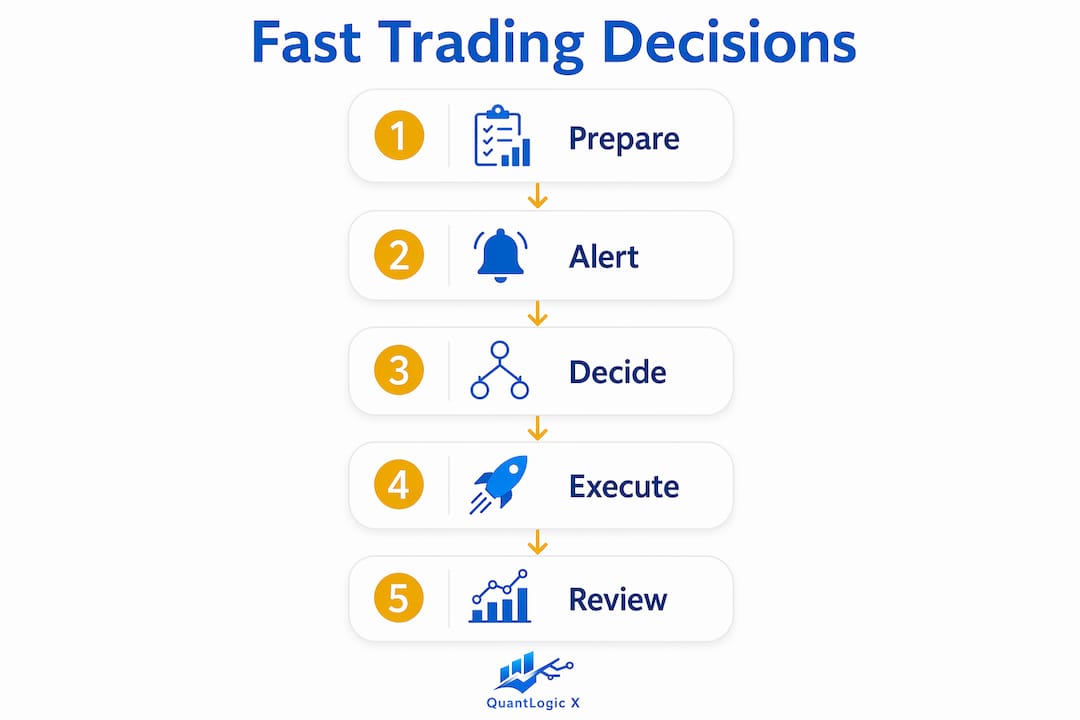
Top traders spend 90% of their time on preparation, defining exact entry and exit rules before the session opens. During live trading, they execute like a machine because every scenario has already been rehearsed. The decision was made before the market opened. The live session is just confirmation and execution.
Pre-market preparation follows a specific structure. You identify the key levels where price is likely to react. You write out "if-then" scenarios: if price breaks above X with volume, then enter long with a stop at Y. When the scenario plays out, you do not deliberate. You act. This is how adaptive decision-making transforms speed from guesswork into disciplined execution.
Bernard Baruch, one of the most successful American investors of the 20th century, noted the importance of swift action backed by preparation, conviction, and analysis. His point was not that speed alone wins. His point was that preparation makes speed possible without recklessness.
A solid pre-session checklist for faster decisions:
- Review overnight news and earnings that affect your watchlist.
- Mark key support and resistance levels on your charts before the open.
- Write out your if-then scenarios for each stock on your watchlist.
- Set price alerts at your planned entry levels.
- Confirm your position size and maximum daily loss before trading begins.
Traders who build a consistent day trading routine report fewer emotional errors and faster execution during live sessions. The routine removes uncertainty. Uncertainty is what slows decisions down. A scalping signal algorithm can further reduce the cognitive load by surfacing high-probability setups automatically, so you spend less time searching and more time executing.
Key Takeaways
Fast, disciplined decisions in day trading require preparation, psychological control, and low-latency execution working together, not speed alone.
| Point | Details |
|---|---|
| Speed comes from preparation | Top traders define entry and exit rules before the session, enabling machine-like execution during live trading. |
| Hesitation costs real money | Deviating from a trading plan due to hesitation reduces earnings by 31% compared to disciplined adherence. |
| Limit indicators to 2–3 | More than three indicators causes analysis paralysis, slowing decisions and reducing trade quality. |
| Latency matters more than strategy | Execution delays can convert profitable setups into losing trades by increasing slippage and collapsing risk-reward ratios. |
| Emotional control is non-negotiable | Stress-driven impulsive choices cause losses; pre-written rules and daily loss limits remove emotion from real-time decisions. |
Speed is a skill, not a personality trait
Traders often assume that fast decision-making is something you either have or you do not. That belief is wrong, and it keeps a lot of people from improving. Speed in day trading is a skill built through repetition, preparation, and honest review of past trades.
What I have seen consistently is that traders who struggle with slow decisions are not slow thinkers. They are under-prepared. They sit down at the open without a clear plan, face a moving market, and freeze because they are making decisions for the first time in real time. The market does not wait for that process to finish.
The traders who execute fast are the ones who already made their decisions before the session started. They are not thinking during the trade. They are confirming. That distinction changes everything. When you remove the deliberation from the live session, speed becomes natural rather than forced.
The other piece that rarely gets discussed is review. Traders who log every trade and review their decisions weekly build pattern recognition faster than those who do not. You start to see your own hesitation points. You recognize the setups where you consistently freeze. Then you write a specific rule for that scenario. Over time, your decision tree shrinks, and your execution speed increases.
Speed without preparation is impulsive. Preparation without speed is theoretical. The combination is what produces consistent results in fast markets.
— Tran
Quantlogicx signals built for traders who need to act fast
Day traders who need to cut decision time without cutting accuracy use Quantlogicx. The Quantlogicx TradingView indicator delivers real-time buy and sell signals across stocks, forex, and cryptocurrency, with zero repaint technology that locks in signals at bar closure. Over 2,000 traders rely on the algorithm, and individual users have recorded gains of $8,200 within a single month.
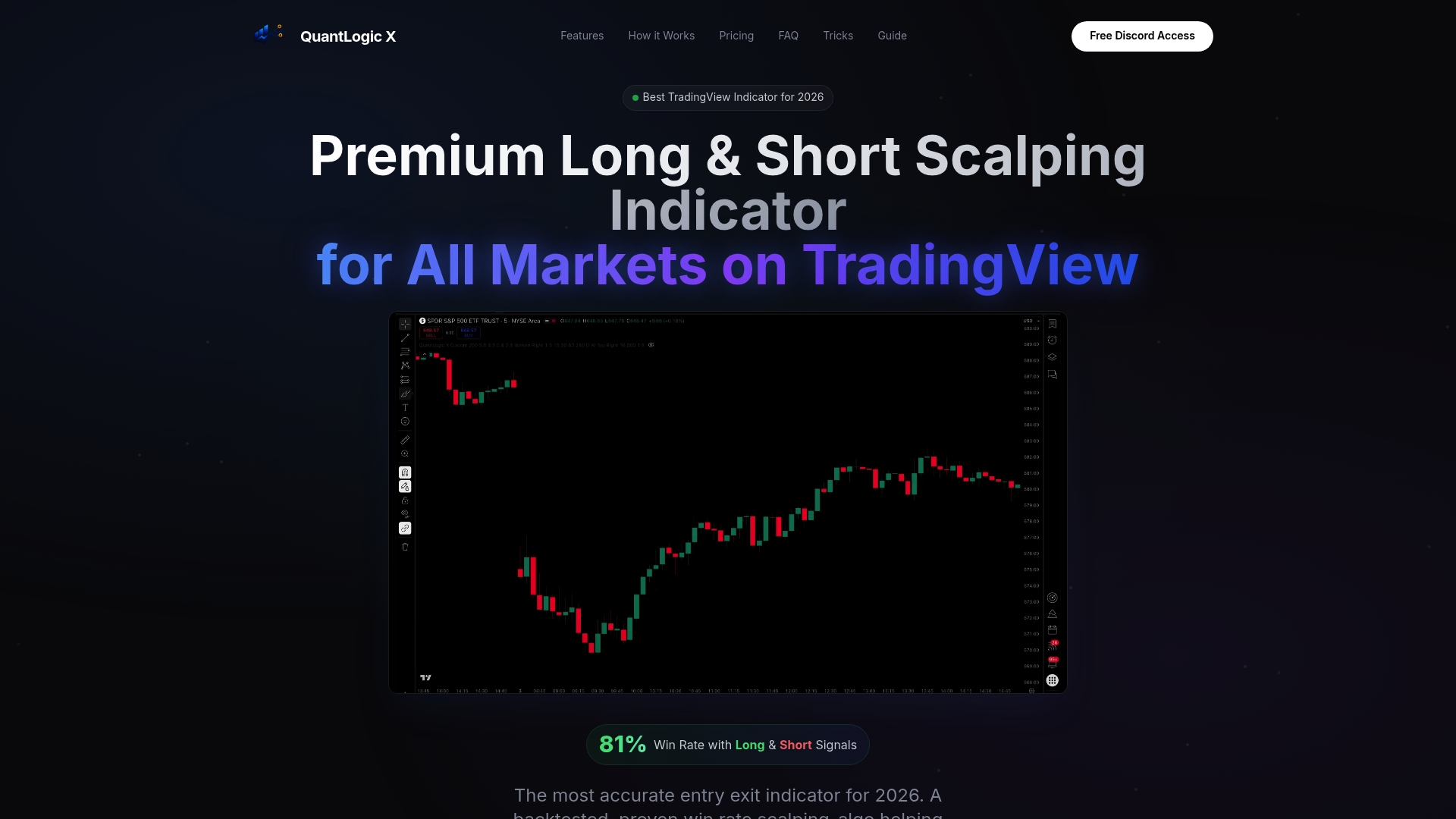
The indicator runs on TradingView with real-time alerts, so you receive a signal the moment a setup confirms. No scanning. No second-guessing. The signal fires, you check your pre-written rule, and you execute. Quantlogicx reports an 81% win rate across its user base. For traders who want to act faster without acting blindly, the Quantlogicx indicator is worth a close look.
FAQ
Why does day trading require faster decisions than swing trading?
Day trading operates on 1–5 minute charts where profitable windows last seconds to minutes. Swing trading allows hours or days to evaluate a setup, removing the urgency that defines intraday trading.
What is the biggest psychological barrier to fast trading decisions?
Analysis paralysis is the most common barrier. Using more than 2–3 indicators creates conflicting signals that cause hesitation and missed trades in fast-moving markets.
How does latency affect day trading profitability?
Latency, the delay between your decision and your order fill, increases slippage and can collapse a trade's risk-to-reward ratio before the position is even open. Direct-access brokers and wired connections reduce this risk.
How can I make faster decisions without becoming impulsive?
Write if-then scenarios before the session opens and set price alerts at your planned entry levels. When the alert fires, your analysis is already complete and you only need to confirm and execute.
Does preparation actually speed up live trading decisions?
Top traders spend 90% of their time on preparation, defining exact entry and exit rules before the session. That preparation removes real-time deliberation, which is what makes fast execution possible without impulsive errors.