

Scalping is defined as a high-frequency intraday trading style where positions last seconds to a few minutes, while day trading involves holding positions from minutes to several hours within the same trading session. Both strategies close all trades before the market closes, but the difference between scalping and day trading runs much deeper than time alone. Understanding what is scalping vs day trading shapes every decision you make: how much capital you need, how long you sit at your screen, and whether your personality can handle the pressure. This guide breaks down both styles across trade frequency, risk management, profitability, and lifestyle fit.
How do scalping and day trading differ in trade duration and profit targets?
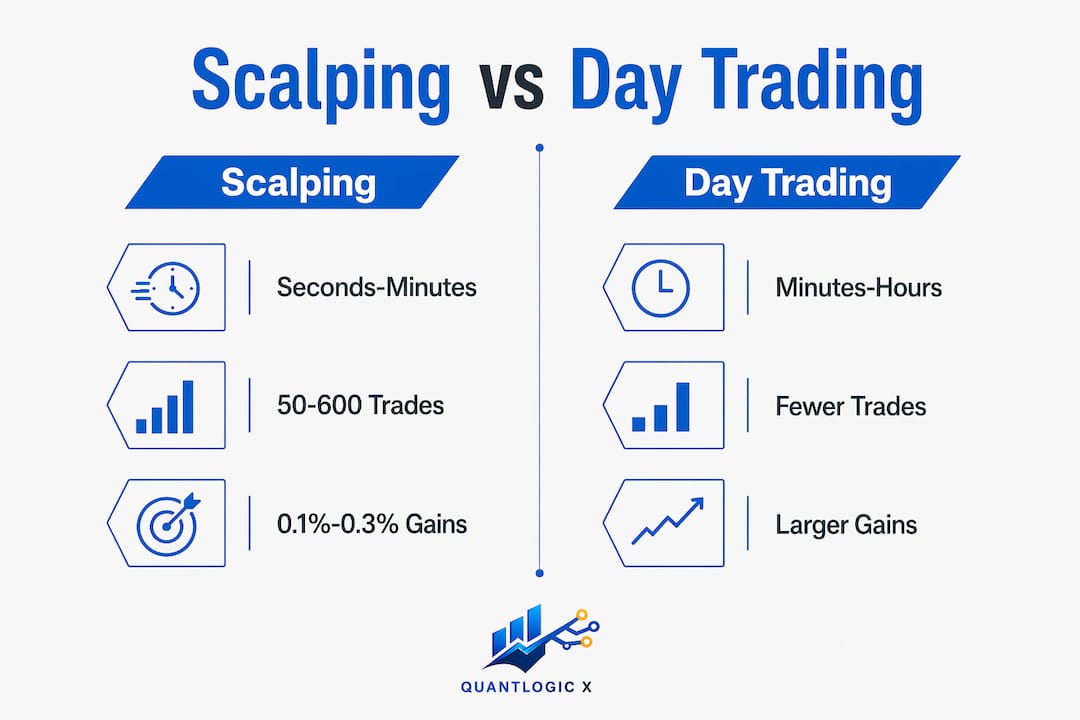
Scalping positions last seconds to minutes, with active scalpers executing anywhere from 50 to 600 trades per month. Day traders hold positions for minutes to hours and typically execute 2 to 100 trades per month. That gap in frequency is the single biggest operational difference between the two styles.

Profit targets reflect that frequency gap directly. Scalpers target small gains of roughly 0.1% to 0.3% per trade, relying on volume to build returns. Day traders aim for larger moves of 1% to 3% per trade, accepting fewer setups in exchange for bigger individual payoffs. Neither approach is wrong. They are just built on opposite assumptions about how profits accumulate.
Pro Tip: If you are new to trading, start by paper trading both styles on TradingView for two weeks each. Track how many trades you take, how long you hold, and how your emotions respond. The data will tell you which style fits before you risk real money.
The table below contrasts the core mechanics of each style at a glance.
| Factor | Scalping | Day trading |
|---|---|---|
| Trade duration | Seconds to minutes | Minutes to hours |
| Trades per month | 50–600 | 2–100 |
| Profit target per trade | 0.1%–0.3% | 1%–3% |
| Stop loss width | Ultra-tight | Wider |
| Screen time per day | 6–8 hours | 3–4 hours |
Scalping strategies explained in most trading courses focus on 1-minute or tick charts, where every second counts. Day trading basics, by contrast, rely on 5-minute, 15-minute, or even hourly charts, giving traders more time to analyze and react. The chart timeframe you prefer often signals which style suits you naturally.
What are the risk and money management differences?
Scalpers minimize risk with ultra-tight stop losses, typically risking 0.25% to 0.5% of account equity per trade. Day traders accept wider stops but take far fewer trades, so total daily exposure can be similar. The key difference is how that risk is distributed across time and trade count.
Transaction costs hit scalpers harder than day traders. High trade volume means spreads and commissions compound quickly, eroding the small profit margins scalpers depend on. A scalper taking 20 trades a day pays 20 sets of commissions. A day trader taking 3 trades pays 3. This is why serious scalpers use ECN or raw-spread accounts to keep per-trade costs as low as possible.
Here are the core risk management practices for each style:
For scalpers:
- Use ECN or raw-spread accounts to reduce transaction costs
- Set stop losses at 0.25%–0.5% of account equity per trade
- Limit total daily loss to a fixed dollar amount before stepping away
- Trade only the most liquid instruments, such as EUR/USD, SPY, or Bitcoin
For day traders:
- Use wider stops based on the instrument's average true range
- Risk no more than 1%–2% of account equity per trade
- Avoid trading during low-volume periods like the lunch hour
- Review your trade journal after every session to spot patterns
Cognitive fatigue is a genuine risk in scalping. Two hours of rapid-fire decision-making can degrade your judgment as much as sleep deprivation. Day trading gives your brain more recovery time between decisions, which is a real structural advantage for most people.
Pro Tip: Set a hard daily loss limit before you open your platform each morning. When you hit it, close everything and walk away. This single rule prevents the revenge trading spiral that wipes out most new traders.
How do profitability and success rates compare?
The profitability numbers for both styles are sobering. Between 72% and 97% of retail day traders lose money over long periods, with only 1% to 15% achieving consistent profitable returns after accounting for fees and commissions. Approximately 1% maintain profitability over a five-year window. That is not a reason to quit before you start. It is a reason to prepare differently than most traders do.
"Only about 1% of retail traders maintain profitability over a five-year window. The majority who fail share one trait: they never built a disciplined review process."
Scalping carries similar odds. The high trade frequency means more opportunities to profit, but also more opportunities to make emotional mistakes. A single bad hour of revenge trading can wipe out a week of disciplined gains. The traders who survive long-term in either style share one habit: they journal every trade.
Active journaling significantly improves success rates for both day traders and scalpers. Traders who track entries, exits, reasons, and emotions build a feedback loop that pure screen time cannot replicate. Without that record, you repeat the same mistakes without realizing it.
Trader performance often plateaus with short-term strategies, and many traders do not improve meaningfully with practice alone. This is the uncomfortable truth about both scalping and day trading. More screen time does not automatically produce better results. A clear edge, a tested strategy, and honest self-review matter far more than hours logged.
Comparing scalping vs swing trading adds another layer. Swing traders hold positions for days or weeks, which dramatically reduces transaction costs and cognitive load. For new traders, swing trading often produces better early results simply because it allows more time to think. But if your schedule or temperament demands intraday activity, scalping and day trading remain valid paths with the right preparation.
What trader characteristics suit scalping versus day trading?
Neither scalping nor day trading is objectively better. Success depends on matching the style to your personality, risk tolerance, and available time. Choosing based on which style sounds more exciting is one of the most common and costly mistakes new traders make.
Scalping suits traders who:
- Thrive under pressure and make fast decisions without second-guessing
- Can maintain emotional detachment across dozens of trades per session
- Have 6–8 hours of uninterrupted screen time available daily
- Are comfortable with technology, fast execution platforms, and direct market access
- Can accept that most individual trades will be small wins or small losses
Day trading suits traders who:
- Prefer analytical patience over rapid-fire execution
- Can dedicate 3–4 focused hours per day to the market
- Handle larger per-trade swings without emotional disruption
- Want time to read charts, assess context, and plan entries deliberately
- Are building toward a consistent trading routine with structured daily habits
Capital requirements also differ in practice. Scalpers in U.S. equity markets must meet the Pattern Day Trader rule, which requires a minimum of $25,000 in a margin account. Forex and crypto scalpers face lower capital thresholds, but transaction costs still demand a meaningful account size to absorb commission drag. Day traders face the same $25,000 rule for U.S. stocks but can operate in forex or crypto with less starting capital.
Technology matters more for scalping than for day trading. Scalpers need fast execution, low-latency data feeds, and platforms built for speed. TradingView works well for both styles, but scalpers benefit from direct access brokers with one-click execution. A scalping signal algorithm can also reduce the cognitive load of identifying entries in real time, which is a meaningful edge when you are taking dozens of trades per session.
Key Takeaways
Scalping and day trading are both viable intraday strategies, but your success depends on matching the style to your personality, schedule, and risk tolerance rather than chasing the one that sounds most profitable.
| Point | Details |
|---|---|
| Trade duration defines the style | Scalping lasts seconds to minutes; day trading lasts minutes to hours within one session. |
| Profit targets differ sharply | Scalpers target 0.1%–0.3% per trade; day traders aim for 1%–3% per trade. |
| Transaction costs hit scalpers harder | High trade frequency compounds commissions, requiring ECN accounts for profitability. |
| Most retail traders lose money | Between 72% and 97% of retail traders lose over time; journaling improves those odds. |
| Style fit beats style preference | Match your choice to your temperament, schedule, and capital, not to excitement alone. |
What I have learned about choosing a trading style
Tran here. After watching hundreds of traders try to force a style that does not fit them, the pattern is always the same. A naturally patient person tries scalping because it looks exciting, burns out in three weeks, and blames the market. A fast-twitch decision-maker tries day trading, gets bored waiting for setups, and starts overtrading. The style was never the problem. The mismatch was.
The honest question to ask yourself is not "which style makes more money?" It is "which style can I execute without fighting my own instincts every session?" Scalping demands that you act fast and feel nothing. Day trading demands that you wait and stay disciplined. Both are hard. Neither is forgiving of emotional trading.
I have seen traders turn scalping into a reliable income and others blow up accounts doing the same thing. The difference was never the strategy. It was whether they journaled, set hard daily loss limits, and treated trading like a performance career rather than a lottery ticket. Day trading and scalping are high-performance disciplines. They reward preparation and punish impulsiveness in equal measure.
Start with paper trading. Run both styles for a month each. Look at your data honestly. The numbers will tell you what your gut might not.
— Tran
Take your trading signals to the next level with Quantlogicx
Knowing the difference between scalping and day trading is the first step. Having a reliable signal tool is what separates traders who act on that knowledge from those who stay stuck in analysis.
Quantlogicx offers a TradingView indicator built specifically for intraday traders, with an 81% win rate and zero repaint technology. That means the long and short signals you see at bar close are the signals that stay. Over 2,000 traders have used the algorithm across stocks, forex, and cryptocurrency, with individual users recording gains of $8,200 within a single month. Whether you are learning scalping on SPY or refining a day trading setup, Quantlogicx delivers clear, real-time alerts without the noise. Explore the TradingView indicator and see which signals fit your style.
FAQ
What is the main difference between scalping and day trading?
Scalping involves holding trades for seconds to minutes with dozens of trades per session, while day trading holds positions for minutes to hours with far fewer trades. Both close all positions before the market closes.
Is day trading profitable for beginners?
Between 72% and 97% of retail day traders lose money over time, making profitability rare without disciplined preparation. Consistent journaling and a tested strategy significantly improve the odds.
How much screen time does scalping require?
Scalping typically demands 6–8 hours of focused screen time per day. That intensity creates cognitive fatigue, which is why emotional detachment and hard daily loss limits are non-negotiable for scalpers.
Do scalpers need special accounts or tools?
Scalpers benefit from ECN or raw-spread accounts to minimize transaction costs, since high trade frequency makes commissions a major drag on profits. Fast execution platforms and low-latency data feeds also matter more for scalping than for day trading.
Can a beginner start with scalping?
Most trading educators recommend that beginners start with day trading or swing trading before attempting scalping. The rapid decision-making and emotional demands of scalping are easier to manage once you have a solid foundation in reading charts and managing risk.