

Automated trade signals are software-generated alerts that trigger or recommend trades based on predefined rules, without human hesitation or discretion. The core appeal is straightforward: they remove the gap between a signal and its execution. For traders who have watched a good setup evaporate while they second-guessed the entry, that gap is where money disappears. The benefits of automated trade signals go well beyond speed. They include emotion removal, consistent rule-following, and the ability to monitor multiple markets at once. Quantlogicx, which reports an 81% win rate across stocks, forex, and cryptocurrency, is one example of how automated signal generation translates directly into measurable trader outcomes.
1. Benefits of automated trade signals: faster execution and fewer errors
Speed is the most immediate advantage of automated trade signals. A system that executes the moment conditions are met beats any manual process, every time. Human traders hesitate, misread price levels, or simply miss the window. Automation does none of those things.
Execution consistency matters more than most traders realize. Even a mediocre strategy executed flawlessly outperforms a superior strategy executed with human error. That is a counterintuitive but well-documented finding from algorithmic trading research.
The specific errors that automation removes include:
- Hesitation at entry: Waiting for "one more confirmation" that never comes
- Missed stop-losses: Manually skipping a stop because the trade "feels like it will recover"
- Skipped trades: Fatigue or distraction causing a trader to miss valid setups
- Inconsistent sizing: Emotional position sizing that deviates from the plan
Automated systems also handle volume that no human can match. One system can scan dozens of instruments simultaneously and execute across all of them without degradation in speed or accuracy.
Pro Tip: When evaluating any automated system, test how it handles slippage and latency under real market conditions. A signal that looks clean in backtesting can lose its edge if execution is delayed by even a few hundred milliseconds in fast markets.

2. Emotional and psychological benefits of trade signal automation
Emotions are the single biggest source of trading losses for retail traders. Fear causes early exits. Greed causes traders to hold past their target. Revenge trading after a loss causes oversized positions that blow accounts. Automated signals remove all of these from the moment-to-moment decision loop.
Trading expert Adrian Reid identifies automation as the primary tool for eliminating ego from trade execution. When a system fires a signal and executes it without asking for your opinion, you cannot override it based on a feeling. That discipline, applied consistently over hundreds of trades, compounds into a measurable performance advantage.
"Automation removes the ego and emotional friction that causes common errors such as hesitation and revenge trading in manual execution. The system does not care how you feel about the trade." — Adrian Reid, Enlightened Stock Trading
Traders using AI for behavioral analysis report a 15–25% improvement in risk-adjusted returns within 90 days of consistent use. That improvement does not come from a better strategy. It comes from executing an existing strategy without emotional interference.
The psychological relief is also real. Knowing that a system is watching the market and will act when conditions are met removes the anxiety of constant screen monitoring. Traders report lower stress and better decision-making on the strategic level when they are not consumed by execution-level pressure.
3. Scalability and time savings from automated signals
One automated system can be monitored in minutes per day, compared to the hours required for manual market scanning and trade management. That time difference is not trivial. It is the difference between trading as a full-time obsession and trading as a disciplined, manageable process.
Automation scales across markets without a linear increase in effort. A trader running a manual strategy on one instrument cannot simply add ten more without proportionally increasing their workload. An automated system handles that expansion without additional time cost.
Key time and scale advantages include:
- Multi-market coverage: One system monitors forex, equities, and crypto simultaneously
- Overnight and off-hours execution: Trades execute while you sleep, without missed opportunities
- Consistent portfolio management: Drawdowns and position sizing stay within rules even during personal disruptions
- Reduced screen time: Strategic review replaces constant monitoring
Pro Tip: Automation does not replace the work of developing a quality strategy. It only executes what you give it. Traders who automate a losing strategy simply lose faster and more consistently. Build the edge first, then automate it.
4. Why automation alone does not guarantee profits
The most important limitation of automated trade signals is also the least discussed. Automation executes a strategy. It does not create one. If the underlying strategy has no edge, the automation makes that failure more efficient, not more profitable.
Only 27% of retail AI trading bots outperformed a simple S&P 500 buy-and-hold strategy over a 12-month period. The average profitable strategy lifespan in that analysis was approximately 47 days. That is a short window, and it reflects how quickly market conditions can erode an automated edge.
A study of 500 retail traders found that algorithmic trading users averaged 15 trades per week versus 6 for non-users. Their Sharpe ratio was 0.9 compared to 1.4 for non-users. More activity did not produce better risk-adjusted returns.
Additional risks traders must account for:
- Overfitting: Systems trained too tightly on historical data fail in live markets when conditions shift
- Signal saturation: When too many traders use the same signal logic, the edge disappears
- Market regime changes: A system built for trending markets will lose in ranging conditions
- Repainting signals: Some signal tools alter past signals retroactively, making backtests look better than reality
Signal tools that cannot be objectively verified due to vague rules, repainting, or exit ambiguity are less reliable than fully automated systems with transparent track records. The distinction matters because many retail traders confuse receiving a signal alert with having a complete automated system.
There is a fundamental difference between a signal service that alerts a human and full trade automation that executes without hesitation or discretion. The latter is nearly impossible to replicate manually, even with the best intentions.
Reliable signal providers publish transparent track records that include losses and drawdowns, not just winning trades. If a provider cannot show you verifiable performance data, treat that absence as a warning sign.
5. How to get the most out of automated trade signals
The traders who benefit most from automation share one habit: they treat their system as a business, not a lottery ticket. That means regular performance reviews, clear rules for when to pause a system, and no overriding signals based on gut feeling.
Traders who override or filter automated signals consistently underperform those who maintain disciplined execution of the system's rules. Overriding feels like control. In practice, it reintroduces the emotional errors that automation was designed to remove.
Practical steps for maximizing trade signal automation benefits:
- Verify before you commit: Run any signal service on a demo account for at least 30 days before risking real capital
- Check for zero-repaint technology: Signals that repaint past bars are unreliable for live trading decisions
- Monitor for signal saturation: If a strategy stops working, check whether the market has adapted to the same logic
- Use behavioral analytics: AI journaling tools that track your override decisions reveal patterns you cannot see in the moment
- Set clear pause criteria: Define in advance what drawdown level or losing streak triggers a system review
The role of verified signals in a trading process is not to replace judgment entirely. It is to remove judgment from the execution layer, where emotion does the most damage, while preserving it for the strategic layer, where experience adds real value.
Pro Tip: Prefer full automation over manual signal execution whenever possible. The hesitation between seeing a signal and acting on it is where most of the psychological edge gets lost. If your platform supports automated order execution, use it.
Key takeaways
Automated trade signals deliver their greatest value when built on a verified strategy, executed without emotional interference, and reviewed regularly for performance decay.
| Point | Details |
|---|---|
| Speed removes the execution gap | Automation acts the moment conditions are met, eliminating hesitation and missed entries. |
| Emotion removal compounds over time | Consistent, rule-based execution across hundreds of trades outperforms emotional discretion. |
| Scalability is a structural advantage | One system covers multiple markets simultaneously with minimal daily monitoring time. |
| Strategy quality determines outcomes | Automation executes an edge. It cannot create one where none exists. |
| Verification separates reliable signals | Transparent track records with losses and drawdowns are the baseline for any credible signal service. |
What I've learned from years of watching traders automate
The traders I've seen succeed with automation share one trait: they stopped treating their system as a black box and started treating it as a business process. They review performance weekly. They know their maximum drawdown. They have a written rule for when to pause the system. That level of discipline is rare, and it is exactly what separates the traders who benefit from automation from those who blow up chasing the next signal service.
The biggest mistake I see is traders automating before they understand what they are automating. They find a signal with a good-looking backtest, turn it on, and then panic during the first real drawdown. They override the system, miss the recovery, and blame the tool. The tool was never the problem.
Automation is not a shortcut to profits. It is a shortcut to consistency. Consistency only pays off if the underlying strategy has a real edge. Markets evolve, volatility regimes shift, and adaptive filters are not optional for systems that need to survive long-term. The traders who understand that build something durable. The ones who don't cycle through signal services looking for the one that finally works.
My honest advice: spend more time on strategy validation than on automation setup. Once you have a verified edge, automation does its job well. Without that foundation, no amount of technology helps.
— Tran
Quantlogicx: verified signals built for serious traders
Traders who want the benefits of automated trade signals without the verification guesswork have a direct path forward with Quantlogicx. The platform's TradingView indicator uses zero-repaint technology, meaning every long and short signal is locked in at bar closure. No retroactive changes. No misleading backtests.
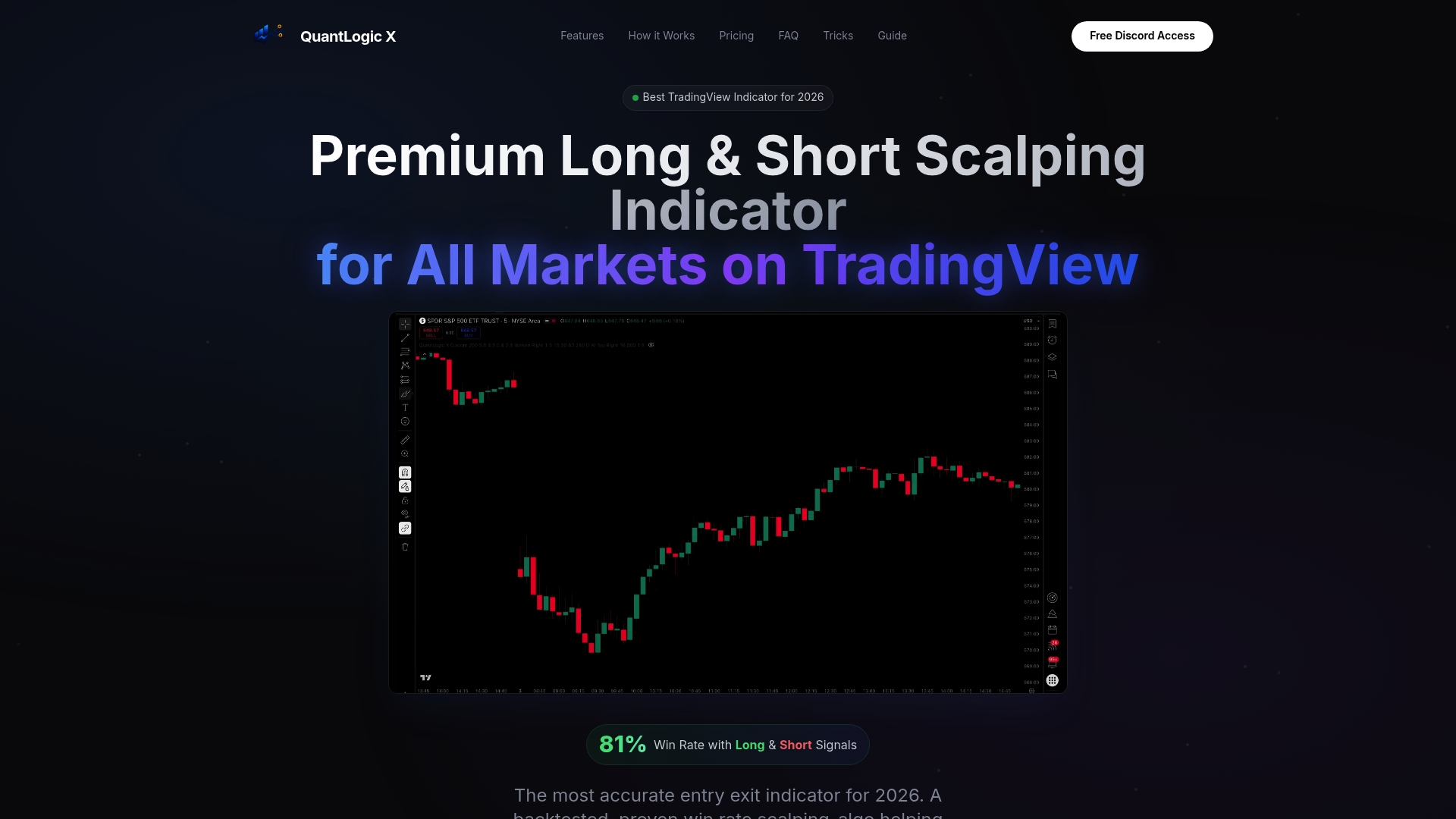
Over 2,000 traders have used the Quantlogicx algorithm across stocks, forex, and cryptocurrency, with individual users recording gains of $8,200 within a single month. The system includes real-time alerts and community support, making it accessible for both new traders and experienced ones who want consistent execution without complexity. If you are ready to see what a transparent trading indicator looks like in practice, Quantlogicx is worth a close look. You can also explore reliable signal examples to understand what verified performance data should look like before committing to any system.
FAQ
What are the main benefits of automated trade signals?
Automated trade signals remove emotional decision-making, execute trades faster than any manual process, and allow traders to monitor multiple markets simultaneously. Their primary value is consistent, rule-based execution across every trade.
Do automated trade signals guarantee profits?
No. Only 27% of retail AI trading bots outperformed a simple S&P 500 buy-and-hold strategy over 12 months. Signals execute a strategy. If the strategy has no edge, automation accelerates losses rather than preventing them.
What is the difference between a signal alert and full automation?
A signal alert notifies a human trader who must then act manually, which reintroduces hesitation and emotional drift. Full automation executes the trade directly without human input, removing those execution errors entirely.
How do I know if a signal service is reliable?
Reliable providers publish transparent track records that include losing trades and drawdown periods, not just wins. If a service cannot show verifiable performance data, that is a clear warning sign.
Can automated signals work for scalping?
Yes. Scalping benefits significantly from automation because the entry and exit windows are narrow. Systems like Quantlogicx, which uses zero-repaint technology and real-time alerts, are designed specifically for scalping across multiple asset classes.