

Reliable trade signals are predefined, structured alerts generated by combining technical, fundamental, and algorithmic data to guide buy and sell decisions. The best examples of reliable trade signals share one defining trait: they never rely on a single indicator. Instead, they layer MACD, RSI, SMA, order flow data, and AI-generated alerts into setups with clearly defined risk parameters like stop-loss and take-profit levels. Tools like PredictEngine and Coinquant have published backtested evidence showing exactly which combinations work and why. This guide breaks down each signal type with real performance data so you can apply them with confidence.
1. What are examples of reliable trade signals using combined indicators?
Combined technical indicator signals are the most well-documented category of reliable trade signals. The core logic is simple: technical indicators are lagging by nature, so using one alone produces too many false entries. Stacking multiple filters forces the market to confirm a move from several angles before you commit capital.

The most tested example is the MACD crossover filtered by RSI above 50 and the 200-period SMA on Bitcoin. According to Coinquant's six-year backtest, this combined setup produced a win rate of 53.6% and a Sharpe ratio of 1.318. The standalone MACD produced only a 44.9% win rate and a 0.814 Sharpe ratio across 287 trades. That is a meaningful gap. The combined filter also cut maximum drawdown from 38.6% down to 16.8%, which matters more than win rate for long-term survival.
Here is what each filter adds to the setup:
- MACD crossover: Identifies momentum direction when the signal line crosses the MACD line
- RSI above 50: Confirms the trend is in bullish territory before entry
- 200-period SMA: Acts as a structural filter, keeping you on the right side of the long-term trend
- Confluence requirement: All three must align before a trade triggers
Pro Tip: Use the combined signal on a higher timeframe like the daily or 4-hour chart first. Then drop to a lower timeframe to time your entry. This reduces noise and improves your indicator performance metrics significantly.
Price action patterns follow the same logic. Engulfing candles gain reliability only when they appear at established support or resistance, not in the middle of a range. Experts recommend a 30–60 minute confirmation window after a breakout before committing capital. Context is the filter.
2. How does RSI divergence work as a trend reversal signal?
RSI divergence is the discrepancy between what price is doing and what the RSI indicator is doing at overbought or oversold extremes. When price makes a new high but RSI makes a lower high, that is bearish divergence. The market is losing momentum even as price climbs. That gap often precedes a reversal.
RSI divergence at overbought levels above 70 or oversold levels below 30 produces win rates of 60–70% when executed correctly on 4-hour or higher timeframes. That win rate is not guaranteed by RSI alone. It requires confirmation from two additional sources:
- MACD confirmation: The MACD histogram should be shrinking or crossing in the direction of the anticipated reversal, confirming momentum is fading
- On-Balance Volume (OBV) confirmation: OBV should diverge alongside RSI, showing that volume is not supporting the current price move
- Price confirmation: Wait for a candlestick close that breaks a minor swing level before entering the trade
The 4-hour timeframe is the minimum for this setup. On lower timeframes, noise overwhelms the signal and the win rate drops sharply. Swing traders and crypto traders find this setup particularly useful because reversals on 4-hour and daily charts tend to produce large enough moves to justify the risk.
Never trade RSI divergence in isolation. The signal alone tells you momentum is weakening. It does not tell you when price will turn or how far it will move. MACD and OBV answer those questions.
3. What reliability do order flow signals offer?
Order flow signals read the actual buying and selling activity in the market rather than derived indicators. They show you what institutional traders are doing in real time. The most reliable order flow signals include absorption at key levels, iceberg order replenishment, and bid/ask imbalances.
Order flow signals like iceberg order replenishment and absorption at tested structural levels carry the highest reliability of any signal type. The catch is significant. These signals depend entirely on the quality of your data feed. Retail traders frequently misread order flow because their data arrives with lag or is incomplete. That lag turns a valid signal into a false one.
Here is what to watch for in order flow:
- Absorption: Large sell orders appear at a resistance level but price does not fall. Buyers are absorbing the supply. This signals a likely breakout upward.
- Iceberg orders: A large hidden order repeatedly replenishes at the same price. This reveals institutional interest at that level.
- Bid/ask imbalance: When the bid side of the order book is dramatically larger than the ask side, buying pressure is building.
Pro Tip: Always combine order flow signals with a structural technical level like a daily support zone or a weekly pivot. Order flow signals at random price levels are far less reliable than those appearing at levels the market has already tested and respected.
The practical barrier for most retail traders is data quality. Professional order flow tools like Bookmap or Sierra Chart provide the real-time depth needed. Free or delayed feeds produce false signals in choppy markets, which is where most retail traders lose money on this approach.
4. How do AI and LLM-powered signals improve trade outcomes?
AI-powered trade signals, specifically those generated by large language models (LLMs), process enormous volumes of structured financial data to generate buy and sell alerts. They identify patterns across price history, earnings data, and market sentiment faster than any manual analysis. The results are promising but come with specific conditions.
A PredictEngine case study showed that using limit orders instead of market orders with LLM-generated signals increased net returns from 8.4% to 22.7% and improved the Sharpe ratio from 0.97 to 1.84. The study processed 347 limit order sets with a 69.5% fill rate. Of the orders that filled, 63.8% produced positive outcomes. That data makes a clear case for execution discipline over raw signal frequency.
| Execution Method | Net Return | Sharpe Ratio | Fill Rate |
|---|---|---|---|
| Market orders | 8.4% | 0.97 | 100% |
| Limit orders | 22.7% | 1.84 | 69.5% |
The tradeoff is real. Limit orders mean some trades never fill. You miss entries. That frustrates traders who want to act on every signal. But execution discipline using limit orders consistently produces better risk-adjusted returns and lower drawdowns than chasing entries with market orders.
LLMs also have a documented weakness. They struggle with predicting crowd psychology in fast-moving, news-driven markets. Political events, surprise central bank decisions, and social media-driven price spikes fall outside the structured data patterns LLMs process well. Use AI signals in trending, data-driven environments and treat them with caution during high-impact news events.
For traders interested in the algorithmic side of this, the scalping signal algorithm guide covers how these systems generate entries and exits in real time.
5. How to compare and choose the best reliable trade signals for your style?
Choosing the right signal type depends on your market, timeframe, and risk tolerance. No single signal type dominates every condition. The table below gives you a direct comparison across the main categories.
| Signal Type | Typical Win Rate | Best Markets | Key Strength | Key Weakness |
|---|---|---|---|---|
| MACD + RSI + SMA confluence | 53.6% | Crypto, stocks | Backtested, structured | Lagging, fewer trades |
| RSI divergence | 60–70% | Forex, crypto | Strong reversal timing | Requires confirmation |
| Order flow signals | Context-dependent | Futures, forex | Real institutional data | Requires premium data |
| LLM-powered signals | 63.8% (when filled) | Stocks, crypto | Large data processing | Fails in news-driven markets |
Here is how to match signal type to trader profile:
- Scalpers benefit most from order flow signals and real-time alerts on short timeframes, provided they have quality data feeds
- Swing traders get the most value from RSI divergence on 4-hour and daily charts combined with MACD confirmation
- Crypto traders have strong evidence for the MACD + RSI + 200 SMA confluence setup based on Coinquant's Bitcoin data
- Algorithmic traders should explore LLM-powered signals with limit order execution for better risk-adjusted returns
The biggest mistake traders make when evaluating signals is chasing win rates above 85–90% without asking about drawdowns or transparency. Over-optimizing for unrealistically high win rates without understanding inevitable drawdowns causes rapid capital loss. A credible signal provider shows you the full picture: win rate, drawdown, Sharpe ratio, and the number of trades in the sample. Anything less is incomplete.
High-quality trading signals always include a defined stop-loss, take-profit, and context for the trade. If a signal service skips those elements, the signal is not complete regardless of its advertised win rate. Understanding what makes a solid trading entry signal is the foundation for evaluating any provider.
Key takeaways
Reliable trade signals require confluence, execution discipline, and transparent risk parameters to produce consistent results across markets.
| Point | Details |
|---|---|
| Confluence beats single indicators | Combining MACD, RSI, and SMA raised Bitcoin win rate from 44.9% to 53.6% in backtesting. |
| RSI divergence needs confirmation | Use MACD and OBV alongside RSI divergence to reach the 60–70% win rate range. |
| Execution method matters | Switching to limit orders with LLM signals raised net returns from 8.4% to 22.7%. |
| Order flow requires quality data | Retail traders using laggy feeds get false signals; real-time feeds are non-negotiable. |
| Avoid unrealistic win rate claims | Providers showing 85–90% win rates without drawdown data are hiding the full picture. |
What I have learned from years of trading with multiple signal types
The hardest lesson I learned was not about which indicator to use. It was about trusting a single signal too much. Early on, I would see a clean MACD crossover and enter immediately. Sometimes it worked. More often, I was fighting the trend because I skipped the RSI and SMA filters. The moment I started requiring confluence before every entry, my drawdowns shrank noticeably.
RSI divergence is the signal type I respect most and use most carefully. It looks obvious on a chart in hindsight. In real time, it requires patience that most traders do not have. You see the divergence forming and want to enter early. The right move is to wait for price confirmation, which means watching a setup develop and sometimes missing the first 10–15% of the move. That discipline is what separates traders who profit from divergence and those who get stopped out repeatedly.
AI and trading psychology are more connected than most traders admit. LLM-powered signals fail most often not because the algorithm is wrong but because the trader abandons the limit order strategy the moment a trade does not fill. The system works when you follow it completely. Selective execution destroys the edge.
My advice to newer traders is straightforward. Pick one signal type, backtest it on your specific market and timeframe, and run it for at least 50 trades before judging it. Tools like Quantlogicx remove a lot of the manual setup by combining proven signal logic with real-time alerts, which lets you focus on execution rather than indicator configuration.
— Tran
How Quantlogicx gives you reliable long and short signals on TradingView
Quantlogicx is built for traders who want proven signal logic without building it from scratch.
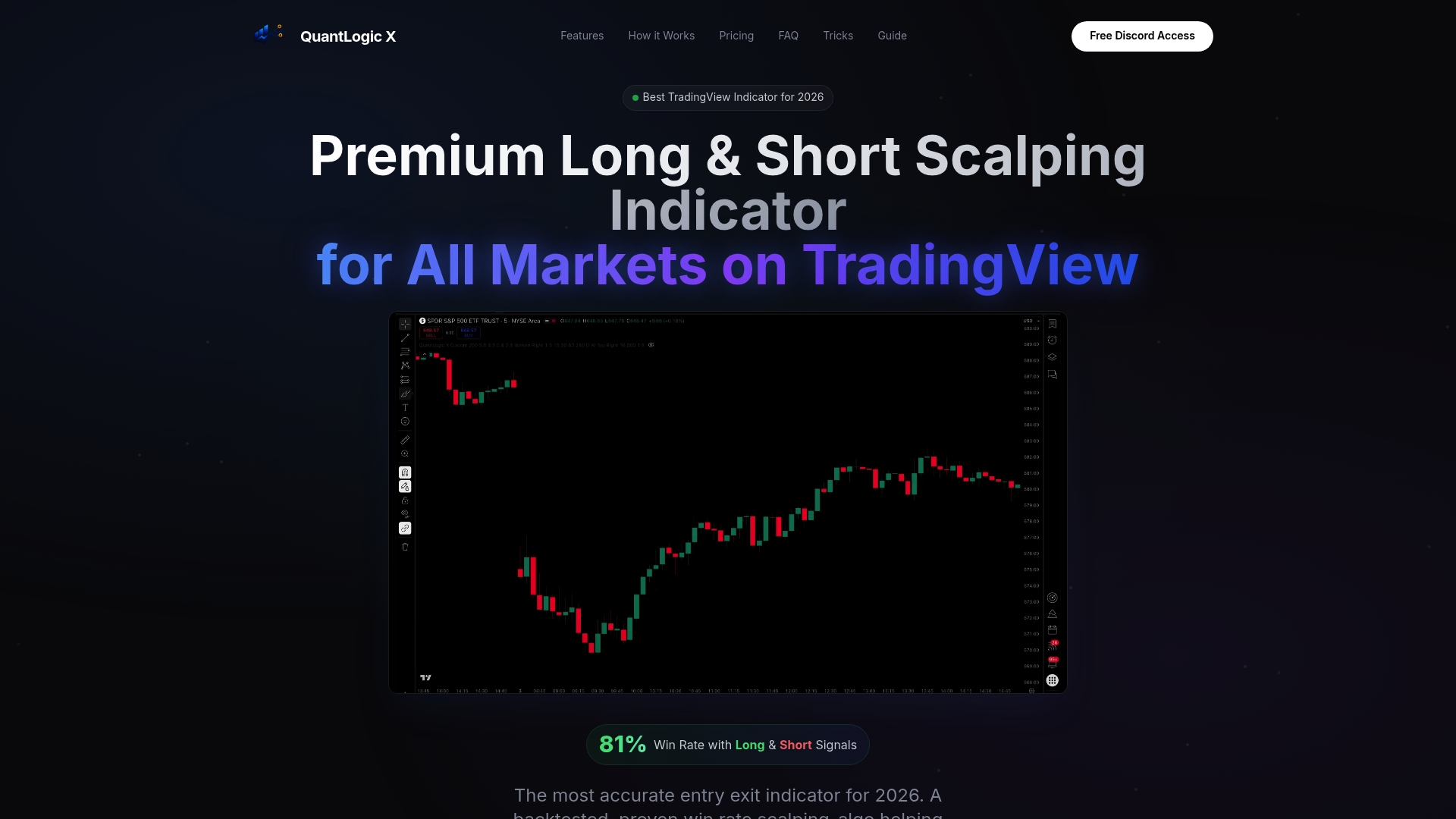
The Quantlogicx TradingView indicator combines multiple signal types into a single tool with zero repaint technology, meaning every long and short signal is locked at bar close. Over 2,000 traders use it across stocks, forex, and cryptocurrency, with individual users recording gains of $8,200 in a single month. Real-time alerts and a built-in community make it practical for both new traders learning signal basics and experienced traders who want consistent entries without managing five separate indicators. If you trade forex specifically, the forex signals integration page shows exactly how the tool applies to currency pairs.
FAQ
What are the most reliable trade signals for beginners?
The MACD crossover filtered by RSI above 50 and the 200-period SMA is the most beginner-friendly reliable signal. It is fully rule-based, backtested across six years of Bitcoin data, and requires no subjective interpretation.
How do I know if a trade signal provider is credible?
A credible provider discloses win rate, maximum drawdown, Sharpe ratio, and the number of trades in their sample. Providers advertising win rates above 85% without drawdown data are not showing you the full picture.
Can I use RSI divergence as a standalone signal?
No. RSI divergence alone produces inconsistent results. Combining it with MACD and On-Balance Volume confirmation on 4-hour or higher timeframes is what produces the 60–70% win rate range documented in divergence trading research.
What is the difference between live trade signals and backtested signals?
Backtested signals show historical performance under ideal conditions. Live trade signals reflect real-time execution, including slippage, spread, and emotional decision-making. Always verify a signal's live track record before trusting its backtest results.
Do AI-powered trade signals work in all market conditions?
No. LLM-powered signals process structured financial data well but struggle in fast-moving, news-driven markets where crowd psychology drives price. Use them in trending, data-consistent environments and reduce exposure during high-impact news events.