

Scalping profit setups are specific trading patterns with defined entry signals, exit rules, and risk parameters that let day traders capture small, repeatable price movements for consistent gains. Professional scalpers typically achieve a 40%–70% win rate, depending on setup complexity and market conditions. That range matters because it tells you scalping is not about being right every time. It is about having a structured edge and executing it without hesitation. The examples of scalping profit setups covered here give you exactly that: clear criteria, real performance benchmarks, and the risk guidelines that separate profitable scalpers from those who blow up their accounts.
1. What are the best scalping profit setups used by professionals?
The five setups below are the most widely used by active day traders. Each one has defined entry logic, a stop placement rule, and a realistic profit target. These are not theoretical. They are the short-term trading setups you will see repeated across prop firm training programs and professional trading desks.
Level 2 momentum scalp
The Level 2 momentum scalp enters when the order book shows a sudden shift in buying or selling pressure. You watch the bid and ask stacks on a Level 2 screen and enter as large orders absorb the opposing side. The target is 1:1 to 2:1 risk-reward, and you exit immediately if the order flow reverses. This setup rewards traders who read tape fast and punishes those who hesitate.

VWAP deviation scalp
The VWAP deviation scalp enters when price touches the Volume Weighted Average Price and prints a reversal candle with volume confirmation. Stops sit $0.10–$0.20 below the entry candle, and targets are set at prior swing highs. Holding times run 2–10 minutes for this strategy. It works best on trending days when price repeatedly respects VWAP as a support or resistance line.
Opening range breakout scalp
The opening range breakout scalp waits for the first 15 minutes of the session to form a high and low, then enters on a confirmed break above or below that range. This setup can produce 3:1 to 5:1 risk-reward on strong directional days with a news catalyst. The standard trade management rule is to take half the position off at 1:1 and trail the stop on the remainder.
Micro pullback on strong momentum
This setup enters on the first pullback candle after a strong momentum move, confirmed by a volume spike on the breakout candle. The entry triggers when the pullback candle's high breaks to the upside. Risk is defined by the low of the pullback candle. This is one of the most reliable scalping trading strategies for stocks showing relative strength in the first hour.
EMA pullback scalp in trend
The EMA pullback scalp enters on a retracement to the 9 EMA during a confirmed uptrend or downtrend. The 9 EMA pullback setup targets 1.5:1 to 2:1 risk-reward and suits 1–5 minute holding periods. It is considered beginner-friendly because the signal is visual and the rule is simple: price pulls back to the 9 EMA, holds, and resumes trend direction.
Pro Tip: Before trading any of these setups live, run at least two weeks of simulation on a single setup. Switching between all five at once is the fastest way to lose money and confidence simultaneously.
2. How to choose the best scalping setup for your market conditions
Matching your setup to current market conditions is as important as the setup itself. A breakout strategy fails in a choppy, range-bound session. A mean-reversion setup fails on a strong trend day. Getting this wrong is the most common reason scalpers have losing streaks that have nothing to do with their execution.
- Trending markets: Use the EMA pullback scalp or micro pullback setup. Both require directional momentum to work. Stocks like AAPL, TSLA, NVDA, and SPY provide the volume and movement these setups need.
- Range-bound markets: Use the VWAP deviation scalp. Price oscillates around VWAP, giving you defined entry and exit zones without needing a directional bias.
- News-driven opens: The opening range breakout scalp performs best here. A catalyst creates the directional bias that drives the initial range break.
- London Open sessions (forex): Breakout setups on EUR/USD and GBP/USD benefit from the liquidity surge that hits at the London Open. Spreads tighten and volume spikes, creating clean breakout conditions.
- Low-liquidity periods: Avoid scalping during midday lulls or illiquid instruments. Tight bid-ask spreads on mega-cap stocks like SPY and QQQ are what make scalp setups profitable. Wide spreads erase your edge before the trade even starts.
Use the Average True Range indicator to size your stops dynamically. ATR adapts to current volatility, so your stop is never too tight on a volatile day or too wide on a quiet one. This single adjustment improves the consistency of every setup on this list.
3. Managing risk and execution costs in scalping trades
Risk management drives 80% of scalping success. The setup gets you in the door. Risk management keeps you in the game. Most scalpers who fail do not fail because their setups stop working. They fail because one bad trade wipes out ten good ones.
- Risk per trade: Keep each trade's risk to 0.1%–1.0% of your account. This range preserves capital through losing streaks without forcing you to quit.
- Execution costs: Commissions and slippage can consume $2–$3 per 30-second trade on 200 shares. That means your net profit per trade may be only $9–$10 after costs. High-probability setups on liquid instruments are the only way to stay ahead of this friction.
- ATR-based stops: Size your stop loss using ATR so it adapts to volatility. A fixed 10-cent stop works on a calm day and gets you stopped out immediately on a volatile one. ATR-based stop loss sizing solves this problem automatically.
- Avoid penny stocks: Illiquid instruments have wide spreads and erratic order flow. The execution friction alone makes profitable scalping nearly impossible.
- Cut losses fast: Seasoned scalpers exit losing trades based on Level 2 order book shifts, not stop-loss hits. If the order flow that justified your entry disappears, you exit. Period.
Pro Tip: Track your gross profit and net profit separately in a trading journal. If your gross is strong but your net is weak, your setup is fine. Your execution costs are the problem.
4. Scalping setup comparison: effectiveness, risk-reward, and ease of use
The table below compares the five core setups across the metrics that matter most to active scalpers.
| Setup | Typical R:R | Win Rate Range | Experience Level | Best Market | Session |
|---|---|---|---|---|---|
| Level 2 momentum scalp | 1:1–2:1 | 55%–70% | Advanced | Stocks | Pre-market, open |
| VWAP deviation scalp | 1.5:1–2:1 | 50%–65% | Intermediate | Stocks, futures | Full session |
| Opening range breakout | 3:1–5:1 | 40%–55% | Intermediate | Stocks, ETFs | First 30 min |
| Micro pullback momentum | 1.5:1–2:1 | 55%–65% | Beginner-Intermediate | Stocks | First hour |
| EMA pullback scalp | 1.5:1–2:1 | 50%–60% | Beginner | Stocks, forex | Trending sessions |
The opening range breakout offers the highest potential reward but the lowest win rate. That tradeoff is intentional. You win less often but win bigger when you do. The EMA pullback and micro pullback setups are the most accessible for newer scalpers because the signal is clear and the risk is easy to define. The Level 2 momentum scalp requires reading order flow in real time, which takes months of practice to do reliably.
Key takeaways
Scalping profit setups work when you match the right setup to market conditions, control execution costs, and risk no more than 1% of your account per trade.
| Point | Details |
|---|---|
| Match setup to conditions | Use breakout setups on trending days and VWAP setups in range-bound sessions. |
| Control execution costs | Commissions and slippage can cut net profit to $9–$10 per trade on liquid stocks. |
| Risk per trade | Limit each trade to 0.1%–1.0% of account capital to survive losing streaks. |
| Master one setup first | Practicing a single setup extensively before going live reduces errors and improves speed. |
| Liquidity is non-negotiable | Trade mega-cap stocks like SPY, QQQ, and AAPL to keep spreads tight and execution clean. |
What I have learned from years of watching scalpers succeed and fail
The most common mistake I see is traders treating scalping as a prediction game. They spend hours studying charts looking for the "perfect" signal, then freeze when it appears because they second-guess themselves. Scalping is not about predicting direction. It is about capturing small, predictable profits from order flow and getting out the moment that order flow changes.
The second mistake is setup hopping. A trader tries the VWAP setup for two days, has a losing session, and immediately switches to the opening range breakout. Then that loses and they move to the EMA pullback. Three weeks later they have no edge in any setup and a smaller account. Mastering a single setup through simulation before risking real capital is the single most underrated practice in scalping.
The traders I have seen build real consistency share one habit: they treat their scalping signal checklist like a pilot treats a pre-flight checklist. Every box gets checked before every trade. No exceptions. That discipline is what separates a 60% win rate from a 45% win rate on the exact same setup.
Accept that you will lose trades. A 55% win rate with a 1.5:1 risk-reward ratio is a profitable system. The math works in your favor over hundreds of trades. The only way to break that math is to let losers run and cut winners short, which is exactly what undisciplined scalpers do.
— Tran
Quantlogicx: built for scalpers who need fast, reliable signals
Scalping requires split-second decisions. Quantlogicx delivers a TradingView indicator built specifically for that speed, with zero repaint technology that locks in long and short signals at bar closure. You get a signal you can trust, not one that changes after the fact.
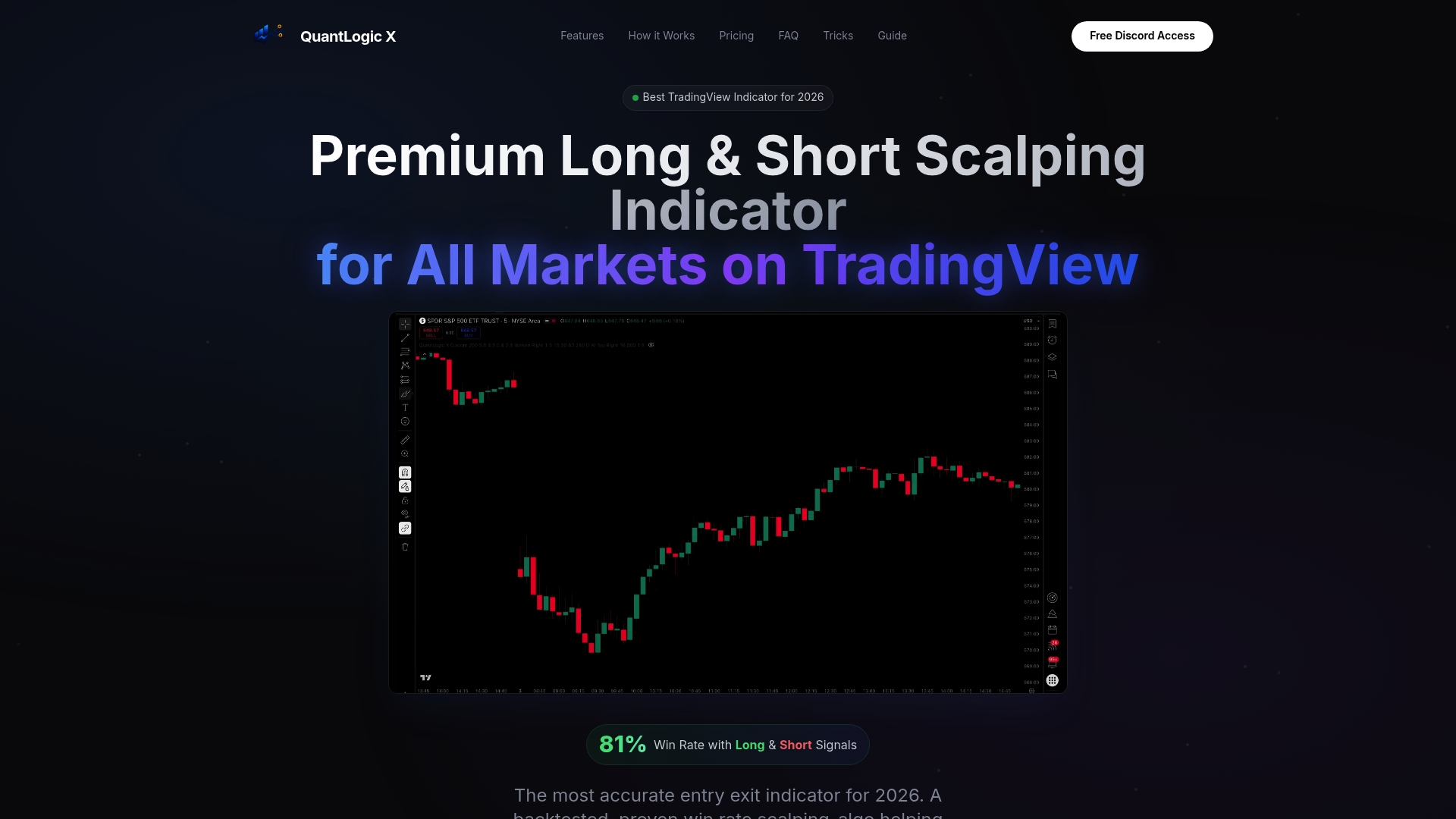
Over 2,000 traders use the Quantlogicx algorithm across stocks, forex, and cryptocurrency. The indicator reports an 81% win rate, and individual users have recorded gains of $8,200 within a single month. Real-time alerts and a trader community come included. Whether you are running the VWAP deviation scalp or the opening range breakout, the Quantlogicx TradingView indicator gives you the entry and exit signals to execute each setup with confidence.
FAQ
What is a scalping profit setup?
A scalping profit setup is a defined trading pattern with specific entry signals, stop placement, and profit targets designed to capture small price movements quickly. The goal is consistent, repeatable gains rather than large single-trade wins.
What win rate do professional scalpers achieve?
Professional scalpers typically achieve a 40%–70% win rate depending on the setup and market conditions. A win rate above 50% combined with a 1.5:1 or better risk-reward ratio produces a profitable system over time.
Which scalping setup is best for beginners?
The EMA pullback scalp on the 9 EMA is the most beginner-friendly setup because the signal is visual and the risk is easy to define. It suits 1–5 minute holding periods and works in any trending market.
How do execution costs affect scalping profits?
Commissions and slippage can consume $2–$3 per trade on 200 shares, reducing net profit to roughly $9–$10 per trade. Trading liquid mega-cap stocks with tight spreads is the most direct way to minimize this friction.
How much should I risk per scalping trade?
Risk 0.1%–1.0% of your account per trade. This range keeps losses manageable during losing streaks and preserves enough capital to continue trading through normal variance.