

Types of day trading markets are the distinct asset classes and venues where traders open and close positions within a single session to profit from short-term price movements. The three most active categories are stock markets, forex markets, and cryptocurrency markets, each with its own rules, hours, and risk profile. Choosing the right market is not about finding the "best" one universally. It is about finding the one that fits your personality, capital, and schedule. Retail traders now account for over 25% of total U.S. equity volume, which shows how broadly accessible these markets have become for individual traders in 2026.
1. Types of day trading markets: an overview
Day trading, formally called intraday trading, means entering and exiting all positions before the market closes. No overnight risk. No holding through earnings surprises. Every market type covered here supports that approach, but each one demands a different skill set. Stocks reward pattern recognition and news awareness. Forex rewards macro thinking and discipline. Crypto rewards speed and risk tolerance. Knowing these differences before you commit capital is the single most important decision you will make as a new trader.

2. Stock markets for day trading
The U.S. stock market runs a 6.5-hour session, from 9:30 AM to 4:00 PM Eastern Time. That fixed window creates predictable volatility patterns that experienced traders exploit. Most profitable stock trades happen in the first 60–90 minutes after the open, a period traders call the "Golden Window." Volume drops sharply at midday, making price action choppy and unreliable. The final 30 minutes before close often see a second surge as institutional traders rebalance.
The instruments available in stock day trading include:
- Equities: Individual company shares with news-driven catalysts
- ETFs: Basket products like SPY or QQQ with high liquidity and tight spreads
- Options: Leveraged contracts with defined risk, popular for experienced traders
A major regulatory shift changed the rules in 2026. FINRA replaced the pattern day trader designation and the $25,000 minimum equity requirement with a new intraday margin monitoring system. The old rule counted day trades and restricted accounts that fell below $25,000. The new intraday margin system monitors your equity relative to open positions in real time, giving traders more flexibility without the hard account minimum. This change lowers the barrier to entry for U.S. stock day traders significantly.
Pro Tip: Focus your stock trading on the first 90 minutes of the session. Avoid the midday lull unless you have a specific mean-reversion setup with a clear edge.
3. Forex markets for day trading
The forex market is the largest financial market in the world by daily volume. It runs 24 hours a day, five days a week, cycling through the Sydney, Tokyo, London, and New York sessions. That 24/5 access with high liquidity makes forex attractive for traders who cannot sit at a screen during U.S. market hours. You can trade the London open at 3:00 AM Eastern or the New York session at noon. The market fits your schedule, not the other way around.
Key characteristics of forex day trading include:
- Liquidity: Major pairs like EUR/USD and GBP/USD have some of the tightest spreads of any asset class
- Leverage: Retail leverage reaches up to 500:1 depending on your region and broker
- Volatility: Forex majors move 0.6–1.2% daily on average, smaller than stocks or crypto
- Price behavior: Forex majors are range-bound 60–70% of the time, which favors mean reversion strategies over trend-following
Forex has no equivalent to the pattern day trader rule. You can make as many trades as you want with no minimum account balance requirement from regulators. That regulatory simplicity makes it a popular starting point for traders with smaller accounts. The tradeoff is that macro drivers like central bank decisions, inflation data, and geopolitical events can move currency pairs sharply and without warning.
Pro Tip: Trade forex during session overlaps, especially the London/New York overlap from 8:00 AM to 12:00 PM Eastern. Volume and volatility peak during these windows, creating cleaner setups.
4. Cryptocurrency markets for day trading
Crypto markets never close. They run 24 hours a day, seven days a week, with no official open or close. That constant availability is both an advantage and a trap. You can trade Bitcoin at 2:00 AM on a Sunday. You can also lose money at 2:00 AM on a Sunday. Crypto realized volatility runs 3–5 times average equity volatility, and many altcoins move even more dramatically. That volatility creates large profit opportunities and equally large loss potential.
Crypto day trading stands out in several ways:
- Hours: Fully 24/7 with no session breaks or overnight gaps
- Volatility: Daily price ranges of 3–8% for major coins, with altcoins often moving 5–15% intraday
- Access: No PDT rule, no $25,000 minimum, and low account minimums on most exchanges
- Asset universe: Thousands of coins and tokens, though liquidity varies widely beyond the top 20
The absence of regulatory minimums makes crypto the most accessible day trading market for traders starting with limited capital. The cost structure differs from stocks and forex. Most crypto exchanges charge percentage-based trading fees rather than fixed commissions, which adds up quickly for high-frequency traders. Liquidity also drops sharply outside the top coins, so sticking to Bitcoin, Ethereum, and a handful of high-volume altcoins is the practical approach for most day traders.
Pro Tip: Stick to the top 5–10 coins by market cap when starting out. Liquidity is deeper, spreads are tighter, and price action is more predictable than in low-cap altcoins.
5. How to choose the best day trading market for your profile
Matching your market to your personality is more important than chasing the highest volatility or the most leverage. Stocks suit traders who value consistency, forex suits macro-focused traders, and crypto suits those who tolerate high volatility. That framework is a useful starting point, but your capital and schedule matter just as much.
Work through these four questions before committing to a market:
- How much capital do you have? Stock day trading under the new FINRA intraday margin rules still requires meaningful capital to trade freely. Forex and crypto allow you to start with smaller amounts.
- What hours can you trade? If you work a day job, the U.S. stock session may be off-limits. Forex and crypto both offer flexibility outside standard business hours.
- How much volatility can you handle? Crypto's 3–8% daily swings can wipe out undercapitalized accounts fast. Forex's smaller moves require more patience but carry lower shock risk.
- Do you prefer structured or open-ended sessions? Stocks have a clear open and close with predictable volatility patterns. Crypto never stops, which can lead to overtrading.
Experienced traders often allocate 60–80% of their capital to stable forex positions and 20–40% to satellite crypto or equity positions, respecting tight risk limits per trade. That allocation reflects the risk profile of each market, not a preference for one over another. New traders should pick one market, learn it deeply, and only diversify after building a consistent track record. Spreading across all three markets at once is the fastest way to learn nothing about any of them.
Pro Tip: Use a day trading timeframe guide to match your chosen market's volatility to the right chart intervals before placing your first live trade.
6. Comparing key features across popular day trading markets
The table below summarizes the core attributes of each market type to help you compare them at a glance.
| Feature | Stocks | Forex | Crypto |
|---|---|---|---|
| Trading hours | 6.5 hours/day (U.S. session) | 24/5 | 24/7 |
| Typical daily range | 0.8–2.5% | 0.6–1.2% | 3–8% |
| Leverage available | Varies by broker/margin rules | Up to 500:1 (region-dependent) | Up to 100:1 on some exchanges |
| Regulatory minimum | New intraday margin rules (2026) | No PDT rule | No PDT rule |
| Primary cost | Commissions + spreads | Spreads | Percentage-based fees |
| Best for | Structured, news-driven traders | Macro-focused, flexible-hours traders | High-risk, high-reward traders |
The daily price range differences across these markets are not just numbers. They define how large your stop losses need to be, how much capital you need to risk per trade, and how fast a bad trade can hurt your account. A 5% intraday move in a crypto position is routine. The same move in a forex major would be a historic event.
Key takeaways
The best day trading market is the one that matches your capital, schedule, and risk tolerance, not the one with the highest volatility or the most leverage.
| Point | Details |
|---|---|
| Stock session structure | The "Golden Window" of 60–90 minutes after open delivers the most reliable setups. |
| FINRA 2026 rule change | The $25,000 PDT minimum is gone, replaced by real-time intraday margin monitoring. |
| Forex flexibility | 24/5 access and no PDT rule make forex accessible for traders with limited capital or off-hours schedules. |
| Crypto volatility | Crypto moves 3–5 times more than equities daily, creating both larger gains and larger losses. |
| Market selection framework | Pick one market, learn it deeply, and only diversify after building a consistent track record. |
What I've learned about picking the right market
The biggest mistake I see new traders make is choosing a market based on what sounds exciting rather than what fits how they actually think and live. Crypto looks thrilling on a chart. A 10% move in a single day feels like easy money until you are on the wrong side of it at midnight with no clear catalyst and no one to call.
Stocks became significantly more accessible in 2026 with the elimination of the old pattern day trader rules. That change is genuinely good news for traders who were locked out by the $25,000 minimum. But easier access does not mean easier profits. The structure of the stock session, the importance of news flow, and the discipline required to sit out the midday lull are skills that take real time to build.
Forex is the market I recommend most often to traders who are serious but starting small. The spreads are tight, the hours are flexible, and the absence of a PDT rule removes one major psychological barrier. The catch is that macro-driven moves require you to understand central bank policy, inflation data, and global risk sentiment. That is a real learning curve.
My honest advice: use a multi-market scalping guide to understand how signals differ across asset classes before you commit to one. Then pick your market, paper trade it for at least 30 days, and track every decision. The market that teaches you the most in those 30 days is probably the right one for you.
— Tran
Quantlogicx signals work across all three markets
Knowing which market to trade is step one. Having a reliable signal to act on is step two. Quantlogicx offers a TradingView indicator built for scalping across stocks, forex, and cryptocurrency, with an 81% win rate and zero repaint technology. That means the long and short signals you see at bar close do not change after the fact.
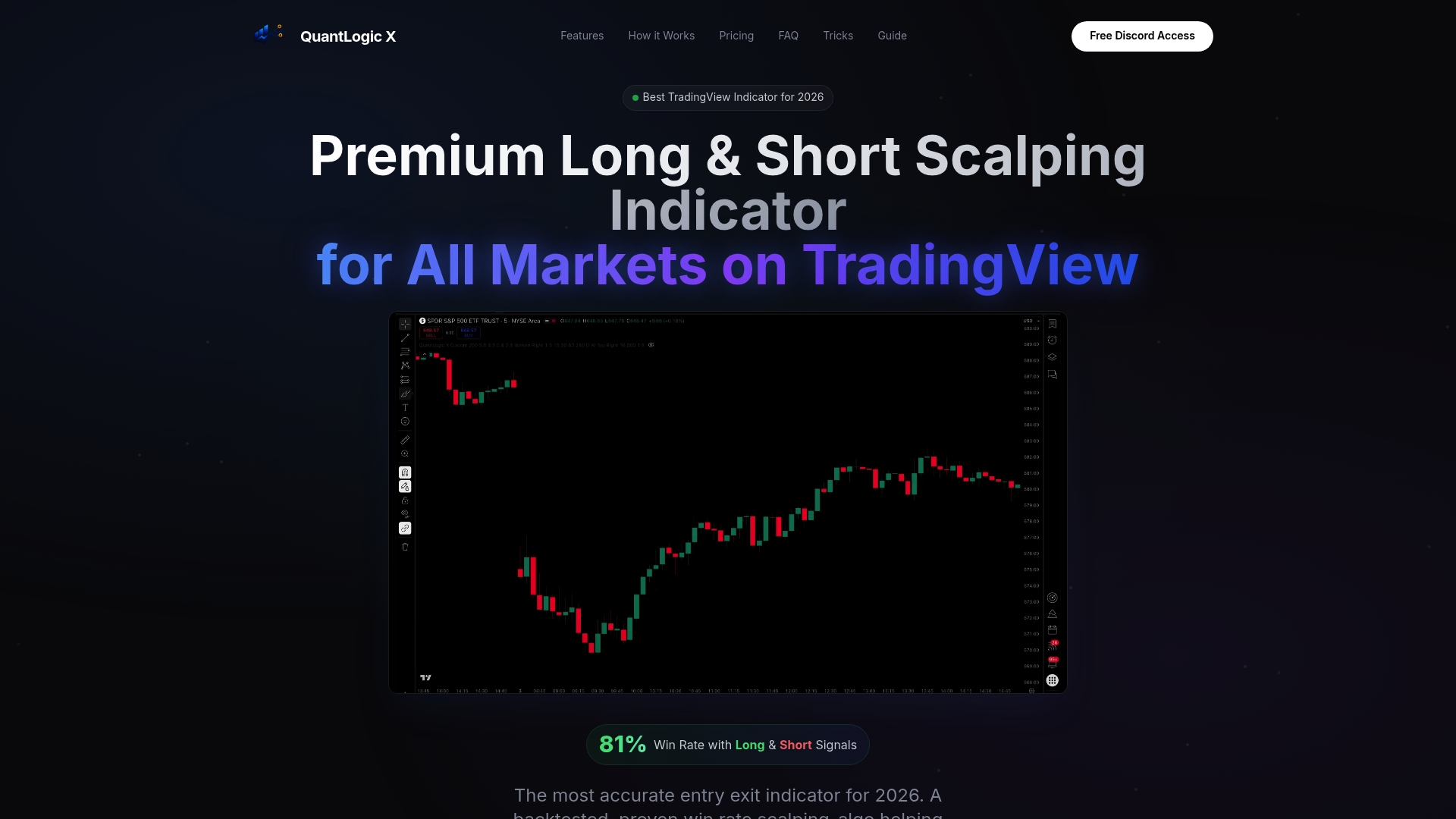
Over 2,000 traders use the Quantlogicx algorithm, with individual users recording gains of $8,200 in a single month. The indicator works whether you are trading SPY during the Golden Window, EUR/USD during the London session, or Bitcoin at 3:00 AM. Real-time alerts keep you in the loop without requiring you to stare at a screen all day. You can explore the best buy/sell indicator for 2026 or check the dedicated crypto trading signals page to see how it performs in your preferred market.
FAQ
What is a day trading market?
A day trading market is any financial venue where traders open and close positions within the same session to profit from short-term price movements. The most common examples are stock exchanges, the forex market, and cryptocurrency exchanges.
Which day trading market is best for beginners?
Forex is often the most practical starting point for beginners because it has no PDT rule, flexible hours, and lower account minimums than U.S. stock trading. Crypto is accessible but carries significantly higher volatility risk.
Did the pattern day trader rule change in 2026?
Yes. FINRA eliminated the $25,000 minimum equity requirement and the pattern day trader designation in 2026, replacing them with a real-time intraday margin monitoring system that gives traders more flexibility.
How volatile is crypto compared to stocks?
Crypto realized volatility runs 3–5 times higher than average equity volatility. Major coins typically move 3–8% daily, while U.S. stocks average 0.8–2.5% per day.
Can I day trade forex and stocks at the same time?
You can, but splitting focus across markets early in your trading career slows skill development. Most experienced traders recommend mastering one market before adding a second, using a clear scalping signal checklist to stay disciplined across sessions.