

Zero repaint in trading means an indicator does not change its past signals after a candle closes. That single property separates trustworthy tools from ones that quietly rewrite history. If you have ever watched a buy signal appear on a live chart, only to find it gone the next time you looked, you experienced repainting firsthand. Understanding what zero repaint means in trading is the difference between building a strategy on solid data and chasing signals that never actually existed.
What does zero repaint mean in trading, exactly?
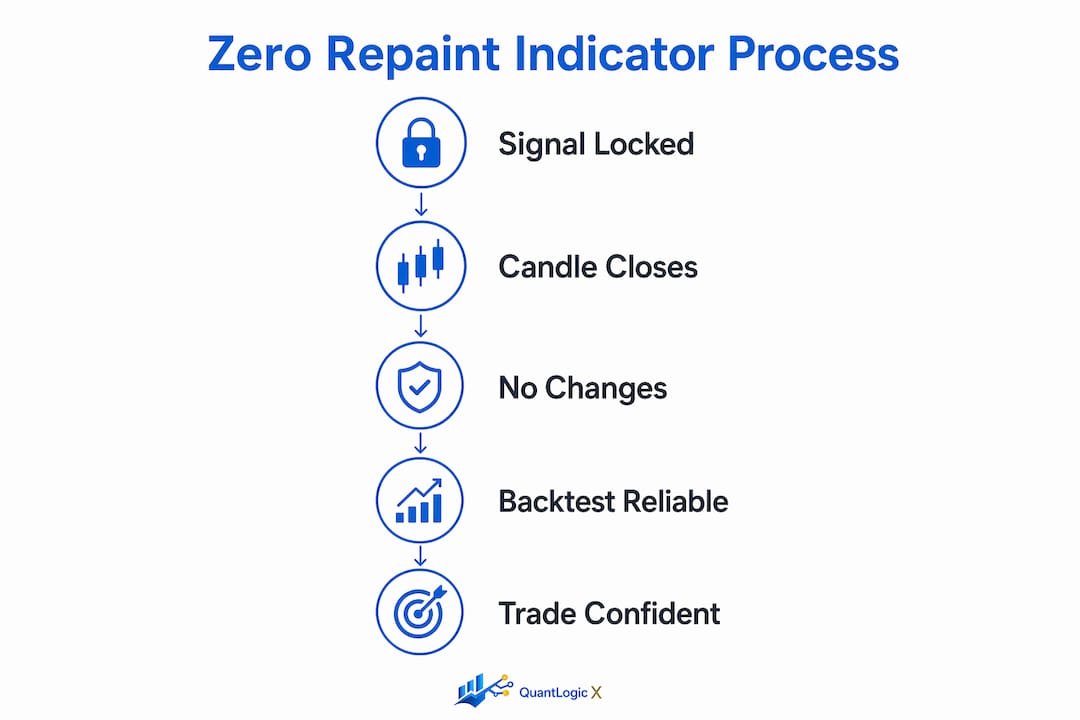
Zero repaint is the property of a trading indicator that locks its signal value permanently once the candle that generated it closes. The signal does not shift, disappear, or reposition on the chart after the fact. What you see on a closed bar is what was visible in real time when that bar closed.
The industry term for this property is "non-repainting." The phrase "zero repaint" is the informal label traders use, particularly in TradingView communities, to market or describe the same concept. Both terms mean the same thing. This article uses both so you recognize them in the wild.

The practical value is enormous. When you backtest a zero repaint indicator, the historical signals on your chart match exactly what you would have seen trading live. That means your backtest results are honest. With a repainting indicator, the chart shows signals that were never actually there during live trading, making past performance look far better than it was.
The Trend S/R HTF indicator on TradingView is a widely cited example. It outputs confirmed signals on current and higher timeframes using only closed bar data, with no historical repainting. That design is the standard all zero repaint tools aim to meet.
What is indicator repainting and why does it happen?
Repainting occurs when an indicator changes historical values after the fact, often by using future or still-forming bar data. The result is a chart that looks accurate in hindsight but was never accurate in real time. Traders who trust repainting indicators make decisions based on signals that did not exist when they needed them.
Repainting happens for two main technical reasons:
- Lookahead bias in code. In Pine Script on TradingView, using
request.securitywithlookahead_oncauses the indicator to read data from a higher timeframe bar that has not yet closed. The signal appears to predict the future because it is literally reading future data. The correct practice reads the previous closed bar instead, eliminating the lookahead. - Forming bar calculations. Some indicators recalculate on every tick of the current candle. That is normal behavior for the live bar. The problem arises when those intrabar values get stamped onto historical bars retroactively, making past signals look different from what they were in real time.
The distinction between normal intrabar updates and harmful repainting matters. An indicator updating its value on the current live candle is expected behavior. An indicator that changes signals on bars that already closed is the problem. The first is a feature. The second is a flaw.
Repainting affects indicators across all major platforms, including TradingView, MetaTrader, and cTrader. The issue is not platform-specific. It is a coding and design choice.
Pro Tip: Reload your chart after a few candles close. If any historical signals shifted position or disappeared, the indicator repaints. That test takes 30 seconds and tells you everything.
How do zero repaint indicators prevent misleading signals?
Zero repaint indicators are built around one rule: only use data from confirmed, closed candles. That rule eliminates lookahead bias at the source. The signal cannot change because the data feeding it cannot change.
The technical implementation in Pine Script follows a clear pattern:
- Read only closed bar data. The script calls
request.securitywithlookahead=barmerge.lookahead_off, which forces the indicator to read the last confirmed bar on any timeframe, not the forming one. - Lock signal values at bar close. The indicator assigns its output value only when
barstate.isconfirmedis true, meaning the candle has fully closed. - Avoid future-referencing functions. Functions that look ahead in time, even subtly, are excluded from the calculation chain.
- Test against historical data. Developers verify that the signals visible on historical bars match what the indicator produced in real time during those periods.
- Document the methodology. Reputable zero repaint indicators state their coding approach publicly so traders can verify the claims.
The result is a tool where backtesting reflects reality. When you see 40 winning signals over the past six months on a zero repaint indicator, those 40 signals were actually generated at those moments. That is the foundation of honest strategy development.
The Trend S/R HTF indicator demonstrates this in practice. It uses multi-timeframe confirmed data to display support and resistance levels without any retroactive signal changes. Traders using it on TradingView can trust that the chart history reflects live conditions.
How do zero repaint indicators compare to standard non-repainting indicators?
Standard indicators like the EMA (Exponential Moving Average) and MACD do not repaint by design. They calculate from price data that is already closed. No custom coding is required to make them non-repainting. They simply are, by their mathematical nature.
This creates an important reality check. The "zero repaint" label on a custom indicator is not proof of superiority over simpler tools. It is a minimum standard, not a premium feature. A custom indicator that does not repaint is doing what the EMA has always done. The label tells you the tool is honest. It does not tell you the tool is good.
Expert traders caution that marketing hype around zero repaint labels often leads traders to overlook simpler, well-tested tools. That caution is worth taking seriously. Complexity is not accuracy.
Where custom zero repaint indicators genuinely add value:
- Multi-timeframe signal confirmation. Standard indicators do not natively combine signals across timeframes. A well-coded zero repaint indicator can do this without introducing lookahead bias.
- Regime detection. Some custom tools identify trend regimes or volatility states that EMA and MACD do not capture directly.
- Visual clarity. Custom indicators can present signals as clean buy/sell labels rather than requiring traders to interpret crossovers manually.
Where they do not add value:
- When the underlying logic is just a dressed-up moving average with a marketing label.
- When the "zero repaint" claim is unverified and the code is not publicly available for review.
Pro Tip: Before trusting any zero repaint label, check whether the indicator's source code is open or auditable. A closed-source "zero repaint" claim is just a claim.
Knowing which indicator types fit your setup matters more than chasing labels. Match the tool to the strategy, not the other way around.
Practical tips for using zero repaint indicators in your trading
Zero repaint indicators improve signal reliability, but they do not make decisions for you. How you use them determines whether they help or hurt your results.
Verify the zero repaint claim before committing. Reload your chart after several candles close and check whether historical signals moved. Use the platform's strategy tester and compare live results to historical output. Signal stability after reload is the clearest proof of a non-repainting design.
Always wait for candle close before acting. Even a zero repaint indicator can show an intrabar signal that shifts before the candle closes. Confirmed signals come only after the bar closes. Acting on a mid-candle signal introduces the same risk as acting on a repainting one.
Combine with price action and momentum filters. Zero repaint indicators work best as regime filters within broader strategies, not as standalone entry triggers. Use them to confirm the trend direction, then let price action drive the actual entry. Adding a momentum confirmation, such as a volume spike or a key level break, reduces false signals significantly.
Measure performance honestly. Track your results from the moment you go live, not from the backtest. Backtests on zero repaint indicators are reliable, but live conditions include slippage, spread, and execution delays that no chart can simulate. Review your indicator performance regularly to catch any drift between expected and actual results.
Avoid over-reliance on any single tool. No indicator, zero repaint or otherwise, wins on every trade. The goal is a consistent edge across many trades, not a perfect signal on every one.
Key takeaways
Zero repaint indicators lock signals at bar close, making backtests honest and live trading decisions more reliable than any repainting tool can provide.
| Point | Details |
|---|---|
| Zero repaint definition | An indicator that does not change past signals after a candle closes. |
| Root cause of repainting | Lookahead bias in code, often from reading forming higher-timeframe bars. |
| Standard indicators | EMA and MACD are inherently non-repainting and do not need a special label. |
| Verification method | Reload the chart after candle close and check whether historical signals shifted. |
| Best practice usage | Combine zero repaint signals with price action and wait for confirmed bar close. |
Why zero repaint matters more than most traders realize
Zero repaint indicators changed how I think about backtesting. Before I understood the concept, I spent months building strategies on indicators that looked brilliant in hindsight and fell apart in live trading. The signals were real on the chart. They just were not real when the market was actually open.
The honest truth is that zero repaint is a baseline requirement, not a selling point. Every indicator you use should meet this standard. The fact that it needs to be marketed as a feature tells you how many tools in circulation do not meet it.
What I have found after years of watching traders use these tools is that the zero repaint property matters most at the strategy-building stage. When your historical signals are accurate, your strategy development is grounded in reality. You can actually learn from past trades instead of chasing phantom patterns. That is where the real value sits, not in any single signal the indicator fires.
The limitation traders miss is this: zero repaint does not mean zero loss. A signal that was genuinely present in real time can still be wrong. The market does not care about your indicator's coding integrity. Risk management and position sizing do more for your account than any indicator property. Zero repaint gives you honest data. What you do with that data is still entirely up to you.
Simplicity also wins more often than traders expect. The EMA and MACD have been non-repainting for decades. They work. Adding a complex custom tool on top of them is only justified if it solves a problem those tools cannot. If it does not, you are adding noise.
— Tran
Quantlogicx: zero repaint signals built for TradingView traders
Traders who want zero repaint signals without building their own indicator have a direct option in Quantlogicx.
Quantlogicx delivers long and short signals on TradingView with zero repaint technology, meaning every signal you see on a closed bar was present in real time. The algorithm reports an 81% win rate and has been adopted by over 2,000 traders across stocks, forex, and cryptocurrency. Individual users have recorded gains of $8,200 within a single month. Real-time alerts and a trader community come included. Whether you are new to technical analysis or running a tested strategy, Quantlogicx gives you reliable buy and sell signals grounded in confirmed bar data, not retroactive chart revisions.
FAQ
What does zero repaint mean in trading?
Zero repaint means an indicator does not alter its historical signals after a candle closes. The signal you see on any past bar is exactly what appeared in real time when that bar closed.
Why do some indicators repaint?
Repainting happens when an indicator reads data from a candle that has not yet closed, a coding error called lookahead bias. In Pine Script, using request.security with lookahead_on is a common cause.
Are EMA and MACD zero repaint indicators?
EMA and MACD are inherently non-repainting because they calculate only from closed price data. They do not carry a "zero repaint" label, but they meet the same standard by design.
How do I test whether an indicator repaints?
Reload your chart after several candles close and check whether any historical signals shifted or disappeared. You can also run the indicator through your platform's strategy tester and compare historical output to live results.
Does zero repaint guarantee profitable signals?
Zero repaint guarantees signal honesty, not profitability. A non-repainting indicator can still generate losing trades. Combining it with price action confirmation and sound risk management is what drives consistent results.