

A day trading risk management workflow is the structured process of applying layered controls to protect your trading capital through position sizing, stop-loss orders, daily risk limits, and drawdown thresholds. Most traders focus only on entries and exits. The traders who survive long-term build a repeatable system around how much they risk, not just where they trade. Three-layer risk management increases 12-month survival rates by 47% compared to traders who rely on stop-loss orders alone. That single statistic reframes risk management from a nice-to-have into the core skill of the profession.
What are the three levels of day trading risk management?
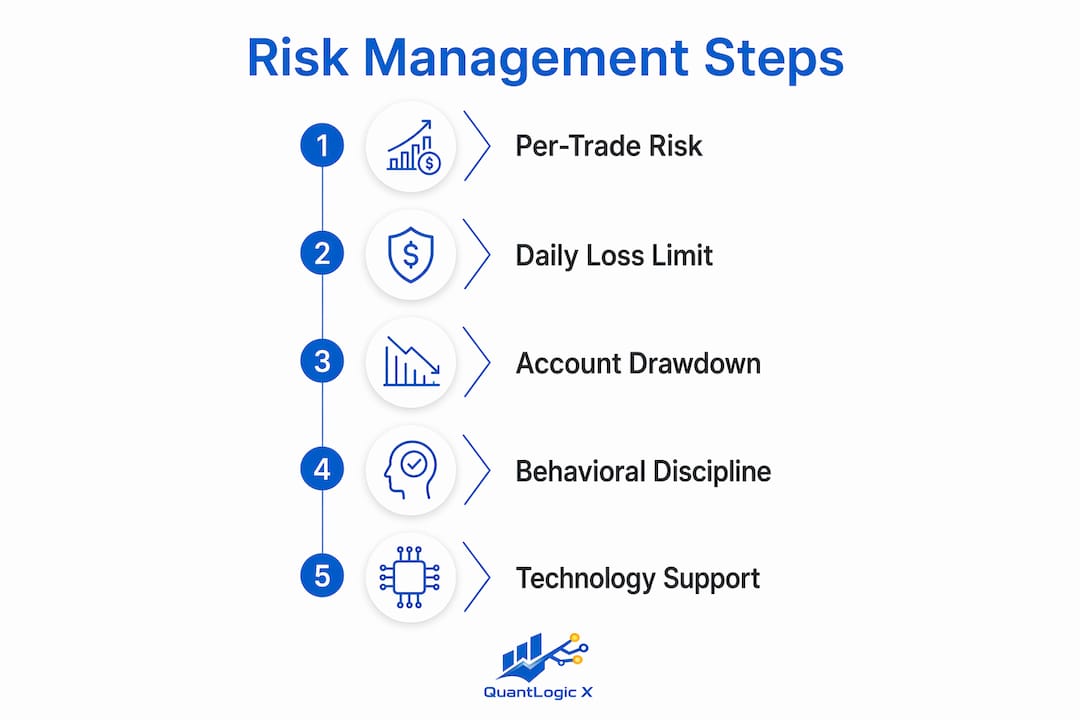
The three-level system is the foundation of every professional trading risk management technique. Each level controls a different time horizon, and together they form a complete safety net.
Level 1: Per-trade risk

Per-trade risk limits how much you lose on any single position. The professional consensus sets this at 1% of your account per trade. On a $25,000 account, that means your maximum loss per trade is $250. This level prevents any single bad trade from doing serious damage.
Level 2: Daily loss limit
The daily loss limit caps your total losses for one trading session. The standard is 3% of your account, which equals roughly three losing trades at 1% each. When you hit this number, you stop trading for the day. No exceptions. This level exists because emotional tilt after a losing streak causes traders to take increasingly poor trades, turning a manageable loss into a catastrophic one.
Level 3: Account drawdown control
Account drawdown control governs your overall equity decline from peak. The standard thresholds are:
- At 10% drawdown: reduce position size by 25–50% and take a mandatory review break
- At 15% drawdown: cut position size to minimum and pause new strategies
- At 20% drawdown: stop trading entirely until you complete a full review and recovery plan
Each level catches what the previous one misses. Per-trade limits stop single disasters. Daily limits stop emotional spirals. Drawdown controls stop slow account erosion that no single bad day triggers. All three working together form a complete risk control system that professional traders treat as non-negotiable.
How do you calculate position size and set stop-loss orders?
Position sizing is the math that connects your risk tolerance to your actual trade size. Get this wrong and no other rule saves you.
The formula is straightforward:
- Determine your account balance (example: $20,000)
- Apply your risk percentage (1% = $200 maximum loss)
- Identify your stop-loss distance in dollars (example: $0.50 per share)
- Calculate: Position Size = Account Balance × Risk% ÷ Stop Loss Distance = $20,000 × 0.01 ÷ $0.50 = 400 shares
That formula gives you a specific, defensible share count before you place a single order. It removes guesswork from the equation entirely.
Stop placement is where most traders make their first serious mistake. Technical stop placement outperforms arbitrary percentage stops because it respects how the market actually moves. Place your stop below a key support level, below a moving average, or below a chart pattern low. A stop placed at "2% below entry" ignores whether that level has any technical significance.
The minimum risk/reward ratio every trade must clear is 2:1. If your stop is $200 away, your target must be at least $400 away. Trades that don't meet this threshold simply don't get taken.
Pro Tip: Use the Average True Range (ATR) indicator to size your stops dynamically. A stock with an ATR of $1.20 needs a wider stop than one with an ATR of $0.30. Placing a tight stop on a volatile stock almost guarantees a premature exit.
Two behaviors destroy per-trade risk discipline faster than anything else. First, using mental stops instead of hard stops entered in the platform immediately. Second, moving your stop further from entry after the trade goes against you. Moving stops away from entry is hope management, not risk management. Trailing stops may only move toward your entry price, never away from it.
What rules govern daily loss limits and account drawdown management?
The daily loss limit is the single most critical protective layer in your entire workflow. It must be treated as a hard rule with zero exceptions.
"The daily maximum loss limit is the single most critical protective layer to protect capital. Once hit, the trading day ends. No re-entries, no revenge trades, no 'one more try.' The rule exists precisely for the moments when you most want to break it."
A practical daily loss structure works in graduated steps:
- First losing trade: Continue trading, no adjustment needed
- Second consecutive loss: Reduce position size by 50% for the remainder of the session
- Third consecutive loss: Stop trading for the day, regardless of time remaining
- Daily limit hit (3%): Session ends immediately, platform closed
The recommended daily loss cap of 3% equals roughly three times your per-trade risk. This structure gives you room to absorb a normal losing streak without triggering a full stop, while still protecting you from emotional escalation.
Account drawdown management operates on a longer timeline. At 10–15% drawdown, the correct response is to scale back position size and take a structured break, not to trade harder to recover. At 20% drawdown, you stop trading entirely and review every trade in your journal before returning. The goal is not to recover losses quickly. The goal is to stop the bleeding and diagnose the cause.
Real-time monitoring makes enforcement practical. Set platform alerts at 50%, 75%, and 100% of your daily limit so you get a warning before you hit the wall. Equity curve tracking software shows your drawdown visually, which makes the numbers harder to rationalize away.
How do behavioral discipline tools and checklists fit into your workflow?
Discipline fails at the moment of execution, not during planning. A pre-trade checklist converts your rules from intentions into a physical gate that every trade must pass through.
A complete pre-trade checklist covers five areas:
- Setup validation: Does this trade match a defined, tested pattern?
- Stop-loss confirmation: Is the stop placed at a technical level before order entry?
- Position size check: Has the position size been calculated using the formula?
- Daily limit check: Is the remaining daily loss budget sufficient for this trade?
- Emotional state check: Am I neutral, or am I trading to recover a loss?
The fifth item is the one traders skip most often. Blurring trading execution with emotional decisions is the most frequent and costly mistake active traders make. A "hard-no rule" addresses this directly. You identify your single most damaging behavioral pattern, such as adding to a losing position, and lock it as a cancel condition. If that behavior is present, the trade does not happen.
Pro Tip: Keep your checklist as a physical card next to your keyboard, not a mental list. The act of physically checking each box slows you down enough to catch impulsive decisions before they become executed orders.
Journaling every trade creates the accountability loop that makes the checklist meaningful. Record your entry, exit, planned stop, actual stop, and emotional state at entry. Review weekly. Patterns in your journal reveal which rules you break most often, which is exactly where your workflow needs reinforcement. A consistent daily trading routine built around pre-trade and post-trade review is what separates traders who improve from those who repeat the same mistakes.
What technology supports and automates your risk management workflow?
Modern trading platforms remove the manual burden from risk enforcement. The key is knowing which features to configure before you start trading each day.
| Feature | Function | Workflow benefit |
|---|---|---|
| Position size calculator | Computes share count from account risk and stop distance | Eliminates manual math errors |
| Hard stop order | Executes stop automatically without manual intervention | Prevents mental stop failures |
| Daily loss alert | Notifies at preset P&L thresholds | Enforces daily limit in real time |
| Equity curve tracker | Visualizes drawdown over time | Makes drawdown thresholds visible |
| Real-time margin monitor | Tracks intraday margin usage | Supports regulatory compliance |
Modern trading platforms automate alerts, stop orders, and risk tracking so that critical limits get enforced even when emotions push back. This automation is not optional for serious traders. It is the mechanism that makes your rules stick.
Regulatory context matters here. FINRA updated Rule 4210 in april 2026, replacing the old pattern day trader framework with new intraday margin requirements that enforce real-time or end-of-day margin deficit monitoring. This change means your platform's margin tracking is now a compliance tool, not just a convenience. Traders using 0DTE options and app-based platforms face intraday risk exposure that traditional equity-only risk models cannot capture. Your workflow must account for this.
Configure your platform before the market opens. Set your daily loss alert, enter your stop orders immediately after each fill, and check your equity curve at the end of every session. Automation handles enforcement. You handle judgment.
Key Takeaways
A three-level risk management system combining per-trade limits, daily loss caps, and drawdown controls gives day traders the highest probability of long-term capital survival.
| Point | Details |
|---|---|
| Three-level system | Per-trade, daily, and drawdown controls work together as a complete safety net. |
| Position sizing formula | Use Account Balance × Risk% ÷ Stop Distance to calculate every trade size before entry. |
| Daily loss limit | Cap daily losses at 3% and stop trading immediately when that threshold is hit. |
| Technical stop placement | Place stops at support levels or ATR-based distances, never at arbitrary percentages. |
| Automate enforcement | Configure platform alerts and hard stops before the session to remove emotional override. |
Why most traders underestimate the workflow side of risk management
I've watched traders spend weeks perfecting their entry signals and then blow up their accounts in a single afternoon. The entry is not the problem. The workflow is.
The hardest lesson I've internalized is that risk management is not a set of rules you follow when things go wrong. It is a system you build before the market opens, every single day. The traders I've seen survive long-term all share one habit: they treat their daily loss limit as a physical stop sign, not a suggestion. When they hit it, they close the platform. Not after one more trade. Immediately.
The behavioral side gets underestimated because it feels soft compared to formulas and indicators. But moving a stop further from entry, skipping the checklist on a "obvious" setup, or trading through a daily limit to recover losses are all decisions that feel rational in the moment. They are not. Every one of them is an emotional override of a rule you set when you were thinking clearly.
My practical recommendation: review your trading journal every Friday. Look specifically for the trades where you broke a rule. Not the losing trades. The rule-breaking trades. That pattern tells you exactly where your workflow needs a harder gate. Adjust the rule, not the exception.
Risk management is not a skill you learn once. It is a practice you maintain, test, and tighten based on real data from your own trading history.
— Tran
Quantlogicx: built for traders who take risk seriously
Executing a disciplined risk workflow requires more than rules on paper. You need signals you can trust and alerts that fire before a trade goes wrong.
Quantlogicx delivers a TradingView indicator built specifically for active traders across stocks, forex, and crypto. The zero-repaint technology means every long and short signal is confirmed at bar close, so you are never reacting to a signal that disappears. Over 2,000 traders use the algorithm, with individual users recording gains of $8,200 in a single month. Real-time alerts integrate directly into your pre-trade checklist workflow, and the Quantlogicx indicator pairs with position sizing discipline to give your entries a clear technical foundation. See the full tool at Quantlogicx.
FAQ
What is a day trading risk management workflow?
A day trading risk management workflow is a structured, repeatable system of rules covering position sizing, stop-loss placement, daily loss limits, and account drawdown thresholds applied before and during every trading session.
How much should you risk per trade in day trading?
Professional consensus sets the per-trade risk limit at 1% of your account balance, which means a $20,000 account risks no more than $200 on any single trade.
What is the recommended daily loss limit for day traders?
The standard daily loss limit is 3% of your account, roughly equal to three losing trades at 1% each. When you reach this limit, you stop trading for the rest of the day without exception.
When should you stop trading due to account drawdown?
At 10–15% drawdown, reduce position size and take a structured break. At 20% drawdown, stop trading entirely and complete a full journal review before returning to the market.
How does FINRA's 2026 margin rule affect day traders?
FINRA updated Rule 4210 in april 2026 to require real-time or end-of-day intraday margin deficit monitoring, replacing the older pattern day trader framework and making platform-level margin tracking a compliance requirement for active traders.