

Trade signal confluence is defined as the alignment of two or more independent trading signals at the same price and time, creating a higher-probability basis for entering or exiting a trade. The industry standard treats three independent signals as the "sweet spot" for discretionary setups. Two signals may be coincidence. Four signals risk marking a level so obvious that liquidity exhaustion becomes a real threat. Understanding what is trade signal confluence separates traders who react to noise from those who act on genuine edge. Quantlogicx is built around this exact principle, filtering entries through multiple confirming signals before generating an alert.
What is trade signal confluence and why does it matter?
Trade signal confluence is the practice of stacking genuinely independent signals that all point to the same market event. When a higher-timeframe trend, a key support level, and a volume spike all agree on the same price zone, the probability of a successful trade rises meaningfully. A single moving average crossover tells you one thing. Three unrelated signals telling you the same thing is a different conversation entirely.

Confluence is a risk management tool, not a profit guarantee. That distinction matters. Traders who treat confluence as a magic formula take on false confidence and ignore the market uncertainty that always remains. The correct framing is that confluence filters out low-quality setups and improves your risk-to-reward profile. It does not eliminate losing trades.
The trade signal confluence meaning becomes clearest when you compare it to single-signal trading. A trader relying only on RSI entering oversold territory will take many setups. A trader requiring RSI oversold, price at a prior weekly support level, and a bullish volume spike will take far fewer setups. The second trader's entries will be tighter, better justified, and easier to manage with a defined stop.
Why signal independence is the foundation of real confluence
Signal independence is the most misunderstood requirement in confluence trading. Two indicators are independent only when they draw from different data sources or measure different market phenomena. RSI and Stochastic, for example, are both derived from recent price data. Stacking them does not create confluence. It creates the illusion of confluence from correlated inputs, which misleads traders into poor decisions.
True independent signal families include:
- Higher-timeframe trend direction (weekly or daily bias)
- Structural levels (prior support, resistance, or order blocks)
- Liquidity events (stop hunts, sweeps of recent highs or lows)
- Volume confirmation (spikes indicating institutional participation)
- Price action triggers (engulfing candles, pin bars, or inside bar breakouts)
- Session timing (London open, New York open, or overlap windows)
Each family measures something different. A liquidity sweep combined with a volume spike and a daily trend alignment gives you three genuinely independent reasons to act. That is real confluence. Three momentum oscillators pointing the same direction is not.
The practical test for independence is simple: if removing one indicator would not change the signal from the others, they are likely correlated. Apply that filter to every indicator you use.
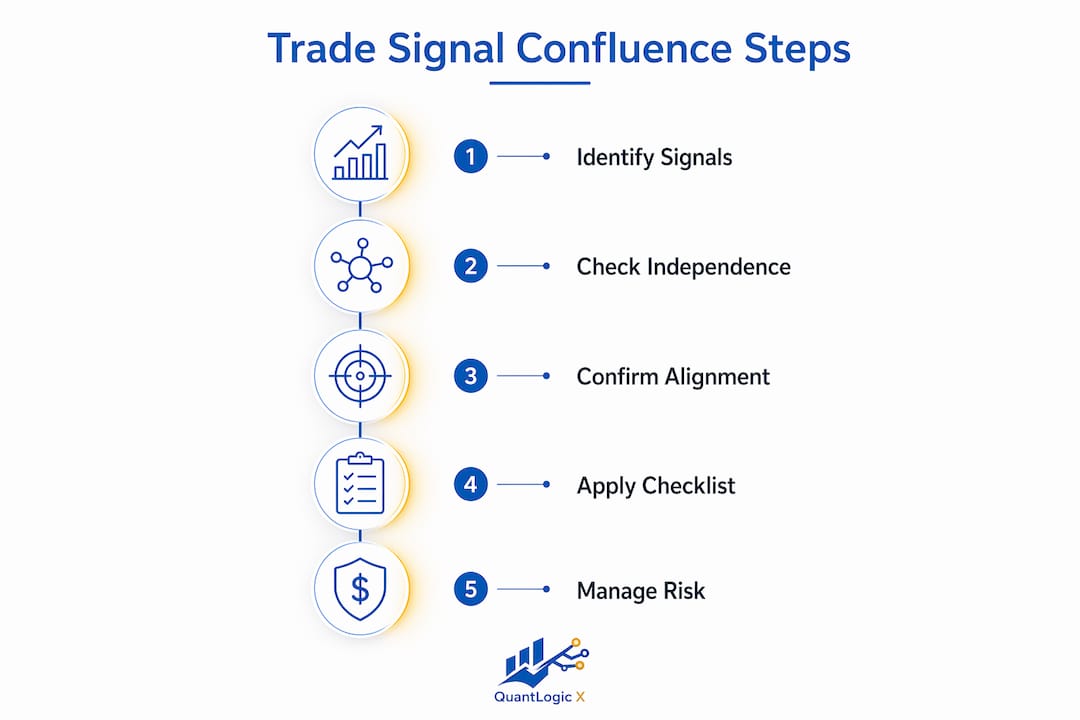
Pro Tip: Map your current indicators to their data source. If two or more indicators use closing price as their primary input, treat them as one signal, not two.
How to build a trade signal confluence checklist
A written checklist is the most direct way to formalize your confluence strategy. Without one, traders default to subjective real-time judgment, which is vulnerable to emotion and hindsight bias. A written pre-session checklist with a minimum signal threshold removes that vulnerability and builds statistical clarity over time.
Build your checklist in this order:
- Define your minimum threshold. Three independent signals is the standard starting point. Write that number down and commit to it before the session opens.
- List your signal families. Assign one slot to trend direction, one to structure, one to a liquidity or volume event, and one to a price action trigger. Each slot must be filled by a genuinely independent source.
- Add context filters. Note the broader market condition. A bullish setup in a confirmed downtrend on the daily chart carries less weight than the same setup in an uptrend.
- Include risk metrics. Before marking a setup as valid, confirm where your stop goes and what your risk-to-reward ratio is. A setup with no clean invalidation zone fails the checklist regardless of how many signals align.
- Log every trade with a confluence score. Record which signals were present, whether the checklist was followed, and the outcome. Review this log after 30 trading sessions.
The scalping signal checklist approach works for any timeframe. The discipline of following a predefined list is what separates traders who improve from those who repeat the same mistakes.
Pro Tip: Set a rule that you cannot enter a trade until every checklist item is answered in writing. This one habit eliminates most impulsive entries.
Common pitfalls when interpreting signal confluence
Most confluence mistakes fall into a small number of repeatable patterns. Recognizing them early saves significant capital.
- Stacking correlated indicators. Loading a chart with MACD, RSI, and Stochastic looks like three signals. All three derive from price momentum. That is one signal dressed in three costumes.
- Ignoring counter-signals. A bullish confluence setup in a zone where the weekly chart shows strong resistance is not a clean setup. Traders who ignore the opposing evidence take on hidden risk.
- Confusing quantity with quality. Requiring five or six signals sounds disciplined. In practice, it leads to analysis paralysis and missed trades. The three-signal standard exists because it balances precision with frequency.
- Treating confluence as certainty. Confluence is probabilistic, not deterministic. Every setup carries the possibility of failure. Position sizing and stop placement must reflect that reality.
- Skipping the independence check. Traders build elaborate systems and never verify whether their signals are actually independent. The result is false confidence built on redundant data.
High-precision confluence trading reduces trade frequency. That is a feature, not a flaw. Fewer setups with higher quality is the intended outcome. Traders who resist this trade-off end up lowering their standards to generate more trades, which defeats the purpose entirely.
What does trade signal confluence look like in practice?
A practical confluence setup in forex might look like this. The daily chart shows a clear uptrend. Price pulls back to a prior weekly support level that also aligns with a Fibonacci retracement zone. A liquidity sweep takes out the lows of the previous session before reversing. A bullish engulfing candle closes above the swept low. Volume on that candle is above the 20-period average.
That setup contains four independent signals: trend direction, structural level, liquidity event, and price action trigger with volume confirmation. Each signal comes from a different domain. Confluence zones like this produce stronger and more reliable market reactions because multiple independent reasons converge at the same price.
The risk management benefit is equally concrete. Confluence zones enable tight stop placement just beyond the clustered signals. A stop set below the liquidity sweep low is objectively justified by the structure. That tight invalidation zone allows a larger position size for the same dollar risk. The math improves because the setup is better defined.
Here is a framework for the most common signal families and their roles:
| Signal family | What it measures | Role in confluence |
|---|---|---|
| Higher-timeframe trend | Market direction bias | Context filter |
| Structural levels | Prior support or resistance | Price zone anchor |
| Liquidity events | Stop hunts or order flow | Entry timing trigger |
| Volume confirmation | Institutional participation | Signal strength validator |
| Price action trigger | Candlestick pattern or breakout | Precise entry point |
For traders who want to go deeper on identifying reliable trade signals, building familiarity with each family separately before combining them is the most effective path. Understanding how to confirm buy and sell signals adds another layer of discipline to the process.
The fintech infrastructure behind modern trading platforms increasingly integrates liquidity and volume metrics directly into signal algorithms, making confluence detection faster and more systematic for active traders.
Key Takeaways
Trade signal confluence is the most reliable filter available for improving trade quality, and it works only when signals are genuinely independent and applied through a written, pre-session checklist.
| Point | Details |
|---|---|
| Three-signal threshold | Three independent signals is the industry standard for a high-probability confluence setup. |
| Independence is non-negotiable | Correlated indicators like RSI and Stochastic count as one signal, not two. |
| Written checklist prevents bias | A pre-session checklist with a fixed minimum threshold removes emotion and hindsight from entries. |
| Confluence tightens stops | Clustered signals create precise invalidation zones, improving risk-to-reward and position sizing. |
| Fewer trades, higher quality | Requiring more signals reduces frequency but raises the average quality of each setup taken. |
What I've learned from trading confluence the hard way
The first time I built a confluence checklist, I had seven criteria on it. Seven. I thought more filters meant more discipline. What it actually meant was that I watched dozens of clean setups pass without entering because I was always one signal short. I spent three weeks observing and barely trading.
The lesson was not to lower my standards. The lesson was to choose the right three signals and trust them completely. Once I cut the list to three genuinely independent criteria and committed to following it without exception, my entries became cleaner and my stops became tighter. The win rate did not explode overnight, but the losing trades got smaller and the winning trades got larger. That asymmetry compounds over time in ways that a high-frequency, low-quality approach never does.
The hardest part of confluence trading is not finding the signals. It is sitting on your hands when the market is moving and your setup is one signal short. That patience is the actual edge. Traders who cannot wait for the full checklist to align will always underperform traders who can. Journaling each trade with a confluence score is what makes that patience sustainable. When you can see in your own data that checklist-compliant trades outperform impulsive entries, the discipline becomes self-reinforcing.
My advice: start with three signals, log every trade for 90 days, and let your own data tell you whether to add a fourth criterion. Do not borrow someone else's system. Build yours from evidence.
— Tran
Quantlogicx and the case for automated confluence detection
Applying a confluence checklist manually across multiple markets and timeframes is demanding work. Quantlogicx addresses that directly with its TradingView indicator, which detects independent signal alignment and generates long and short alerts only when multiple conditions are met simultaneously.
Over 2,000 traders use Quantlogicx across stocks, forex, and cryptocurrency, with the platform reporting an 81% win rate and individual users recording gains of $8,200 within a single month. The zero repaint technology means every signal is locked at bar closure, so the alert you see is the alert that was valid when the candle closed. For traders who want to apply confluence-based forex signals without building every filter manually, Quantlogicx enforces the checklist automatically. The community and real-time alerts add accountability that solo trading rarely provides.
FAQ
What is the minimum number of signals for trade confluence?
The industry standard is three independent signals. Two signals may be coincidence, while four or more can mark a level so widely known that liquidity exhaustion becomes a risk.
How do I know if my signals are truly independent?
Check whether each signal draws from a different data source or measures a different market phenomenon. RSI and Stochastic both use price momentum and count as one signal, not two.
Does confluence guarantee a winning trade?
Confluence does not guarantee winning trades. It is a probability filter that improves risk-to-reward and filters out low-quality setups, but market uncertainty always remains.
How does confluence improve stop placement?
Clustered signals create a tight, objective invalidation zone. A stop set just beyond that zone is structurally justified and allows a larger position size for the same dollar risk.
How long should I track confluence trades before drawing conclusions?
Recording trades for at least 30 to 90 sessions gives enough data to identify whether your checklist criteria are producing a genuine edge and where adjustments are needed.