

A trading strategy is a predefined, rules-based framework that tells you exactly when to enter a trade, when to exit, and how much to risk on every position. Think of it as a business plan for markets: it replaces gut instinct with objective criteria and aims for consistent profitability through disciplined risk control. Understanding what is a trading strategy separates traders who survive long-term from those who blow up their accounts chasing random signals. Whether you are placing your first trade or refining a system you have used for years, a well-built strategy is the single most important tool you own.
What is a trading strategy made of?
A trading strategy is composed of six essential components: market selection, timeframe, entry triggers, stop-loss rules, take-profit targets, and position sizing. Omitting any one of these, especially risk management and exit rules, is the most common cause of account failure. Each component plays a specific role, and they only work when they function together as a complete system.
The six core components
- Market context (setup): This defines the conditions that must exist before you even consider a trade. Examples include a trending market on the daily chart or a specific price pattern forming near a key support level.
- Entry trigger: This is the precise event that opens your trade. A moving average crossover, a breakout above resistance, or a candlestick reversal pattern all qualify as entry triggers.
- Execution: This covers how you place the order. Market orders, limit orders, and stop-entry orders each carry different slippage risks and suit different setups.
- Stop-loss rules: A stop-loss defines your maximum loss on any single trade. Risk management best practices recommend never risking more than 1–2% of total account equity per trade, with a minimum risk-to-reward ratio of 1:2. This rule keeps a losing streak from wiping out your account.
- Take-profit targets: These define when you close a winning trade. Setting a fixed target, a trailing stop, or a time-based exit removes the temptation to hold too long and give back gains. Practical profit target methods can help you choose the right approach for your style.
- Position sizing: This calculates how many shares, contracts, or lots you trade based on your account size and stop-loss distance. Correct position sizing is what makes the 1–2% risk rule work in practice.
Pro Tip: Write every component down before you trade a single dollar. A strategy that exists only in your head is not a strategy. It is a guess.
What are the common types of trading strategies?

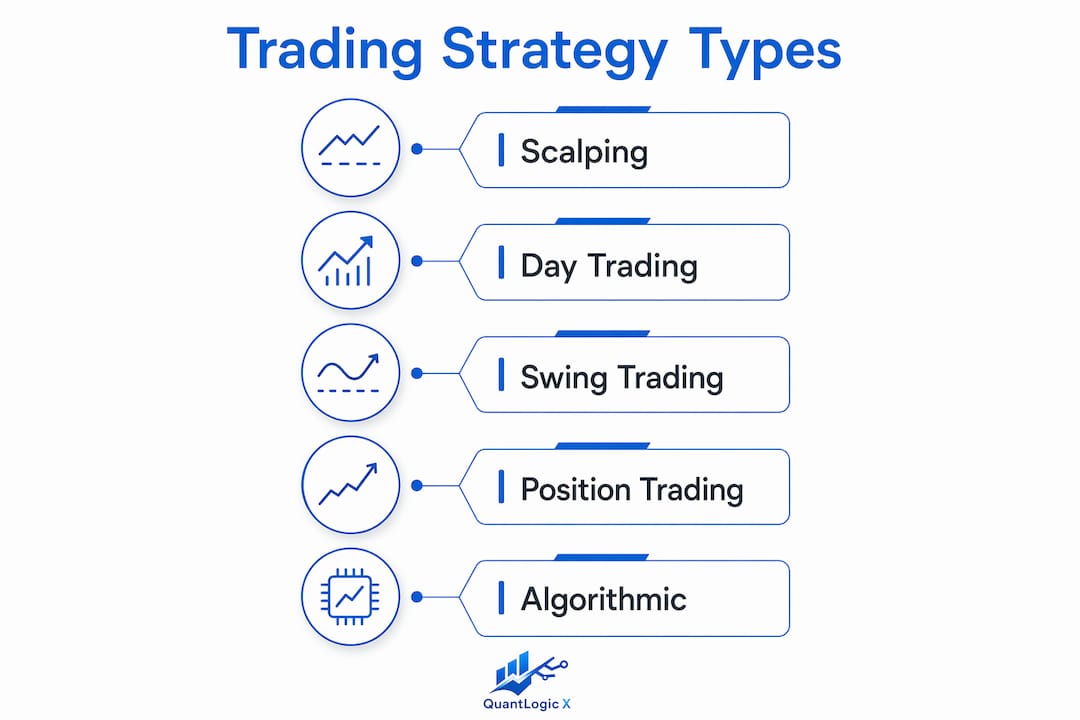
Trading strategies fall into four main timeframe categories: scalping, day trading, swing trading, and position trading. Each suits a different lifestyle, risk tolerance, and level of market experience. Longer-term strategies require less intense focus and are generally better for beginners.
Beyond timeframe, strategies also differ by the type of analysis they use:
- Technical strategies rely on price action, volume, and indicators like moving averages, RSI, and MACD to identify trade setups.
- Fundamental strategies use financial data, earnings reports, and economic indicators to determine whether an asset is undervalued or overvalued.
- Sentiment strategies track news flow, social media activity, and options market positioning to gauge crowd behavior.
- Quantitative strategies apply statistical models and large datasets to find repeatable edges, often with automated execution.
| Strategy type | Typical timeframe | Focus | Best for |
|---|---|---|---|
| Scalping | Seconds to minutes | Price momentum, tight spreads | Experienced, fast-decision traders |
| Day trading | Minutes to hours | Intraday trends and reversals | Active traders with dedicated screen time |
| Swing trading | Days to weeks | Multi-day price patterns | Part-time traders with patience |
| Position trading | Weeks to months | Macro trends and fundamentals | Long-term, lower-frequency traders |
Beginners benefit most from swing or position trading. The slower pace gives you time to analyze setups, review your decisions, and build discipline without the pressure of split-second execution. Scalping strategies demand a different skill set entirely and are better approached after you have mastered the basics.
How do you create a trading strategy that fits your goals?
Building a personal trading strategy follows a clear sequence. Skipping steps, especially validation, is how traders end up with systems that look great on paper but fail in live markets.
- Define your universe and timeframe. Decide which markets you will trade (stocks, forex, crypto, futures) and which chart timeframe you will use. Narrowing your focus prevents analysis paralysis.
- Write your entry criteria. Specify the exact conditions that must be present before you enter. "Price breaks above the 20-day high on above-average volume" is a valid entry rule. "Looks like it wants to go up" is not.
- Set your stop-loss and take-profit rules. Every trade needs a defined exit in both directions. Use the role of stop-loss rules to protect capital and lock in gains at predetermined levels.
- Calculate position size. Apply the 1–2% risk rule to every trade. If your account holds $10,000 and you risk 1%, your maximum loss per trade is $100. Your position size flows from that number and your stop-loss distance.
- Backtest on 50–100 historical trades. Experts recommend two-phase validation: first, test your rules against historical data. A viable strategy typically keeps maximum drawdown under 20%.
- Forward-test on 30–50 live or demo trades. Backtesting alone is insufficient. Forward-testing confirms whether you can actually execute the rules under real psychological pressure. This step separates theoretical systems from ones you can trade consistently.
- Review and refine. After forward-testing, analyze your results. Look at win rate, average risk-to-reward, and maximum drawdown. Adjust one variable at a time.
Pro Tip: Adding too many indicators reduces clarity and increases emotional decision risk. Stick to 2–5 simple indicators. A clean chart forces you to focus on what actually matters.
Simplicity is not a weakness in strategy design. A straightforward system you execute consistently will outperform a complex one you second-guess on every trade.
What are the biggest challenges in executing a strategy consistently?
Execution discipline is the primary cause of strategy failure. Traders abandon their rules during losing streaks, overtrade after wins, and let emotions override objective criteria. A mediocre strategy applied with iron discipline will outperform a well-designed strategy applied inconsistently.
The most effective defense against emotional trading is a mechanical strategy. A valid trading strategy produces clear, objective rules so that any two traders following the same system would take identical trades. That level of specificity removes ambiguity and leaves no room for fear or greed to creep in.
Practical best practices for consistent execution:
- Write your rules in full. Every entry condition, exit rule, and position sizing formula must be documented. If it is not written, it does not exist.
- Use cooldown periods after losses. Psychological guardrails like mandatory breaks after two consecutive losses protect profits and reset your mental state.
- Avoid low-liquidity sessions. Trading during off-hours or illiquid conditions introduces slippage and unpredictable price behavior that your backtested rules cannot account for.
- Track every trade. A trading journal that records your entry, exit, reason for the trade, and emotional state at the time reveals patterns you cannot see in the moment.
- Review weekly, not daily. Daily P&L reviews create emotional noise. Weekly reviews give you enough data to spot real trends in your execution.
Pro Tip: Set a maximum daily loss limit. When you hit it, close your platform and walk away. Protecting capital on bad days is what keeps you in the game on good ones.
Technology also plays a role. Tools that send real-time alerts for your specific entry conditions reduce the time you spend staring at charts and the temptation to force trades that do not meet your criteria.
Key Takeaways
A trading strategy is a complete, rules-based system covering entry, exit, position sizing, and risk management, and consistent execution of that system matters more than finding a perfect signal.
| Point | Details |
|---|---|
| Six components required | Every strategy needs market context, entry trigger, execution, stop-loss, take-profit, and position sizing. |
| Risk the right amount | Never risk more than 1–2% of account equity per trade, with a minimum 1:2 risk-to-reward ratio. |
| Validate before going live | Backtest on 50–100 trades, then forward-test on 30–50 live or demo trades to confirm real execution. |
| Simplicity beats complexity | Use 2–5 indicators maximum. Overcomplexity adds ambiguity and increases emotional errors. |
| Discipline drives results | A mediocre strategy executed consistently outperforms a perfect strategy applied with emotion. |
Why most traders get strategy backwards
Here is what I have seen repeatedly: traders spend months searching for the perfect entry signal and almost no time thinking about exits or position sizing. They treat the entry as the strategy. It is not. The entry is maybe 20% of what determines your outcome. The other 80% is what you do after you are in the trade.
The most successful strategies align with the trader's personality and risk appetite, not with some theoretical ideal. A swing trading system that holds positions for five days is useless to someone who cannot sleep with open trades. A scalping system is equally useless to someone who cannot commit to three hours of focused screen time each morning. Fit matters more than performance metrics on a backtest.
Forward-testing is where most traders cut corners, and it costs them. You can backtest a strategy in an afternoon. Forward-testing takes weeks. But that time spent trading small size in real market conditions is the only way to know whether you can actually follow your own rules when money is on the line. I have seen traders with excellent backtested systems fall apart the first time they take three consecutive losses. The strategy was fine. The execution was not.
My honest advice: build the simplest system that produces a positive expectancy, then trade it exactly as written for 50 live trades before you change anything. Boredom is a feature, not a bug.
— Tran
How Quantlogicx supports rules-based trading
Building a strategy from scratch takes time, and even experienced traders benefit from tools that enforce mechanical execution. Quantlogicx offers a TradingView indicator built specifically for traders who want clear, objective entry and exit signals without the noise of traditional indicators.
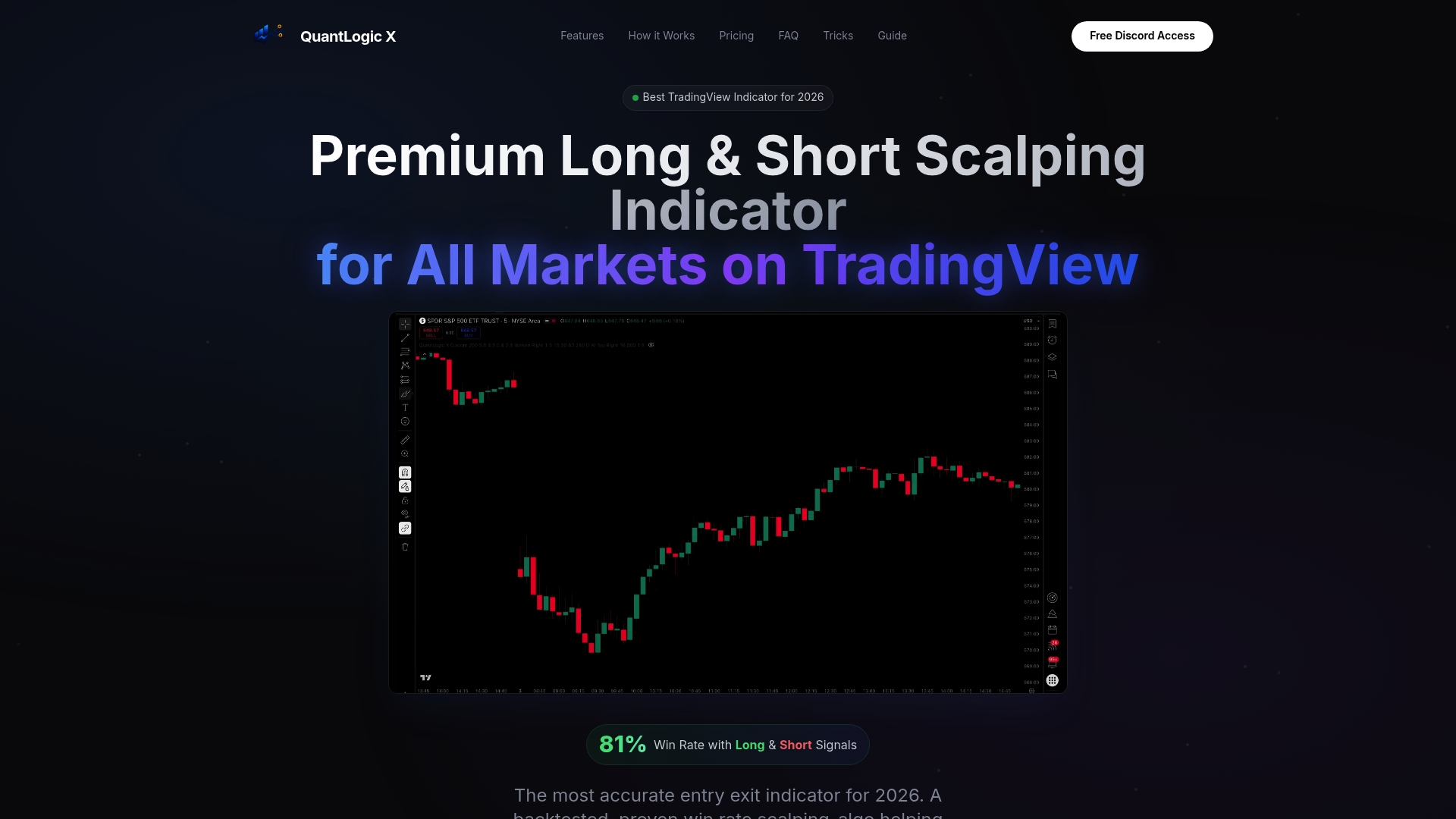
The Quantlogicx indicator uses zero repaint technology, meaning signals are confirmed at bar close and do not shift after the fact. Over 2,000 traders have used it across stocks, forex, and cryptocurrency, with some reporting gains of $8,200 within a single month. Real-time alerts notify you the moment a signal fires, so you spend less time watching charts and more time executing your plan. For traders who want a systematic TradingView signal that supports disciplined strategy execution, Quantlogicx is worth a close look.
FAQ
What is the simplest trading strategy definition?
A trading strategy is a complete set of rules that defines what to trade, when to enter, when to exit, and how much to risk on every trade. It relies on objective criteria rather than intuition.
What are the best trading strategies for beginners?
Swing trading and position trading are the best starting points for beginners. These longer-timeframe strategies reduce the pressure of rapid decisions and give traders time to analyze setups carefully.
How many indicators should a trading strategy use?
A trading strategy should use 2–5 indicators at most. Adding more indicators reduces clarity and increases the chance of conflicting signals and emotional errors.
How do you validate a new trading strategy?
Validate a new strategy by backtesting it on 50–100 historical trades, then forward-testing on 30–50 live or demo trades. Both phases together confirm whether the strategy works and whether you can execute it under real conditions.
Why do most trading strategies fail in live markets?
Most strategies fail because of poor execution discipline, not flawed rules. Emotional responses like fear and greed cause traders to deviate from their written criteria, which undermines even well-designed systems.