

Entry timing in scalping is the single factor that separates profitable trades from losing ones, regardless of how accurate your directional read is. Approximately 80% of scalping success depends on when you enter, not just which direction you trade. A correct market call entered two candles too late can still produce a loss. This guide explains why entry timing matters in scalping, which market windows give you the best execution, and how to build the discipline to get it right consistently.
Why entry timing matters in scalping more than direction
Entry timing governs your risk-to-reward ratio before a single tick moves in your favor. You can read the market correctly and still lose money if you enter at the wrong moment. That is the core paradox every scalper faces.
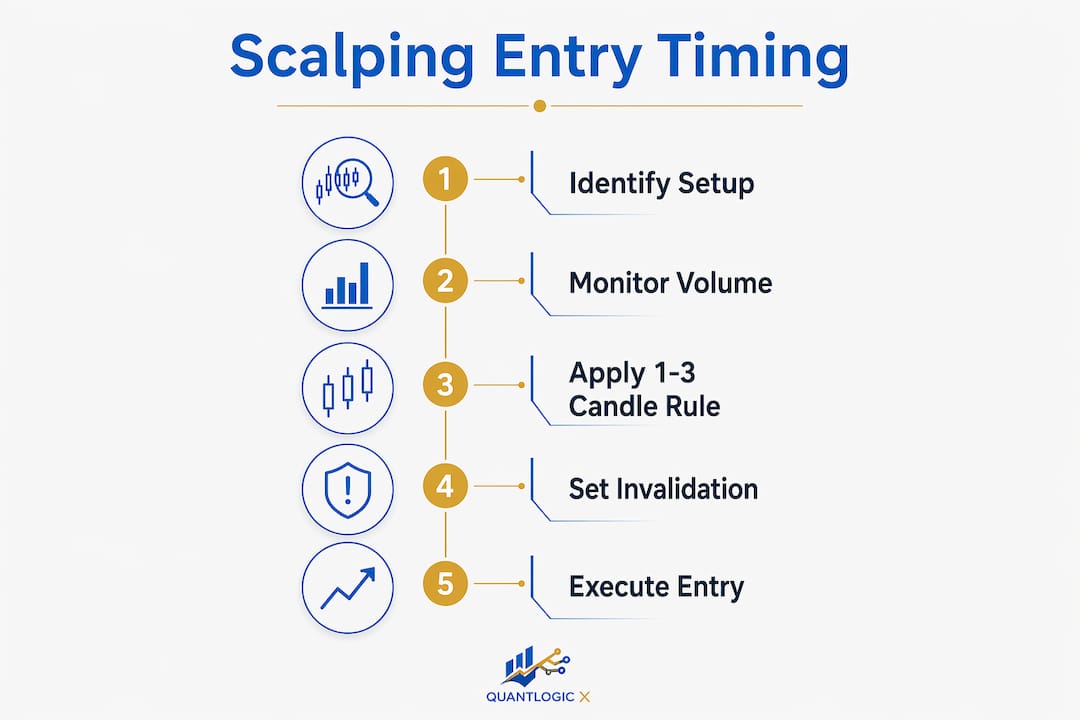
The 1-3 Candle Rule defines this problem precisely. It states that a valid entry must occur within the first three candles of a setup forming. Miss that window and your stop distance stays the same, but the potential reward shrinks because the move has already started. Delayed entry beyond this window reduces risk-to-reward by up to 40%. That single statistic explains why two traders can read the same chart and get completely different results.
Consider a practical example. EUR/USD breaks above a resistance level on a 1-minute chart. A scalper who enters on candle one captures the full projected move with a tight stop just below the breakout. A scalper who enters on candle four faces a stop in the same place but has already missed a portion of the move. The reward shrinks while the risk stays fixed. The trade that looked like a 3:1 setup is now a 1.5:1 at best.

Pro Tip: Before entering any scalp, calculate your exact risk-to-reward ratio at the current price, not at the ideal entry price. If the ratio has degraded below 2:1, skip the trade entirely.
The table below shows how entry delay degrades trade quality across a typical scalping setup.
| Entry Timing | Stop Distance | Reward Potential | Risk-to-Reward |
|---|---|---|---|
| Candle 1 (ideal) | 5 ticks | 15 ticks | 3:1 |
| Candle 2 (acceptable) | 5 ticks | 11 ticks | 2.2:1 |
| Candle 3 (marginal) | 5 ticks | 8 ticks | 1.6:1 |
| Candle 4+ (late) | 5 ticks | 5 ticks or less | 1:1 or worse |
A strategy with a 1.14:1 reward-to-risk requires at least a 47% win rate just to break even before accounting for spreads and slippage. Late entries push you into that danger zone fast.
What are the best time frames and sessions for scalping entries?
The time frame you use for execution and the session you trade in determine how clean your entry signals are. Most scalpers make the mistake of using a single chart for both direction and execution. That produces noise-driven entries.
The 3-5x time frame multiplier solves this. Use a higher time frame for directional bias and a lower one for entry triggers. For example, a 5-minute chart establishes the trend, and a 1-minute chart identifies the exact entry candle. The 15-minute chart shows roughly 55–60% daily trend accuracy but lacks the resolution needed for precise entry. That gap is where most scalpers lose their edge.
Effective scalpers combine multi-time frame analysis with real-time order flow reading to execute within the highest probability ignition points. This is not a theoretical framework. It is the actual workflow of traders who scalp profitably at scale.
The best sessions for scalping entry timing are:
- London-New York overlap (8:00 AM–12:00 PM ET): This window combines tight spreads with strong directional moves. EUR/USD regularly produces intraday ranges of 80–120 pips during this period, giving scalpers clear momentum to trade with.
- First hour of the US session (9:30–10:30 AM ET): Professional scalpers favor this window for its tight spreads and clear order flow. Institutional activity is highest here, which means cleaner price action.
- Last hour of the US session (3:00–4:00 PM ET): End-of-day positioning creates another burst of volume and directional clarity. Entries during this window often align with institutional rebalancing flows.
- Asian session (avoid for most instruments): Thin liquidity produces choppy, directionless price action. Spreads widen and slippage increases. Scalping during this window is a structural disadvantage for most retail traders.
Pro Tip: Set a calendar alert for 8:00 AM ET every trading day. The London-New York overlap opens then, and the first 30 minutes often contain the cleanest scalping entry points of the entire session.
Volume acceleration is the real-time signal that confirms an entry is live. Rapid increases in trade prints per second indicate institutional participation and signal ignition points ahead of large moves. When volume spikes sharply as price approaches a key level, that is your entry trigger. Waiting for the candle to close instead of reading the tape in real time costs you the first candle of the move.
How do psychology and misconceptions hurt entry timing?
Most scalpers believe the problem is speed. They think faster reflexes produce better entries. The reality is the opposite. Scalping success depends less on reaction speed and more on disciplined, repeated execution of defined entries and exits. Chasing speed without a defined trigger produces premature entries, not better ones.
"Waiting too long for confirmation transforms a timely entry into a chase, trapping retail traders on the wrong side of professional profit-taking. The moment you need the candle to close to feel confident, the professionals who created that move are already exiting."
The mental toll of scalping compounds this problem. Scalpers can trade 100 or more positions per day, and that volume creates decision fatigue. Fatigue produces two failure modes: entering too early because you feel the setup is "close enough," or entering too late because you hesitated and then chased. Both destroy your risk-to-reward profile.
Successful timing requires knowing your exact invalidation point before you enter. If you cannot define where the trade is wrong, your entry has no structural basis. This is not a mindset tip. It is a technical requirement. Without a defined invalidation level, you cannot set a meaningful stop, and without a meaningful stop, your position sizing is guesswork.
Pro Tip: Write your invalidation level on a sticky note before you place the order. If price reaches that level before your entry triggers, the setup is dead. Do not enter.
Consistent scalping profitability often takes 12–18 months to develop because the psychological and technical challenges compound each other. Traders who skip simulator practice and go straight to live trading with full size almost always develop bad timing habits that are hard to unlearn.
How can scalpers improve entry timing with practical strategies?
Improving entry timing is a skill built through structured practice, not intuition. The following methods address the technical and psychological sides of the problem together.
-
Use multi-time frame analysis on every trade. Set your direction on the higher time frame and wait for the lower time frame to confirm alignment. Never enter against the higher time frame trend, even if the lower time frame setup looks clean.
-
Read volume acceleration as your entry trigger. When prints per second spike sharply as price approaches a key level, that is the ignition signal. Enter on the first candle of acceleration, not after the candle closes. Tape reading for scalping entry points is a learnable skill, and it is more reliable than waiting for lagging indicators to confirm.
-
Define your stop before your entry. Place the stop at the structural invalidation level first. Then calculate position size based on that fixed stop distance and your target reward. This forces you to evaluate whether the current price still offers a valid risk-to-reward ratio before you commit.
-
Practice on a simulator for at least 3–6 months. Most retail scalpers need 3–6 months of simulator work before their timing becomes consistent. Simulators let you build the pattern recognition needed for fast entries without the emotional pressure of real money.
-
Trade micro size during the transition to live markets. After simulator practice, trade the smallest available position size on live markets. The goal is to experience real execution conditions, including slippage and spread, without the financial pressure that distorts timing decisions.
-
Use tools that surface order flow and multi-time frame signals simultaneously. Platforms like TradingView, combined with indicators that show real-time signal alignment across time frames, reduce the cognitive load of timing decisions. Tools built for faster scalping profits on MT4 and MT5 can also help automate parts of the entry process for traders who prefer execution-focused platforms.
The beginner scalping guide from Quantlogicx covers position sizing and simulator workflows in detail for traders building these skills from scratch.
Key Takeaways
Entry timing in scalping directly controls risk-to-reward ratios, and a single candle of delay can turn a 3:1 setup into a breakeven trade or worse.
| Point | Details |
|---|---|
| Entry timing drives profitability | Roughly 80% of scalping success depends on when you enter, not just direction. |
| The 1-3 Candle Rule is non-negotiable | Entering after candle three reduces reward potential by up to 40% with no reduction in stop distance. |
| Session selection changes execution quality | The London-New York overlap and first US hour offer the tightest spreads and clearest order flow. |
| Psychology causes most timing errors | Decision fatigue and the need for confirmation push traders into late or premature entries. |
| Simulator practice builds timing discipline | Most scalpers need 3–6 months of structured practice before live timing becomes consistent. |
The hardest timing lesson I had to learn
The biggest trap in scalping entry timing is not entering too late. It is entering almost on time and convincing yourself it counts. You see the setup form, you hesitate for two candles, and then you enter anyway because the direction still looks right. That trade feels like discipline. It is not. It is a degraded setup dressed up as patience.
What I have found is that preparation beats reaction speed every time. The scalpers who execute cleanly are not faster than everyone else. They have done the work before the session starts. They know their levels, their invalidation points, and their target windows. When the setup aligns, the entry is almost automatic because the decision was already made.
The hardest part of building that discipline is letting go of missed trades. Every scalper has watched a clean setup trigger while they were still deciding, and then felt the pull to chase it. Chasing is where the real losses come from. A missed trade costs you nothing. A chased trade costs you both money and confidence.
The path from simulator to live trading is not about getting faster. It is about getting quieter. The noise in your head during a live trade is what causes the hesitation and the premature entries. Simulator practice does not just build pattern recognition. It builds the mental silence that lets you execute without interference.
— Tran
Quantlogicx tools for scalpers who want precise entries
Timing your entries manually across multiple time frames while reading volume in real time is demanding work. Quantlogicx built its TradingView indicator specifically for scalpers who need signal clarity without the cognitive overload.
The Quantlogicx indicator delivers long and short signals with zero repaint technology, meaning every signal is confirmed at bar closure and will not shift after the fact. Over 2,000 traders use it across stocks, forex, and cryptocurrency, with individual users reporting gains like $8,200 in a single month. The TradingView scalping indicator integrates real-time alerts so you never miss an entry window, even during fast-moving sessions like the London-New York overlap. If you want to see how the signals perform before committing, the Quantlogicx platform lets you review live signal history across multiple markets.
FAQ
Why does entry timing matter more than trade direction?
Entry timing controls your risk-to-reward ratio at the moment of execution. A correct directional call entered too late produces a degraded setup where reward potential shrinks while stop distance stays fixed.
What is the 1-3 Candle Rule in scalping?
The 1-3 Candle Rule states that a valid entry must occur within the first three candles of a setup forming. Entering after this window reduces risk-to-reward by up to 40% because the move has already started.
When are the best times to enter scalping trades?
The London-New York overlap from 8:00 AM to 12:00 PM ET and the first US session hour from 9:30 to 10:30 AM ET offer the tightest spreads and clearest order flow for scalping entries.
How long does it take to develop good entry timing?
Most retail scalpers need 3–6 months of simulator practice and micro-size live trading before their entry timing becomes consistent. Full profitability often takes 12–18 months to develop.
What causes premature entries in scalping?
Decision fatigue from high trade volume and the psychological pressure to act before a setup fully forms both cause premature entries. Defining your exact invalidation level before placing an order eliminates most premature entry errors.